

You sit at the kitchen table on a random Thursday, staring at a banking app notification that makes your stomach drop before you've even had your coffee.
It is not that you are reckless; it is that money leaks out through twenty small invisible drains all week long until Friday arrives with a terrifying math problem.
You do not need a punishing spreadsheet that treats every dollar like a moral failure. You need a quiet fifteen minutes before the week starts to look at the numbers.
I used to dread checking my balance until I stopped trying to fix everything at once and built one predictable Sunday routine.
Here are fifteen concrete moves to set up that system, and you can pick whichever two fit your life right now.
Quick Tips Before You Start
Keep it Low Stakes
Pour your coffee first so this feels like checking in, not reporting to a judge.
Use One App
Stick to your main banking app and avoid downloading five complicated new trackers.
Set a Timer
Give yourself exactly fifteen minutes so the task never expands into an all-day dread.
Write it Down
Keep a physical notepad nearby to jot down actual numbers instead of guessing.
1. Open the Banking App Before the Panic Sets In

Waiting until Friday afternoon to look at your balance is an entirely avoidable form of self-torture.
When you avoid looking, anxiety grows quietly in the background and turns every routine grocery run or small purchase into a low-grade panic.
The Federal Reserve reports that roughly 6 in 10 adults could cover a $400 emergency expense with cash easily, while the rest would scramble to borrow or sell something.
That gap between comfort and panic is why checking the numbers before the week starts matters so much.
The mechanism here is simple psychological exposure: your brain treats the unknown balance like a monster in the closet, but actual digits on a screen are just data.
Open your banking app on Sunday morning when the house is quiet and you have enough mental space to breathe.
Look at what cleared, check what is pending, and close the application without issuing a single mental verdict against yourself.
Awareness is not punishment, and seeing the baseline is the only way to make the next dollar a choice instead of a surprise.
💡 PRO TIP
The Sunday Rule
Never check your balances after 8 PM on a work night. Keep financial reviews to Sunday mornings when your nervous system is calm.
2. Split Your Money Into Three Clear Buckets

People fail at budgeting because they try to track forty different spending categories every single day.
Try the three-bucket approach instead: fixed bills, debt minimums, and flexible spending, which simplifies a messy month into three distinct choices.
If you allocate your paycheck the moment it lands, roughly fifty percent to fixed bills and the rest split between debt and spending, you never have to guess what is left.
Keep it simple.
If the fixed bills are covered, the rest is just choices.
Cash Flow Traffic Light
- 🟢 Rent, Utilities, Insurance — Fund these fixed obligations immediately when payday lands.
- 🟡 Minimum Debt Payments — Automate these next to protect your credit score without thinking.
- 🔴 Discretionary Dining Out — Pause or restrict this category until the essentials are secured.
3. Review Three Key Numbers Every Single Week

You do not need to look at every single receipt or download a massive spreadsheet to know where you stand financially.
Checking just three specific figures for ten minutes every Sunday changes everything: look at your current checking account balance, your total credit card balance, and your upcoming fixed bills due in the next seven days.
That is it, because monitoring those three data points stops the panic before Friday arrives.
The mechanism here is simple behavioral feedback: keeping eyes on the actual numbers prevents avoidance from turning a small cash flow tight spot into a full-blown emergency.
I used to dread opening my banking app because I assumed the worst, but looking at the actual balance for five minutes defused the anxiety completely.
This week: open your banking app on Sunday morning, write down those three exact numbers on a scrap of paper, and close the app without judging a single dollar.
4. Automate Your Savings Before You Can Spend It

I used to sit down on the last day of every month, stare at my checking account balance with a knot in my stomach, and wonder where every single dollar had slipped off to.
Relying on willpower to save money at the end of the month is a losing strategy because if the cash sits right there in your checking account, it tends to evaporate into random purchases.
The mechanism is simple: automation replaces daily discipline with a single, quiet routine that runs in the background before you ever get the chance to second-guess it.
Set up an automatic transfer of $50 or $100 every single payday straight into a separate high-yield savings account at a different bank.
I watched my savings account grow for the first time in my life the exact month I stopped letting myself manually move the money, proving that out of sight really is out of mind.
Automation Setup — At a Glance
📅 Timing
Payday morning
💵 Start Amount
$25 to $50
🏦 Destination
Separate bank
The Core Rule
Automate the transfer so you never have to make a choice about saving.
5. Start With a Tiny Monthly Savings Floor

When you read about saving twenty percent of your income while paying off debt, it is easy to just close the tab and give up entirely because your paycheck is already fully spoken for.
If that standard feels completely out of reach right now, simply ignore it and start with a tiny floor like $25 a month transferred automatically.
The mechanism here is behavioral rather than mathematical, because even $25 a month moving without fail helps build the identity of someone who actually saves money.
You can always scale that number up next year when your rent stabilizes or your income shifts, but consistency beats perfection every single time.
This week, set up one recurring transfer of $25 to a separate account and let it run quietly in the background without touching it.
⚠️ COMMON MISTAKE
Waiting for a Windfall
Waiting until you earn more to start saving guarantees you will lifestyle-inflate away every raise. Start with the small floor today.
6. Give Yourself Permission to Scale Back
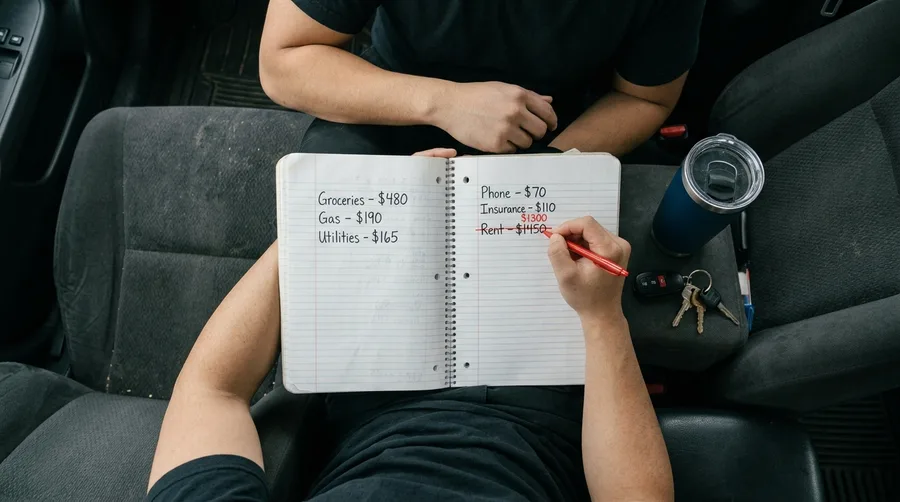
Drop your automatic transfer down to $5 instead of canceling it completely the moment an expensive month hits.
Unexpected car repairs, high medical bills, and family travel happen to everyone, and they inevitably swallow your available cash flow. When life gets heavy, dropping your Sunday money routine entirely feels like the only relief, but that is how you lose the habit for good. Shrinking the transfer amount down to a fraction of normal preserves your financial muscle memory without breaking your budget when you are stretched thin.
You can always scale it back up next month when things settle down.
7. Track Your Spending Leaks for Just One Month

Thirty days of printed bank statements changed everything for me after years of wondering why my grocery budget felt completely bloated.
Seeing $180 spent on random coffee shop pastries and delivery fees in stark black and white made my actual spending habits impossible to ignore.
You cannot fix a leak you refuse to look at, which is why awareness has to come before any attempt at strict budgeting or saving.
Spend thirty days highlighting every recurring subscription and impulsive purchase to see where your hard-earned cash is actually disappearing.
The goal is never to shame yourself for buying lunch or grabbing a latte, but rather to ensure your spending matches what you truly care about.
8. Accept the Honest Trade-Offs of Saving Money

Is saving money really as effortless as the internet makes it look?
It is not, and pretending otherwise is why so many people feel like they are failing before they even start.
Saving money always costs you something immediate in exchange for future peace of mind, and acknowledging that upfront removes the guilt when it feels hard.
Choosing to transfer $200 out of your checking account on payday means you cannot buy that jacket or book that weekend trip right now, and that restriction is a real, tangible loss in the present moment.
That friction is completely normal.
If someone tells you building financial security is effortless or that you can magically find room for everything without giving anything up, they are trying to sell you a course or an app.
Embrace the minor discomfort of saying no to small, attractive purchases so you can say yes to bigger security later.
The trade-off is the entire mechanism of financial progress.
This week: look at one pending purchase, decide what it costs your future self, and let it go.
The Spending Shift
Old Habit
- Checking balance with dread on Friday
- Saving whatever is left over
- Ignoring small subscriptions
Sunday Ritual
- Reviewing numbers calmly on Sunday
- Automating savings on payday
- Auditing leaks monthly
9. Reframe the Scarcity Mindset Into Awareness

For three years, I looked at my checking account balance maybe once a month, right before rent hit, holding my breath.
That heavy feeling in your chest when you open a banking app is not a math problem. It is a protective reflex.
When every dollar feels scarce, your brain treats looking at the numbers like touching a hot stove, so you avoid the statements entirely.
The mechanism here is behavioral avoidance, and it quietly lets small leaks turn into $200 monthly surprises simply because nobody wants to count them.
Try changing the language you use in your own head from I cannot afford this to I am choosing where this $45 goes today.
That tiny shift turns you from a victim of your paycheck into the person steering it.
This week, pick one avoided account, log in on Sunday morning, write down the exact total, and close the tab without judging a single past purchase.
10. Know When to Consult a Professional

You might feel like asking for help means you failed the whole assignment.
It does not mean that at all.
Some numbers get too tangled for a spreadsheet and a Sunday morning coffee to fix alone.
When your total debt exceeds 50 percent of your annual income or collection notices start arriving every week, the math requires an outside view.
A nonprofit credit counselor or a fee-only fiduciary can look at your exact file without judgment and map out a structured debt management plan.
This costs maybe $50 a month in fees, but it saves thousands in compounding interest.
Search for a certified professional this Tuesday afternoon and make the appointment.
11. Avoid the Trap of Over-Optimizing Too Soon

Have you ever spent an entire weekend obsessing over whether a four point two percent savings rate is better than four point one percent while your checking account balance is sitting at twelve dollars?
It is easy to mistake intense research for actual progress when you are trying to get your money together.
Chasing a tiny yield difference on fifty dollars of savings will not change your week.
Perfectionism is usually just fear in disguise, keeping you busy so you never have to face the messy basics.
Get the core systems running with whatever account you already have before you ever open another tab.
Financial Jargon Busted
12. Automate One Bill Transfer Every Payday

I used to spend every single Thursday night scrolling through my bank account trying to remember if the electric bill had cleared yet.
Schedule your internet or utility bill payment to leave your account the day after you get paid.
This simple timing shift takes the guesswork out of confusing due dates and prevents late fees from creeping up on you.
Take four minutes in your banking app today to set up that one automated transfer.
13. Check Your Credit Score Once a Quarter

You do not need to check your credit score every single day like a volatile stock ticker.
Checking it once every three months using your bank is enough to make sure no fraudulent accounts popped up while you were busy living your life.
Look at the actual report for errors and ignore the daily fluctuations so you can protect your financial standing without driving yourself crazy.
14. Build Your Emergency Cushion One Week at a Time

Build your emergency cushion one week at a time instead of waiting for a month where extra cash magically appears.
I started my emergency fund with $50 a paycheck because that was all that fit in the margins of my rent and grocery bills.
It took eighteen months to reach three thousand dollars, and that small cushion saved me when my transmission blew out unexpectedly on the highway.
The Federal Reserve notes that credit card balances sit at over one trillion dollars nationally, mostly because unexpected car or medical repairs hit unprepared households and force them to borrow.
Your emergency fund is the shock absorber that stops a bad Tuesday from turning into a two-year debt cycle, so build it slowly, steadily, and without apology.
Emergency Preparedness Stats
Federal Reserve SHED data on household cash buffers
15. Commit to Just Fifteen Minutes Next Sunday

You have spent half of Sunday scrolling through financial advice that makes you feel like you are already too far behind to catch up.
It is exhausting to carry that heavy knot in your chest every time you think about your bank account balance.
Financial health is built in quiet fifteen-minute increments, not overnight miracles.
When you try to fix every single mistake at once, you usually end up closing the laptop and avoiding the problem for another three months.
The mechanism here is purely about lowering the activation energy so your nervous system stays calm enough to let you look at the numbers.
When the stakes feel lower, you actually stay in the room long enough to see what is happening.
I spent years staring at my statements with sheer dread until I forced myself to set a timer for ten minutes and just breathe through the shock.
Close this tab, pour another cup of coffee, and open your banking app for the first time with a spirit of curiosity instead of dread.
You do not need to fix your entire financial life today.
You just need to take the first small step.
Set a calendar reminder for next Sunday morning and let this be the weekend the panic finally stops for good.
Frequently Asked Questions
Is it too late to start organizing my money if I am in my 40s or 50s?
It is never too late to take control of your cash flow. Starting now means you capture years of intentional spending and automated savings that you would otherwise miss.
How much should I have in my emergency fund before investing?
Aim for one month of bare expenses first so unexpected repairs do not become high-interest debt, then work your way up to three to six months over time.
Should I pay off debt or save money first?
Build a small starter emergency fund of $500 first so you stop borrowing for minor emergencies, then tackle high-interest debt aggressively while maintaining automated savings.
Is it okay to pause my savings contributions for a month?
Life happens and income fluctuates. Lower your transfer amount or pause temporarily when necessary, but keep the Sunday review habit alive so you resume as soon as possible.
Your First Sunday Check-In
Take one concrete action off this list today, whether it is opening your banking app or setting up a twenty-five-dollar automatic transfer.
You do not need to change everything by tomorrow morning, but you do need to start.
Show up for yourself this Sunday.