

You stare at the blinking cursor on your banking app, wondering how everyone else managed to salt away ten thousand dollars while your own account barely covers next week's groceries.
Financial advice often treats every household as if it shares the exact same risk profile, income stability, and fixed overhead. It does not.
Building a cash cushion requires looking past generic rules of thumb and matching your savings target to your actual life.
Let us walk through how to right-size your safety net without feeling like you are constantly failing an arbitrary test.
Quick Tips Before You Start
Separate Your Cash
Keep your emergency savings in a completely different bank from your daily checking account.
Audit Fixed Costs
List only non-negotiable expenses when calculating your baseline survival number.
Ignore the Timeline
It takes as long as it takes to fund your account; consistency beats speed.
1. Adopt a Three-Tiered Cash System

$1,000 sits in your checking account right now as an immediate buffer against overdraft fees and minor car trouble.
Tier two holds one month of essential bills in a high-yield savings account separate from your daily spending app so you are not tempted to swipe it for groceries.
Tier three covers your long-term volatility, holding the remainder of your target based on job stability and household structure.
This tiered approach keeps your money organized without needing complex spreadsheet formulas.
Set up your three tiers this week by opening one separate savings account for tier two.
Target At a Glance
2. Start With a Small Cash Floor

Most people believe they need ten thousand dollars saved before they can finally take a breath.
That massive figure keeps the account at zero because the gap between zero and ten grand feels like climbing a vertical wall in the dark.
The mechanism behind starting small is momentum and breaking the paralysis that comes with looking at an intimidating goal.
Even twenty-five dollars moved automatically each week builds a functional safety net faster than waiting around for a massive windfall that never arrives.
Consistency beats perfection every single time when you are trying to change how money actually moves through your hands.
💡 Tip: Automate the transfer for the exact morning your paycheck clears.
🌱 GROWING TIP
Build the Habit Before the Balance
Focus entirely on making the weekly transfer automatic. The actual dollar amount can scale up once the routine is locked into your budget.
3. Scale Back Your Target With Confidence

You have probably been told that anything less than six months of savings means you are failing at basic financial security.
That blanket rule treats every single household like it faces the exact same risks.
The standard six-month target comes from a time when job stability looked entirely different than it does today for many workers.
If your household relies on two steady government salaries with bulletproof job security, your actual risk of sudden total unemployment is close to zero.
Rigid financial advice ignores personal context, leaving people feeling guilty for having a realistic, lower reserve that fits their actual life.
If you rent an apartment with flexible lease terms and split expenses with a partner, your risk profile looks very different from a single-income homeowner with three dependents.
Scale your target down to match your actual exposure instead of chasing a number designed for someone else entirely.
One month of core expenses might be plenty for your specific situation right now, covering your rent and groceries without requiring a massive mountain of cash.
Give yourself permission to adjust the math without second-guessing your choices every time you open your banking app.
This week: take your actual monthly bare-bones spending, divide it by two if you split bills, and set that lower figure as your legitimate target.
Emergency Fund Scaling Stages
4. Consult Your Own Numbers First

I spent three hours staring at a generic savings calculator last spring before realizing my actual fixed bills were $2,150 higher than the model assumed.
Generic advice falls apart because your local rent, utility spikes, and grocery realities dictate what safety net you actually need instead of a rigid percentage.
Run your specific numbers tonight, and if your tax situation involves freelance income or business assets, schedule thirty minutes with a fee-only fiduciary to map your exact baseline.
5. Break the Scarcity Mindset Cycle

Stop telling yourself you are fundamentally bad with money simply because your savings account balance sits at a modest $150 today.
Scarcity thinking convinces you that every single dollar spent is a personal failure, keeping you trapped in an exhausting loop of financial anxiety where a $20 utility overage ruins your entire mood.
Shift your perspective toward agency and deliberate choice by recognizing that a tight budget is a temporary constraint, not a permanent verdict on your character. Spend 15 minutes this weekend listing three things you actually control.
Money Belief Check
6. Rebuilding My Fund After a Medical Bill

Watching your emergency fund drop to zero in five minutes feels like stepping straight off a cliff after months of careful, grinding work.
I spent my entire emergency savings account on an unexpected root canal a few years ago when the throbbing tooth pain became completely impossible to ignore. The balance vanished in a single digital transaction, and the psychological hit left me winded after all that careful accumulation.
Rebuilding that cushion required starting over completely at $50 a week while cutting our dining-out budget down to absolute zero for nearly six straight months, which tested every ounce of our patience.
That painful financial reset eventually taught me a vital truth: safety nets are meant to be spent when life actually happens, not hoarded like a pristine score you are terrified to lower.
This week, forgive yourself for any emergency withdrawals that felt like personal failures, set a tiny automatic transfer, and let your account grow back slowly.
⚠️ COMMON MISTAKE
Do Not Raid Your Savings for Vacations
Treating your emergency fund like a general slush fund guarantees it will be empty when a real crisis lands on your doorstep.
7. Account for the Hidden Costs of Saving

Locking away too much cash in a basic savings account means you are slowly losing purchasing power to inflation.
The trade-off is very real: every extra dollar sitting in cash earning next to nothing is money not paying down a 21 percent credit card or compounding in an investment account. I kept $10,000 sitting idle for two years out of pure anxiety before realizing inflation was quietly eating away at its actual value every month.
Calculate your exact baseline tonight and route any surplus cash beyond your strict three-month limit directly toward your highest-interest debt or a broad index fund.
8. Stop Chasing Arbitrary Savings Benchmarks

Why are you measuring your peace of mind against a stranger on a screen?
Comparing your bank balance to internet financial influencers triggers unnecessary panic every single time. Many people make the mistake of freezing all spending to hit an aggressive target of six months of cash, burning out within a month and spending it all back down.
Set your own pace based on your actual take-home pay instead of a viral headline. Aim to move just $25 this Friday into a separate account and let that be enough for week one.
Emergency Fund Allocations
Federal Reserve SHED 2024 Context
9. Capitalize on the Compound Growth Window

You keep telling yourself you will start saving seriously once things settle down and life gets just a little bit cheaper.
That moment never arrives because expenses simply shift, evolve, and expand to fill every single dollar that enters your checking account.
Waiting until you feel completely ready usually means waiting forever because life is always expensive.
The quiet mechanism at play here is compound interest, which essentially means your money earns a return, and then that return starts earning its own return.
If you set aside $200 a month into a high-yield account averaging a hypothetical 4 percent return, you are looking at roughly $2,500 after the first year before factoring in the compounding effect over decades.
Interest rates on high-yield accounts fluctuate, but the habit of retaining cash remains permanently valuable.
I wasted three full years waiting for a raise that would finally make saving effortless, only to watch every extra dollar evaporate into lifestyle creep.
The window to build stability opens wider the moment you stop waiting for ideal conditions.
Set up a recurring transfer today so your future self has a fighting chance against inflation.
📈 Your 90-Day Emergency Fund Roadmap
Month One
Open a separate high-yield savings account and deposit your first $500.
Month Two
Calculate your true baseline survival expenses and set a weekly transfer.
Month Three
Automate your deposits on payday and let the system run without manual effort.
10. Review Your Progress Quarterly

People think a savings target is something you set once in January and never touch again until it magically hits six months of income.
That is not how real life works, because rent goes up, grocery bills shift after a job change, and car insurance premiums jump without warning.
Set a calendar reminder every ninety days to open your banking app and look at two numbers: your total cash balance and your current fixed monthly expenses.
Check whether your baseline living costs rose by $100 or $200 since your last review, and adjust your monthly transfer amount upward or downward to match your actual season of life.
I missed mine for six straight months during a busy stretch at work, and when I finally looked, my target fund was actually two months behind my new rent instead of three.
Open your phone right now, create a recurring calendar alert for the first Saturday of every new quarter, and label it simply as my three-month money check.
11. Automate Your Savings Transfers Completely

Set up automatic transfers for the exact morning your paycheck lands.
Relying on willpower to save at the end of the month is a losing battle because whatever is left over after paying bills and buying groceries is usually zero.
When you automate the process on payday, the transfer happens before your daily spending gets a vote.
The mechanism here relies on removing friction and decision fatigue entirely from your routine.
You are not suddenly gaining more discipline; you are simply changing the timing so the system works without your active supervision.
It takes about four minutes in your banking app to set up a recurring $100 or $250 transfer.
I put mine on the first and fifteenth of every month, and after the first thirty days, I completely forgot I even set it up.
The trade-off is that you have to adjust slightly to living on a slightly smaller baseline amount for the first few weeks.
Open your banking app today and schedule that first transfer before you close the tab.
12. Directly Target Your Fixed Expenses

I used to stare at my bank statements late at night, wondering why my total savings balance stayed completely flat despite earning a steady paycheck every two weeks.
The missing piece was simple: I was trying to save whatever was left over at the end of the month instead of treating my savings target like a non-negotiable bill that had to be paid immediately.
Calculate your true baseline survival number by listing rent, groceries, and utility minimums so you know exactly what it costs to keep the lights on and food in the fridge.
Move $100 into your separate savings account every Friday until you hit your customized target, letting automation handle the heavy lifting before discretionary spending gets a chance to absorb the cash.
Review your progress at the end of each month to ensure your cash flow remains balanced and your baseline stays accurate as life changes.
13. Reframe Your Relationship With Debt

It is completely exhausting to watch interest pile up on a credit card while you try to build a savings account, and it makes you want to quit.
You might feel like every dollar saved is a lie when you are carrying a balance at a 21 percent interest rate, making the whole effort feel completely pointless. The reframe changes how the math works for your behavior: your savings account is not competing with your debt payoff, it is the shield that stops you from sliding backward. Without a cash buffer of even $500, the next unexpected $300 car repair goes straight back onto the high-interest card, undoing six months of hard-won progress.
I spent over a year throwing every spare dime at my balances only to wipe out completely the moment my cat needed an emergency vet visit.
Keep a small cash floor while you chip away at those balances instead of draining your checking account to zero every single month.
Open one separate account this week and protect your $25 floor from being swallowed by debt payments.
14. Commit $50 Weekly to Savings
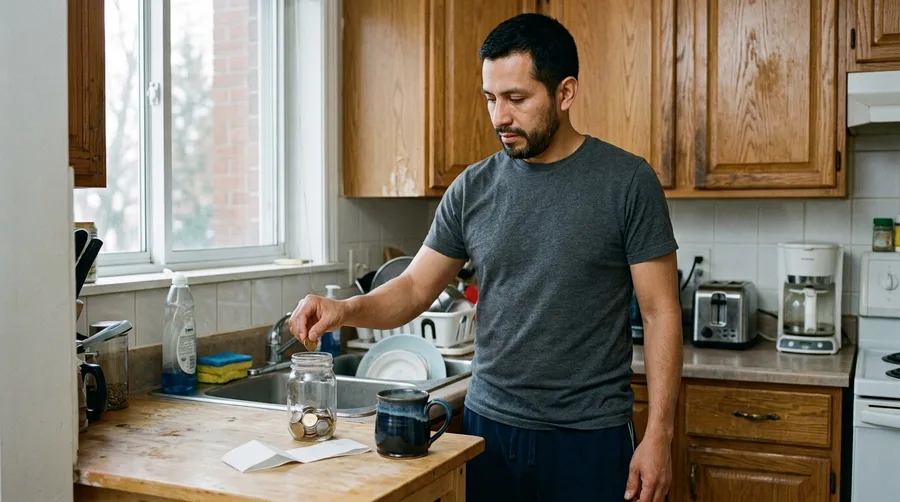
Set up an automatic transfer of $50 every Friday morning into your separate high-yield savings account.
Small weekly chunks bypass the psychological friction of moving larger lump sums, letting you build a balance steadily without disrupting your daily grocery budget or forcing you to scrutinize every single receipt.
I used this exact rhythm when my checking account felt perpetually squeezed, and watching that small baseline creep upward for the first time changed how I viewed my entire financial month.
Log into your banking app right now and schedule the recurring transfer before you close your laptop.
15. Building My Own Safety Net Slowly

I used to feel immense guilt for keeping only one month of expenses in cash.
Once I looked at our stable household income and rental setup, I realized three months was unnecessary overhead for us.
Dropping the rigid benchmark let me redirect extra cash toward retirement accounts where it worked harder.
Frequently Asked Questions
Is it too late to start building an emergency fund at 40?
It is never too late to establish a cash cushion. Starting with a small floor like $500 protects you immediately, and you can scale your target upward as your income and budget allow.
How much should I have in my emergency fund?
Your target depends entirely on your job stability, fixed overhead, and household structure. While traditional advice says three to six months, many households thrive with a customized, smaller reserve.
Should I pay off debt or save money first?
Build a small cash floor of $1,000 first so minor emergencies do not force you back into debt. Once that floor exists, direct your extra cash toward high-interest balances while maintaining your baseline savings.
Is it okay to pause my retirement contributions for a while?
Pausing contributions temporarily to handle an urgent financial reset or build your initial cash floor is acceptable, but aim to restart them as soon as your baseline safety net is secured.
Where should I keep my emergency savings?
Keep your emergency cash in a high-yield savings account at a separate bank from your daily checking account. This keeps the money accessible for true crises while removing the temptation to spend it on impulse purchases.
Start With This One
If you take one move from this list, open a separate high-yield savings account today and move your first automated transfer into it.
You do not need to fix your entire financial life by Friday; you just need to start building a cushion that fits your actual life.