

Is keeping an extra $15,000 parked in checking costing you real money? Yes, exactly $600 every year.
Most savers treat an oversized checking balance as a harmless safety cushion, assuming uninvested cash sits safely at zero operational cost. But at a standard 0.01% checking yield, a $15,000 balance earns just $1.50 over twelve months, while a liquid high-yield cash account earning 4.00% to 4.50% generates $600 to $675 on identical capital.
That gap is an invisible annual drag that erodes purchasing power and increases fraud exposure without buying any extra financial utility. Calculating your exact operational buffer and automating sweeps of surplus cash eliminates this loss entirely without increasing overdraft risk.
| Account Type | Assumed APY | Year 1 Interest | 3-Year Total Value | Liquidity Level |
|---|---|---|---|---|
| Traditional Big-Bank Checking | 0.01% | $1.50 | $15,004.50 | Immediate (Debit / ATM / ACH) |
| Traditional Brick-and-Mortar Savings | 0.02% | $3.00 | $15,009.00 | Same-Day Internal Transfer |
| High-Yield Cash / Savings Account | 4.25% | $637.50 | $16,994.40 | 1–2 Business Days (ACH) |
| Treasury Money Market Fund | 4.50% | $675.00 | $17,117.50 | 1–3 Business Days (Brokerage Settlement) |
The Exact Math Behind the $600 Annual Drag

The $600 annual loss comes from the basic interest spread between a standard 0.01% checking account and a high-yield cash account earning around 4.00% on a $15,000 balance.
Leaving $15,000 sitting in a standard brick-and-mortar checking account pays out a total of $1.50 after twelve months of interest compounding at 0.01% APY. Shift that exact balance over to a competitive high-yield savings vehicle paying between 4.00% and 4.50% APY, and the account produces $600.00 to $675.00 over the same calendar year without locking up liquidity.
Nobody bills you for that $600 difference.
Because bank statements never list foregone interest as a negative charge, this opportunity cost quietly bleeds your cash cushion in plain sight while feeling like safety.
When an unmanaged $15,000 sits untouched in checking over a three-to-five-year window, that passive drag compounds aggressively into $1,800 to $3,300 in missed returns. That is real money surrendered simply by treating a daily payment clearinghouse as a long-term home for emergency reserves.
The money stays safe, but it goes entirely dormant.
The True Cost of Idle Checking Balances
Quantifying the financial penalty of maintaining surplus cash in transactional accounts
Why Traditional Banks Pay Near-Zero on Checking Deposits
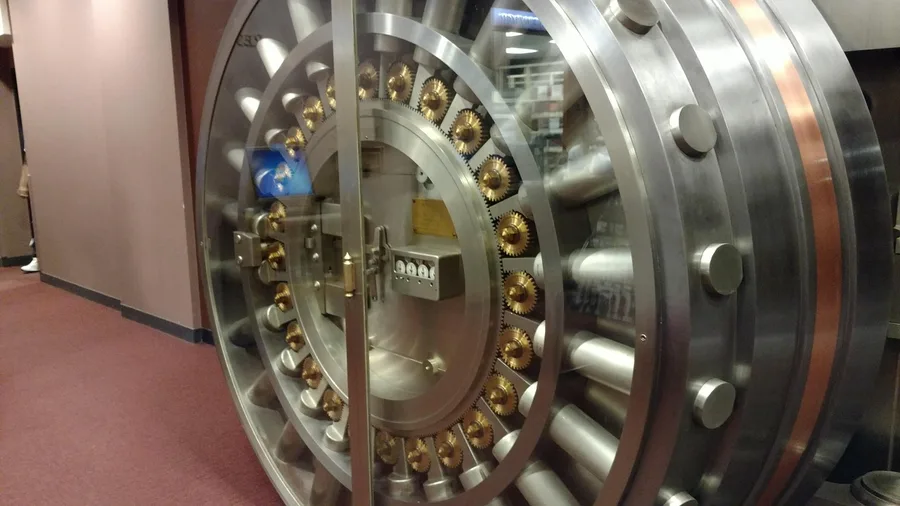
Retail banks keep checking interest near zero because paying depositors competitive rates would eliminate the core profit spread that drives their business model.
Commercial institutions rely on net interest margin, gathering everyday retail deposits at 0.01% and deploying that capital into commercial loans, mortgages, and consumer credit earning 4.00% or higher. The wide gap between the pennies paid to depositors and the interest collected from borrowers forms the foundation of retail banking revenue.
High switching friction keeps customer balances pinned in place.
Banks understand that reconfiguring payroll direct deposits, updating auto-pay bills, and resetting merchant payment profiles creates substantial administrative friction. That inertia allows traditional banks to use zero-interest deposits to fund physical branch networks and extensive staffing, while digital platforms cut overhead and return those savings to account holders.
Branch-heavy institutions will never voluntarily raise checking rates when customers leave billions of dollars parked in transactional accounts without asking for a return.
Your stationary cash subsidizes their branch overhead.
💡 PRO TIP
Separate Transit from Storage
Treat your checking account purely as an electronic transit hub for 30 days of bill outflows. Your wealth and emergency reserves belong in interest-bearing accounts that compound daily.
Inflation Turns Idle Checking Balances Into Guaranteed Losses

Inflation converts the missed interest on an idle checking balance into an active, ongoing reduction of your household purchasing power.
Any year that inflation runs above zero, an unyielding $15,000 checking balance buys less than it did twelve months prior. Because a standard checking account generates a steep negative real return, holding excess cash in transit guarantees that your money loses ground against everyday living expenses.
The static ledger total creates a false sense of security.
Seeing an unchanging $15,000 balance on your mobile app feels safe, but nominal dollar stability obscures the steady contraction of your cash cushion. Moving surplus reserves to an account earning 4.00% to 4.50% largely neutralizes annual cost-of-living increases, protecting the real purchasing strength of your hard-earned savings.
Leaving surplus funds in a zero-interest account means rising retail prices quietly erode the buying power you worked hard to build.
A stationary balance is a shrinking balance.
Account Function: Checking vs. High-Yield Storage
Primary Checking (Transit Hub)
- Pays nominal 0.01% APY on all balances
- Funds immediate debit card and POS transactions
- Holds 30 days of bills plus a 25% safety buffer
- Exposed to point-of-sale card skimming
- High transaction turnover every pay cycle
High-Yield Cash (Storage Vault)
- Pays competitive 4.00%–4.50% APY compounding daily
- No direct debit card attached to account
- Holds core emergency fund and future savings
- Protected by transfer latency and withdrawal limits
- Low transaction frequency, maximum compounding
The Security Trap of the Oversized Checking Cushion

Savers store oversized cash balances in checking accounts primarily to calm transaction anxiety, dreading sudden merchant debits, subscription renewals, or the punitive sting of an unexpected overdraft fee.
Yet that feeling of security introduces genuine financial vulnerability. Keeping a $15,000 balance attached to an active debit card exposes the full balance to point-of-sale skimmers, online database breaches, and direct electronic theft, none of which offer the rapid statutory liability protections standard on credit cards.
Stolen checking dollars vanish from your account immediately.
Leaving all that money in view also creates a dangerous psychological illusion. When your primary dashboard displays a five-figure total every morning, it creates an artificial impression of spending power, completely obscuring the necessary boundary between daily operating funds and permanent emergency reserves.
The result is loose cash management and ongoing theft exposure, turning what felt like a safety blanket into a silent risk for your hard-earned capital.
Checking Account Health Scorecard
Calculating the Exact Cash Buffer Your Checking Account Needs

Your checking account should hold thirty days of necessary expenses plus a twenty to twenty-five percent cash cushion.
That extra margin handles utility spikes, annual subscriptions, or an unplanned grocery run without triggering a low-balance alert.
If regular monthly outflows total $4,000, setting aside twenty-five percent means adding a $1,000 safety buffer. That establishes an operational cap of exactly $5,000 inside the checking account. Anything resting above that number is not working as active cash flow protection; it is simply idling where it cannot earn.
Keeping a $15,000 balance against that $4,000 monthly burn leaves $10,000 parked in the wrong place.
That surplus ten thousand dollars belongs in a dedicated high-yield account where it generates meaningful monthly interest rather than sitting exposed to daily card swipes. Ring-fencing your core $5,000 operating fund ensures every regular bill clears on schedule while the rest starts producing returns immediately.
⚡ 4 Steps to Establish an Automated High-Yield Cash Sweep
Calculate Your 30-Day Expense Ceiling
Add 25% to your average monthly fixed bills to determine your permanent checking account cap.
Open and Link a High-Yield Cash Account
Establish an account yielding 4.00% APY or higher and link it to your checking hub via standard ACH.
Transfer the Immediate Surplus
Move all cash above your calculated ceiling directly into the new high-yield account in one lump transfer.
Schedule a Recurring Monthly Sweep
Automate a transfer 3 business days after your final monthly paycheck to harvest surplus inflows.
Setting Up an Automated Sweep to Capture Yield

You route excess cash into higher-earning accounts without adding friction by linking your primary checking account directly to an external high-yield savings account or money market fund.
This connection creates a dedicated path for capital transfers.
Timing the transfer correctly prevents accidental overdrafts. Set a recurring monthly sweep to pull the surplus two to three business days after your direct deposit lands. That brief pause gives primary mortgage drafts, rent checks, and core utility payments time to clear the ledger before any leftover dollars migrate to interest-bearing storage.
Money remains accessible if plans change.
Standard electronic bank transfers clear in one to three business days, meaning you can pull funds back whenever a large unexpected expense exceeds your working buffer. You capture full market yields all year while keeping complete access to emergency liquidity whenever cash demands suddenly spike.
Quick Rules for Managing Cash Flow
Set a Hard Account Cap
Never allow your checking balance to drift more than 25% above your baseline monthly obligations.
Time Transfers Post-Payday
Schedule recurring savings sweeps 48 to 72 hours after paycheck deposits to ensure fixed bills clear first.
Unlink Debit From Savings
Do not connect your everyday debit card to your high-yield savings vault to maintain security insulation.
Frequently Asked Questions
Will keeping less money in checking increase my risk of overdraft fees?
No, provided you maintain the recommended 20% to 25% buffer above your monthly obligations. A $4,000 monthly expense baseline with a $1,000 buffer gives you ample cushion to handle billing fluctuations while preventing excess cash drag.
Are high-yield savings accounts as safe as traditional checking accounts?
Yes. Legitimate high-yield savings accounts at FDIC-insured banks or NCUA-insured credit unions carry the exact same federal protection up to $250,000 per depositor, per account ownership category.
How long does it take to move money back to checking if an emergency happens?
Standard electronic ACH transfers between linked accounts take one to two business days. Many modern banking institutions now offer instant transfers or same-day processing for emergency cash access.
Do I have to switch my entire primary bank to get high-yield interest?
No. You can keep your existing checking account, direct deposits, and bill pay exactly where they are. You simply link an external high-yield account and transfer the surplus funds electronically.
Will I owe taxes on the $600 interest earned each year?
Yes. Interest earned in standard high-yield accounts is taxed as ordinary income at your federal and state marginal tax rates. Even after taxes, earning hundreds of dollars in interest far outperforms earning $1.50.
Capping Your Checking Ledger and Claiming Your Yield
Calculate your 30-day bill obligation this week, set your checking cap at that figure plus a 25% cash buffer, and schedule an automatic monthly sweep of the surplus into high-yield storage.
A stationary $15,000 checking balance does not provide extra safety. It quietly surrenders return, loses purchasing power to inflation, and leaves excess capital exposed to merchant debits and fraud.
That parked $15,000 does not need to sit idle and cost you $600 year after year. An automated sweep keeps every bill covered while capturing the passive interest your cash should be earning.
Audit Your Checking Balance Today
Review your last three months of bank statements, calculate your monthly expense baseline, and transfer your idle cash surplus into high-yield storage.