

Is a three-year-old used car really the cheaper buy in 2026, or does it just feel that way? Here is the answer with actual numbers on one ordinary compact SUV.
The rule you walked in with says a 3-year-old car has already taken the steep depreciation hit. In 2026 that cushion is thin: this 2023 model with 36,000 miles lists at $29,800, just $3,200 under the 2026 version's $33,000 selling price after a $1,500 factory rebate.
Then the turn. Projected resale three years out is $20,500 for the 2023 and $25,500 for the 2026, so the used car loses $9,300 while the new one loses $7,500. Add the $1,200 tires-and-brakes bill the 2023 will need within a year and the new car is $3,000 ahead.
So the used-car rule only holds at a lower used price, with cash, or over a much longer hold. Decide by checking the used sticker against $28,000 and the gap against $4,000, then request out-the-door quotes on both.
| Cost item | 2026 New | 2023 Used (36,000 miles) |
|---|---|---|
| Price after rebate | $33,000 | $29,800 |
| Projected resale after 3 years | $25,500 | $20,500 |
| Depreciation over 3 years | $7,500 | $9,300 |
| Tires and brakes within 12 months | $0 | $1,200 |
| Total 3-year cost before insurance | $7,500 | $10,500 |
| Insurance, 3 years | $5,250 | $4,500 |
| Basic warranty | 3 years / 36,000 miles | Expired |
| Pre-purchase inspection | Not needed | About $150 |
The sticker gap is smaller than you think
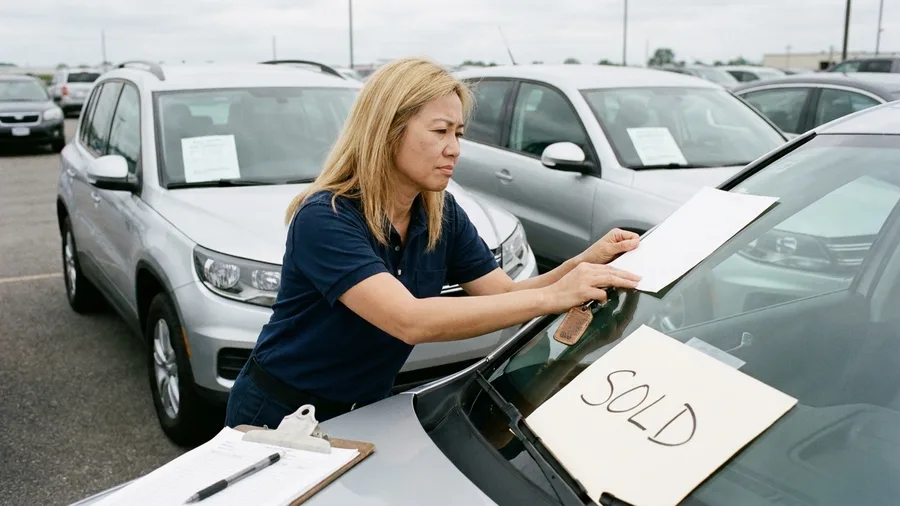
The gap between a new 2026 compact SUV and the same model three years old is only $3,200 in this example. That is the whole number, and it is smaller than most buyers expect when they walk onto a lot expecting a heavy used-car discount.
Here is how the two prices land. The 2026 model carries a $34,500 MSRP, but a $1,500 factory rebate comes off the top, so the selling price you actually work from is $33,000. The 2023 with 36,000 miles on the odometer is listed at $29,800. Subtract one from the other and you get $3,200.
That is not a steep discount.
The old rule of thumb assumes a three-year-old car has already shed its worst depreciation, and that the buyer who steps in at that point picks up the savings the first owner paid for. The rule is fine in principle. The problem is that it assumes a gap wide enough to reward you for taking on someone else's miles.
At $3,200, the cushion that rule depends on is thin. So the price you pay today tells you less than you think about which car is cheaper. The question worth your attention is what each one will lose over the next three years.
💡 PRO TIP
Ask for the used car's service history in writing
A 36,000-mile car with documented oil changes and a fresh set of tires is worth several hundred dollars more than one with a blank history. Ask for the records before you negotiate, and use what is missing as a reason the price comes down.
The next three years favor the new car

From today's prices, the used car loses $1,800 more value over three years than the new one. The projections are $25,500 resale on the 2026 and $20,500 on the 2023, and the arithmetic turns the usual logic around.
Run each side. The new car costs $33,000 and is projected to be worth $25,500 in three years, so it sheds $7,500. The used car costs $29,800 and is projected at $20,500, so it sheds $9,300.
The used car starts $3,200 cheaper and still loses more.
The reason is that depreciation clocks from what you pay, not from the year the car was built. The 2023 already took its early drop, but $29,800 is a high price for a car entering its fourth year, and a car at that price has more value left to give up than a new one at $33,000 does. The clock you care about starts the day you sign, and on that clock the used car is behind from the first month.
This is the part of the math that surprises people, and it is worth sitting with before any repair costs get added to the bill.
⚠️ COMMON MISTAKE
Stop shopping by sticker price alone
The purchase price is the least useful number on the lot. What the car costs you is purchase price minus what it is worth when you sell it, plus everything you spent in between. Two cars $3,200 apart on the sticker can be $3,000 apart in the other direction by year three.
Total three-year outlay: new wins by $1,800

Add everything up over three years, before repairs, and the new car is $1,800 cheaper. Depreciation is the biggest line item, so purchase price minus projected resale gets you most of the way to a real number.
For the new car that is $33,000 minus $25,500, leaving $7,500. For the used car it is $29,800 minus $20,500, leaving $9,300. The difference is the $1,800 advantage to the new car, and it exists before a single part needs replacing.
Then the wear items show up. A 2023 with 36,000 miles will need tires and brakes within 12 months, and that runs about $1,200. Add it to the used car's column and its three-year cost becomes $10,500 against the new car's $7,500. The new car is now $3,000 ahead.
Keep the frame honest, though. Taxes, dealer fees, and financing sit outside this three-year math. They belong in an out-the-door quote and a separate look at any loan, because those numbers can move the total meaningfully in either direction.
So you hold two figures: $1,800 before the tires and brakes, $3,000 after. A cut in the used car's price, a seller who has already replaced those parts, or a real difference in financing can each pull that margin back the other way. The $3,000 is a starting point, not a final answer.
Rebates and negotiating room are not symmetrical

The $1,800 gap is measured off the listed prices, so the only way to close it through negotiation is to attack the used car's $29,800 sticker hard enough to change the three-year math. That sounds easier than it is, because the two sides start from very different positions before haggling even begins. The new car's $33,000 selling price is already a discounted number: it reflects a $1,500 factory rebate applied by the manufacturer, money that came off before you ever walked onto the lot.
The used car has almost no factory money behind it.
Nobody is subsidizing the $29,800 listing. A realistic negotiation on an ordinary used compact SUV in this price range tends to move the number somewhere between $500 and $1,000, not thousands. Say you win the full $1,000. That brings the used car to $28,800, which is still $800 above the $28,000 point where its three-year depreciation finally matches the new car's $7,500. It also leaves the used car only $4,200 below the new one, a gap that still has to absorb $1,200 of tires and brakes in the first year.
A $1,000 discount does not automatically close a $1,800 ownership gap, and that is the part worth sitting with before you get attached to either car. The used price has to fall far enough to flip the math, not just far enough to feel like a win at the desk. So the next practical step is to request out-the-door quotes on both vehicles, including taxes and fees, because rebate treatment and dealer documentation fees are handled differently from dealer to dealer and can quietly move the real gap by a few hundred dollars either way.
Two things people get wrong about this comparison
Warranty and repair risk tilt toward new

On the ownership side, the new car's 3-year/36,000-mile basic warranty runs across exactly the same three years this whole comparison uses, which means the repairs that might otherwise come out of your pocket in that window are covered if they are eligible. The used car's basic warranty has already expired. Some powertrain coverage remains, so the protection against a major engine or transmission failure is still there, but the smaller things a basic warranty catches now land on you.
The $1,200 tires and brakes are a separate bill, not a warranty issue at all.
Those are wear items, and no warranty was ever going to pay for them. They are immediate maintenance you can count on paying within the first 12 months of used ownership, stacked on top of whatever basic repairs the expired coverage no longer absorbs. Covered versus paid is the cleanest way to see it: the new car's repairs are the manufacturer's problem for three years, and the used car's basic repairs are yours while its powertrain protection stays in place.
Price movement can shift the purchase numbers by a thousand dollars either way, but negotiation does not follow you into year two or year three. The used car carries both the $1,200 wear bill and the open-ended risk of a basic repair that the new car's warranty would have covered, and that risk is the piece the sticker price never shows you.
What the Sticker Price Leaves Out — Three-Year Gap Math
📉 Depreciation, 2023 model
$9,300 over 3 years vs $7,500 on new
🧮 The $3,000 net gap
$1,800 worse depreciation + $1,200 wear items
🛡️ What insurance narrows
$750 over 3 years in the used car's favor
⚙️ Warranty risk you are pricing
Basic repairs on you, but not major powertrain failures
🔍 Buy the used only if
Pre-purchase inspection passes and price is $750+ below the $29,800 ask
📄 Quality of that risk
Bounded by a factory-backed powertrain, not unlimited
The ask that closes it
At $29,800 you are paying $3,000 more over three years than the $33,000 new car — $750 covered by cheaper insurance. You would need roughly $2,250 off to break even, and $28,000 or less to actually win.
Insurance and fees are close, not decisive
Insurance partly favors the used car, but by an amount that is too small to settle the decision. Quotes for the same coverage come in at about $1,750 a year for the 2026 model and $1,500 a year for the 2023, a $250 annual difference in the used car's favor. Over three years that adds up to $750 saved.
It is real money, and it is not enough to flip anything.
Set the $750 against the new car's $1,800 depreciation advantage before repairs, and insurance narrows the difference without erasing it. Once the used car's $1,200 tires-and-brakes bill enters the picture, the new car is still ahead by roughly $3,000, and a $750 insurance credit does not touch that. What insurance does tell you is that this line item is not where the fight is won; it is a rounding-error-sized tilt, not a decisive one.
Taxes and registration are a different matter, and they vary by state, so they are left out of the three-year math entirely. That exclusion is worth remembering, because a state with high registration fees or a tax on the full purchase price can move the real out-the-door numbers on both cars. Get those figures quoted locally rather than assumed. For now, treat the $250 a year as a small nudge toward the used car, not a reason to pick it.
Used needs a $150 inspection; new is known
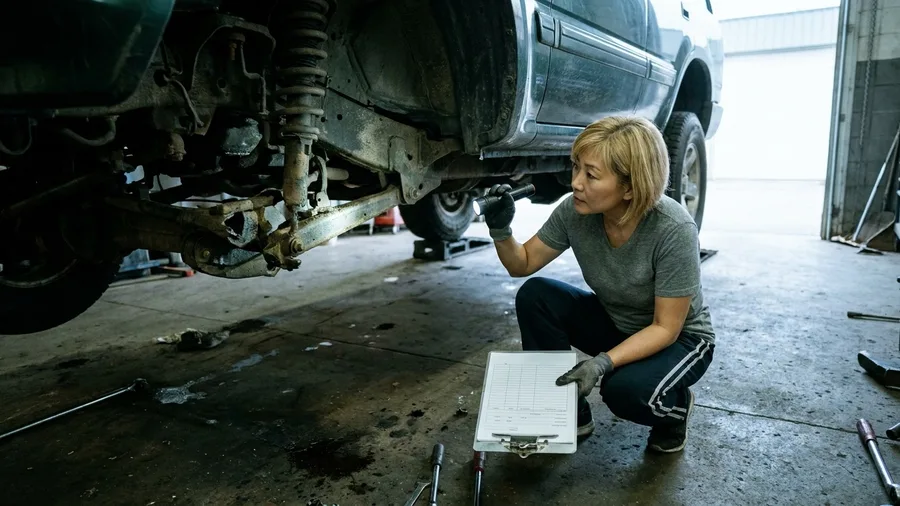
The used SUV's condition is the one part of this comparison you cannot look up. It logged 36,000 miles before you ever saw the ad, and the listing won't tell you who drove it or how hard.
You can pay about $150 for a prepurchase inspection, and it is the cheapest fact you will buy in this whole decision. A mechanic puts it on a lift, reads the brake pads and tire tread, checks for frame damage and fluid leaks, and hands you a written list in under two hours. Compare that against the $1,200 in tires and brakes the used car already needs within 12 months: the inspection costs an eighth of the repair bill it exists to warn you about, and a fraction of an engine or transmission bill it could spare you.
Before you sign anything, pull a vehicle history report and confirm in writing how the remaining warranty transfers. The 3-year/36,000-mile basic coverage on the 2023 has already run out, so those repairs fall on you. Powertrain protection may still be in force, but you need the transfer rules from the manufacturer in writing, not a salesperson's word across a desk.
And a new SUV needs none of this. Zero previous owners, no history to verify, no lift fee, no call to the warranty desk. Certified pre-owned sits between the two: a used price with some inspection done for you and some coverage attached, typically asking more than the $29,800 ordinary listing.
Budget the $150 before the test drive, and walk away from any seller who won't allow an inspection.
🚗 The paperwork order that keeps the $150 from being wasted
Call the shop before the seller
Ask if they do prepurchase inspections and what the $150 covers. Some shops only lift cars they service.
Schedule it inside the return window
Book the inspection within any dealer's 3-day or 7-day return period, so a bad report still lets you unwind.
Photograph the report, not the car
Keep the written findings. Frame damage or fluid leaks are negotiating chips worth more than the $150 you paid.
Order the history report the same day
Run the VIN before the lift, not after. A salvage or odometer flag saves you the inspection fee entirely.
Get the transfer rule in an email
Ask the manufacturer's warranty line, not the sales desk, whether powertrain coverage follows the vehicle and what proof it needs.
When the used car still wins

Once the inspection and warranty carry their price, the used car still wins below a number: $28,000 against this new one, and the reason is what the two cars lose from that point forward. A 2023 bought at $28,000 and resold three years later at $20,500 costs $7,500 to own, exactly the $7,500 the new SUV loses from $33,000 down to $25,500. Tires and brakes shrink that, since the used side carries the $1,200 bill first, though a $1,000 negotiated cut or a set of tires or brakes already replaced closes the rest of the gap.
Below $28,000, three levers pull the used car ahead. Its insurance runs $250 a year cheaper, which is $750 over three years. Any wear items already done come off its bill while the new car's stay theoretical. And every dollar off the asking price drops straight onto the used side of the ledger.
Paying cash is a fourth lever. The core math leaves financing out, so interest sits outside the comparison; settle it in cash and no loan interest lands on either sticker, and the lower price does more of the work.
A long hold changes the shape entirely. Keep either SUV eight years or more and depreciation flattens for both, the used car's $5,000-lower entry price and cheaper insurance matter more, and the new car's 3-year/36,000-mile basic warranty is years expired.
The new SUV keeps the edge when the 2023 holds near $29,800, when you sell in three to six years, when the warranty is worth real money to you, and when the gap stays inside $4,000.
The Tiebreakers, Ranked
New wins when
- Same-loan-rate test fails: the new car's rate beats the used rate by more than 1.5 points
- You sell in year 3 to 6, before the used car's $5,000 cheaper entry gets to work on the resale side
- The gap is under $4,000 and the inspection turns up anything you would not fix yourself
- Warranty math: one $1,000+ repair in 36,000 miles erases the used car's whole insurance edge
- You need the car on the road this week and a used one at $28,000 is not on a lot near you
Used wins when
- You pay cash, so the $4,000 loan-interest swing on a 5.9% note never enters the math
- You hold past year 5, when the used car's $5,000 lower entry outweighs its $1,800 extra depreciation
- The tires and brakes show a recent receipt, taking $1,200 off the used side before you start
- An independent inspection clears it for $150 to $250, which is the cheapest insurance you will buy
- You can walk away from anything above $28,000 and wait for the next listing
Who should buy which

The conditions split buyers into two clean groups, and you land in one by answering three questions: how long you keep the vehicle, whether you pay cash, and what the used one actually costs. Keep a car three to six years, want coverage on the expensive parts, and find the 2023 sitting close to new money, and the new SUV fits. The gap in this example is $3,200, which is inside the $4,000 window where the used car's $9,300 depreciation, $1,200 wear bill, thinner factory money, and missing basic coverage add up to more than the discount saves you.
The other group finds the same 2023 at $28,000 or below, writes a check instead of signing a loan, or plans to drive it eight years or longer. Each one attacks a different advantage the new car holds: price, interest, warranty, and the depreciation clock.
The $4,000 gap is the number to carry into the dealership. At $3,200 below new, the used SUV is too close to justify what it costs to own; widen the gap and the decision moves toward used.
So get out-the-door quotes on both, taxes and fees included, and run them against those two figures: the real gap against $4,000, the real used price against $28,000. Then decide.
The old used-car rule buys you the first owner's depreciation. In 2026, at a $3,200 gap, it buys you a bigger bill instead.
— What the three-year math keeps showing
Figures are projections for one 2026 compact SUV example; actual resale varies by condition, mileage and region.
Frequently Asked Questions
Is a 3-year-old used car still the smart money move in 2026?
Not automatically. The rule worked when used prices sat far below new ones, so the second buyer skipped the steep early depreciation. When the gap is only $3,200, the used car can lose more value over your ownership than the new one does. Check the actual gap before you trust the rule.
How much cheaper does a used car need to be to beat new?
On this example, $5,000 or more below the new price moves the arithmetic toward used, and $28,000 or less on a $33,000 new car is the clear threshold. Under $4,000 apart, the new car's depreciation, warranty and financing advantages usually outweigh the discount.
Should I count taxes and financing in the comparison?
Count them, but separately. Sales tax, registration and dealer fees vary by state and belong in the out-the-door quotes you collect from both dealers. Financing depends on your rate and term, so compare identical loan offers on both cars rather than assuming one is cheaper to borrow for.
What does a pre-purchase inspection actually catch?
Frame damage from an unreported accident, uneven tire wear that points to alignment or suspension problems, stored diagnostic codes, and brake measurements that tell you how soon the pads are due. At about $150 it is the cheapest insurance you will buy on a used car.
Often, yes, if the premium is small. A CPO car comes with a dealer inspection and usually some warranty coverage that partly replaces the expired basic warranty. Price one against the ordinary listing; if it lands within a few hundred dollars, it changes the comparison.
What if I keep my cars for ten years?
Then the math tilts toward used. Depreciation flattens for both cars after year eight or so, and the used car's lower purchase price and lower insurance keep paying you back annually. The new car's basic warranty has expired by then anyway, so you are not giving up much.
Two profiles, one quote sheet, and the $4,000 line
Pick the new car if you keep vehicles three to six years, want the 3-year/36,000-mile basic warranty, and the used price sits within $4,000 of new. Pick the used car if you can get it at $28,000 or less, if you pay cash, or if you keep cars eight years or longer.
Run the opening math one more time: $29,800 against $33,000 is a $3,200 gap, but the 2023 loses $9,300 over three years versus $7,500 for the 2026, and the $1,200 wear bill pushes the new car $3,000 ahead.
Either way, the first step is the same. Request out-the-door quotes on both cars with taxes, title, registration and dealer fees itemized, so the $4,000 gap and the $28,000 used threshold become a real comparison instead of a hunch.
The smart-money label belongs to the number, not the model year. A 3-year-old used car is the better buy only when its discount runs larger than the depreciation, repairs, warranty risk and inspection it carries with it.
Run the three-year math on your own two cars
Write down the new price, the used price, and what each will be worth in three years. If the gap is under $4,000, the new car is probably your cheaper buy — and the quote sheet will tell you.