

About 13% of US adults could not cover a $400 emergency with cash at all, according to the Federal Reserve's 2024 survey on household finances. That number is not a measure of character. It is what happens when money sits unchecked long enough to become a surprise.
You know the flinch: the balance you skip, the bill you leave sealed, the "later" you keep promising. The dread is not proof you are bad with numbers. It is proof nothing has been looking, so small leaks stay quiet until a fee or a missed payment makes them loud.
Underneath sit five habits – avoiding the numbers, spending by mood, saving whatever survives, chasing a fast fix, measuring against someone's highlight reel. Every one turns money into a surprise. Pick the sign that made you wince, run its smallest fix for a week, and put the return visit on your calendar so it can stick.
Quick Tips Before You Start
One check, same day
Pick a weekday and time for your money check and put it in your phone calendar with an alarm.
Ten minutes, capped
Set a timer. When it goes off, you close the app whether or not you finished feeling calm about it.
Separate savings account
Open a second savings account at a different bank than your checking so the cushion is boring to reach.
Write the rule down
A rule you keep in your head is a wish. A rule on a note by your desk is a rule.
Mute the triggers
Mute three accounts that make you feel behind before you start any of the fixes below.
1. You avoid looking at your money

Opening the banking app and feeling your stomach drop is not proof you're bad with numbers. It's proof the numbers have been left unchecked, and things left unchecked get loud only when they're already expensive.
The skipped balance becomes a renewal you forgot, a due date that slid past, a low balance you find out about at the register. A $35 overdraft fee or a $29 late charge is the bill for not looking, and it shows up before you do. The dread is doing more damage than the number is.
So give the checking a schedule instead of a mood. Ten minutes, the same day each week: open the balances, name one bill coming up, close the app. No spreadsheet, no full budget, no sorting every category. On a calendar, that dread has somewhere to go, and money stops being a surprise you're avoiding and becomes a decision you already made time for. If you're already checking daily, this isn't your sign.
💡 Tip: Set the check for payday minus two days, not the end of the month. That is when the bill money matters most.
2. Your spending follows your mood

You can spend on a feeling without being reckless with money, and there is a fix that costs nothing but a day. Once the balances are visible, the next leak a weekly check shows is the money that moves with no plan behind it: the cart that opens after a bad meeting, the slow afternoon that ends in a purchase, the good news that arrives with a checkout screen.
The purchase is not really about the item. Stress, boredom and celebration all create a feeling the brain wants to change, and spending changes it fast. That is why the sweater bought at 9pm after a hard Tuesday can still sit unopened when the statement lands, and why the treat from a slow week is hard to remember seven days later.
That is a behaviour problem, not a character flaw, and the repair is a delay. Put 24 hours between the urge and any nonessential buy, and don't just wait. Make a short written list of free things that shift your mood the same way: a walk, a call to someone, the library, a shower, cooking something.
Keep the list where the spending actually starts. If it lives in a notes app you never open, it does nothing. Tape it near the laptop or set it as your phone wallpaper for a week. When the bad meeting ends, the first thing you see is the alternative, and the pause has a chance to work.
This is also the point where your own numbers matter more than anyone's opinion. In the pause, look at what nonessential spending last month actually added up to. That figure, not a rule from a book, is the number to act on. If it is $300 a month, a 24-hour pause on even half of it gives you back $150 without ending treats.
If your mood spending is tied to something heavier, or the delay keeps failing and the balance keeps falling, that is worth talking through with a nonprofit credit counsellor, who is free or low cost. A budgeting app cannot tell you why the cart opens. A person can help you find out.
Planned treats are not the problem, and this pause is not a ban. If you already set aside money for something you enjoy on purpose, skip this one. A treat you decided on is a decision. A treat you barely remember is the leak.
The pause turns a mood into a choice. Seven days of it is enough to see what your spending does without you noticing.
💡 Tip: Add items to the cart and leave them there. If you still want it 24 hours later, buy it without guilt.
How to tell them apart in your own statement
Mood spending
- Buy happens within minutes of the feeling
- Card statement shows 3+ small buys in one bad week
- You would struggle to name it a month later
- Returns or resells it, or never opens it
- Clusters at night or right after work
Planned treat
- Decided on a day you felt calm
- One line, roughly the same size each month
- You could say what it is and why you chose it
- Gets used within the first week
- Comes out of a set amount you named in advance
3. Saving waits until after you spend

Twenty dollars is a real savings plan. So is five. What isn't a plan is waiting for the end of the month, because money that has to survive a whole month of spending to get saved usually doesn't survive it.
That's the trap: saving whatever's left. Bills come out, groceries, gas, the small stuff, and by the 28th there's nothing left even in a month where the income clearly covered everything. The problem isn't that you can't save. It's that saving has no trigger and no separate place to land.
Which is why the account matters as much as the amount. Route a set transfer into a separate savings account the same day your pay arrives, before the spending has a chance to notice it. Start with $20 and leave it there for a month or two. The goal is a transfer that repeats without you deciding each time; the amount can grow later.
That last part is the permission: you don't have to fund three months of expenses this week. A thin cushion still changes what happens next. When a $400 repair hits, the difference between paying it from savings and putting it on a card is the difference between a rough week and a balance that follows you for months.
If your income doesn't land on a set payday, anchor the transfer to the money instead of the calendar. When a payment arrives, move the set amount then. Same trigger, different clock. The point is the same one either way: saving becomes a decision you make before spending, not whatever survives after it.
📅 Your First 7 Days With One Fix
Day 1 — Pick one sign
Choose the single habit from this list that felt most familiar and write it on a sticky note.
Day 1 — Set the small version
Write the smallest version of its fix: one 10-minute check, one 24-hour pause, one $20 transfer.
Day 2 — Put it on the calendar
Add the action as a repeating event with an alarm, on a day you know you will be home.
Days 2–7 — Do it once, badly
Run the action once even if it is messy and you only half finish it.
Day 7 — Put the repeat in
Decide whether the same version runs another week or a slightly bigger one does.
4. You chase quick money fixes
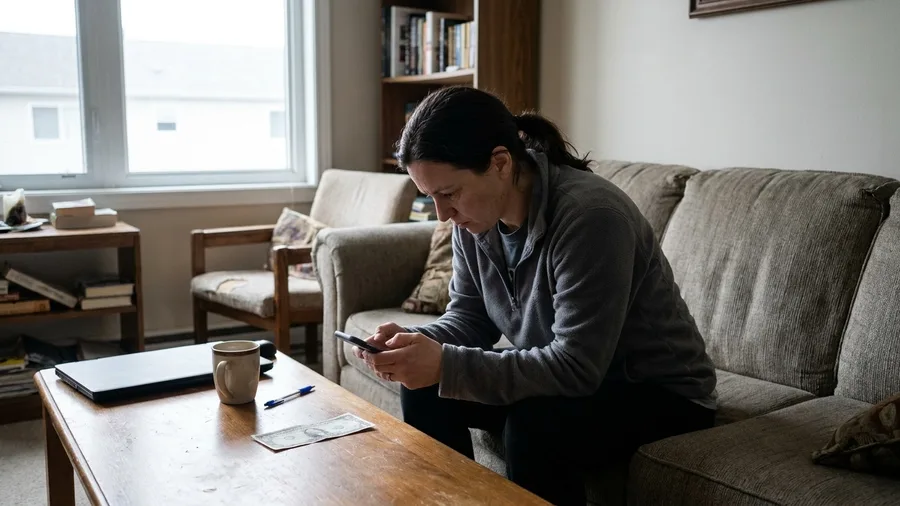
That late-night tip hits different – it's 11pm, the video makes it sound easy, and suddenly you're one buy away from catching up on savings you haven't built yet. The problem is what happens when a $500 buy on a tip sits in an account right as rent is due. It drops, you sell at a loss to make the bill, and now the quick fix cost you twice: once in the drop, once in the fees and the timing mistake.
The fix is a written plan and a 72-hour wait. Write it down in four lines – the goal, the amount, where the money sits, and the bills due in the next 30 days – then make any new money move wait three days: the tip, the course promising fast income, the side-hustle spend. Most of those ideas stop looking urgent by day three.
Before you act, check an official investor education source or a fee-only fiduciary, not the person who sent the tip. Then track where the move lands: note the date, the amount, and the bills that clear before it.
💡 Tip: Any pitch that disappears if you wait three days was never a plan. It was a mood with a marketing budget.
⚠️ COMMON MISTAKE
Cashing out a retirement account is not a rescue
Pulling money from a 401(k) or IRA before retirement age usually brings income tax plus a 10% early-withdrawal penalty, and you cannot put the year's contribution room back. A $5,000 withdrawal can cost you well over $6,000 in total, because the money also stops growing. If a bill is genuinely crushing you, call the lender or a nonprofit credit counsellor before you touch the account.
5. You measure your money by comparison

Because you're comparing your full picture to someone's best angle – the vacation, the new car, the renovated kitchen, each one a highlight with no numbers attached.
So how do you stop? You set one goal of your own and make it the measure. Two hundred dollars a month into a savings account gets you a $500 cushion in about three months, and that number is yours – it has nothing to do with anyone's feed. That's the reason this one is worth starting now rather than next year. Every month you spend comparing is a month the gap gets a little wider, while every month you track your own savings rate or debt balance is one where the number you're watching is actually moving.
The cost of waiting isn't just missed interest. Shame makes you overspend (booking the trip on credit to keep up) or quit entirely (closing the app for a month because the gap feels too wide). Both move you backward while the comparison keeps running.
The move: mute the accounts that trigger it. Not unfollow, not block – mute, so the highlight stops landing on your screen without the friendship drama. Then open one small tracker, not the feed, and write the savings rate or the debt balance once a month, same date.
The goal is the measure now, not the vacation. That turns comparison into one decision about the next goal, which is the only thing you can actually change.
💡 Tip: Mute, do not unfollow. Unfollowing gets noticed; muting takes ten seconds and nobody knows.
Four Fixes People Get Wrong
Frequently Asked Questions
How do I know if I actually have a poor money mindset or if my income is just too low?
Sometimes it is the income, and no budget fixes a paycheck that does not cover the month. The signs above are about habits — avoidance, mood spending, saving last, quick-fix chasing, comparison. If you recognize two or three of them, start with its smallest fix. If your income is genuinely short, a nonprofit credit counsellor can help you see options faster than a spreadsheet will.
What should I do first if money stresses me out so much I cannot open the app?
Do the ten-minute weekly check and nothing else. Open the checking balance, open the savings balance, name one bill coming in the next seven days, close the app. Set a timer. The goal of week one is not a budget, it is proving to yourself that looking does not hurt as much as the dread did.
Is it okay to pause saving for a few months?
Yes, if you write down when it restarts. A pause you scheduled is a decision. A pause you forgot about becomes the permanent state. Put the restart date in your calendar the same day you stop the transfer, and if you can, keep $20 a month running so the habit does not fully stop.
How much should be in my emergency fund before I invest or pay down debt?
Get to one month of bare expenses first — rent, food, utilities, minimum payments — which for a lot of households is somewhere between $2,000 and $3,500. Then decide between debt and investing, and that one depends on your interest rates and tax situation. Run it past a fee-only fiduciary before you commit either way.
Should I pay off debt or save first?
Do both, in that order of size: a small cushion first, then debt, because without a cushion every surprise becomes new debt. The exact split depends on your interest rates and how much the balance is keeping you up at night. A nonprofit credit counsellor can run the math with you for free or close to it.
How long before a money habit actually feels normal?
Give it three months of the same weekly check before you judge whether it is working. The first two weeks feel like effort, the third feels like a chore, and somewhere in the second month it becomes the thing you just do. Set the check to repeat for twelve weeks so you do not have to decide each week.
Pick the sign that stung, then run it for seven days
No, you do not need to fix all five. The useful move is diagnosis: find the one sign that felt most familiar, because that habit sits closest to your daily behavior and is the one a small change can actually reach.
Take its smallest fix for the next seven days – the ten-minute balance check, the 24-hour pause, the $20 automatic transfer, the 72-hour wait, or one goal with the comparison accounts muted. Then book ten minutes in your calendar, same day next week, to see what happened and whether to continue.
The banking-app flinch is not a verdict on you. It is a habit you can put on a schedule and turn into a decision. Whether you are in that 13% or not, one sign, one small fix, seven days, repeat – that is how the surprise goes quiet.
Set the seven-day check now
Put one alarm in your phone for the same time next week and pick the sign you are running. When it goes off, do the ten-minute check and nothing else.
