
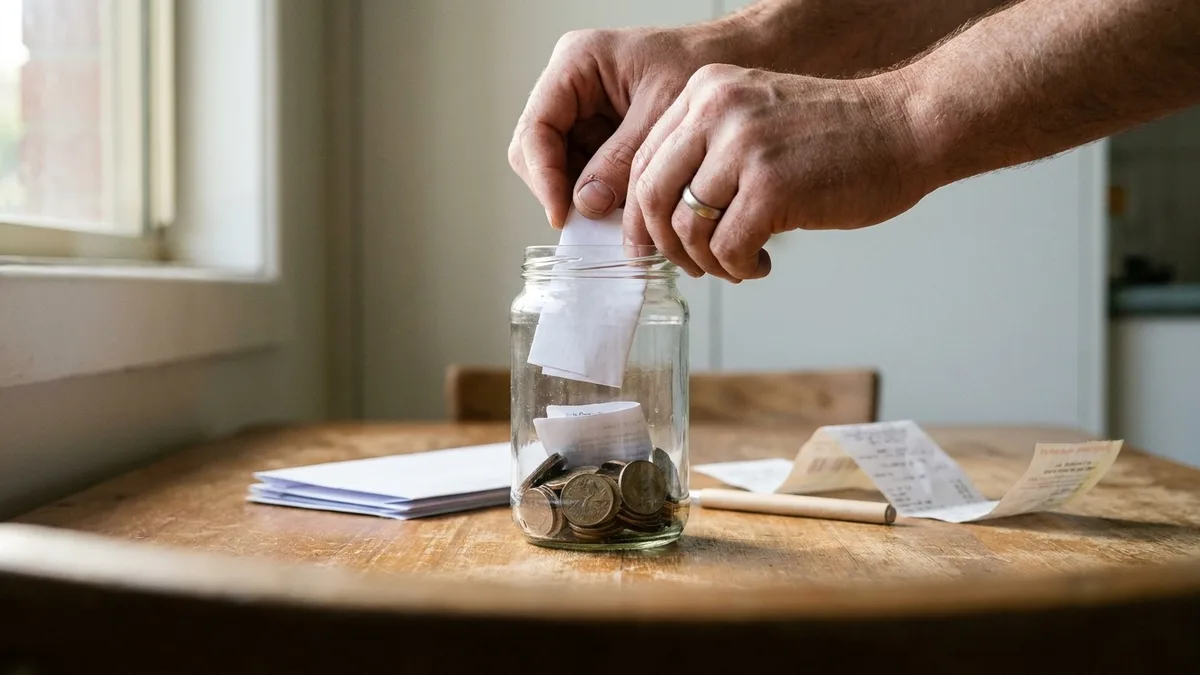
You keep telling yourself the problem is the paycheck, and that a bigger number would fix everything. It is the most comfortable explanation, and it is usually the wrong one.
A steady $6,200 lands on the 1st and the 15th. Rent, the car, utilities, insurance, childcare, gas, groceries, the card minimum, the savings transfer – add the commitments up and about $85 is left before the next deposit. Nobody in that month is poor. The month simply closes early, which tells you the deposit is not the only variable worth looking at.
The six signs ahead are not verdicts on your income. They are points where a money system leaks – timing, small swipes, no buffer, no plan, and not wanting to look – and every one of them survives a raise intact and comes with a first fix. Pick the one that makes you wince and start there.
By the end you should be able to name which sign is yours and know to fix the one producing late fees or fresh card debt before anything else. Then do a single thing: list every automatic payment and its date for one full pay cycle.
Quick Tips Before You Start
Grab one pay cycle
Print or screenshot every bill and automatic payment due between the 1st and the 15th and again from the 15th to the 1st.
Open the app once
Check your real balance today, not the one you assume is there. The number is the same whether or not you look.
Mark late-fee dates
Circle every due date that falls before a payday. Those are calendar problems, not income problems.
Pick a buffer size
Aim for one ordinary car repair — $400 to $500 — as your first cushion goal, in a separate account.
Set a weekly 20 minutes
Same day each week, review the last seven days of transactions. No judgment, just the numbers.
1. Your Paycheck Vanishes Before the Next Payday

The 3rd of the month feels fine. The 19th is when the quiet panic sets in, and you find yourself doing arithmetic in the cereal aisle over a $4 box.
That feeling has a name, and it isn't a small income. Run the actual structure on a $6,200 take-home that arrives on the 1st and the 15th and the arithmetic is right there. Rent at $1,750, the car payment at $480, utilities at $220 and insurance at $250 commit $2,700 before anyone decides anything. Add childcare at $1,100 and gas and transit at $200 for another $1,300, then groceries at $650, dining out and delivery at $420 and subscriptions at $95 for $1,165 more.
The card payment at $350 and the $300 savings transfer made on payday bring the total to $5,815 spoken for.
A normal income, fully assigned before the first discretionary choice. Then about $300 of impulse and convenience buys slides in, and roughly $85 is what's left to carry you to the next payday. Notice the $300 savings transfer too: it leaves on the 1st and gets pulled back by around the 24th when the account runs thin, so the balance never builds. The check that never accumulates is the giveaway.
This is why the fix comes before any raise, and why it comes now rather than after the next review cycle. Two more pay cycles of the identical structure and an extra $500 a month gets absorbed into it without a trace, because nothing in this list is capped by the size of the deposit. The money arrived; the schedule ate it.
So the first diagnostic step is not a budget and not a spending freeze. For one full pay cycle, write down every bill and every automatic payment, with its amount and its date. All of them, including the ones you forgot you set up.
The list is what tells you the truth. Your account balance shows a number and hides a calendar, and the calendar is where the shortfall actually lives.
Start it on your next payday, because a cycle you begin mid-month only shows you half the picture.
💡 Tip: If you only do one thing after reading this, list every automatic payment and its date. The list is the diagnosis.
Same Paycheck, Two Different Months
Illustrative example built on a $6,200 monthly take-home.
2. Small Swipes Drain More Than Fixed Bills

The way to find the leak is a 20-minute review of the last seven days of transactions, once a week, on the same day. Not the month, not the year. Seven days.
Once the fixed lines are on paper, rent at $1,750 clears every month and stops being the suspect. What never appears as a bill is the dining out and delivery at $420, the subscriptions at $95 and the impulse and convenience buys at about $300, which come to $815 a month. That's $335 more than the $480 car payment, a line you already count. Look for the three biggest swipes in each week and nothing else. That's the whole check.
Do the first one this week, then put the next three in your calendar and stop thinking about it between them.
⚠️ COMMON MISTAKE
Budgeting from bills hides the leak
If your budget is a list of rent, car, and utilities, it will always balance and your account will still empty. You have to include the $420 delivery line and the $300 convenience line or you are budgeting fiction.
3. You Pay Late Fees With Cash Available

The Monday after a late payment cleared, I sat down to figure out how I'd managed to owe a penalty in a month when the money was sitting in my account the whole time. The answer was embarrassing in its simplicity: I had the cash on the 1st, the bill was due on the 12th, and by the time the 12th arrived the account was thin again.
Take the $350 card payment due on the 12th against a payday of the 15th. The money for it landed on the 1st and got swallowed by the $815 of everyday spending before the due date ever came around. Three days of gap, one late fee, and a mark on the payment record. This is a calendar failure, not a bare-bones-income failure.
The fix is smaller than the problem. Call the card issuer and ask to move the due date to the 2nd or the 16th, so it lands just after a deposit instead of just before one. Or open a separate bill account, fund it on the 1st with the amount the month's bills need, and touch it for nothing else.
A raise moves the deposit. It never moves the due date. $1,200 more a year leaves the 12th exactly where it is, which is why this sign survives every pay bump without breaking stride.
If you only do one thing this week, log in and change that single date. It takes about eight minutes on hold, and it is the difference between paying for your debt and paying a penalty for the privilege.
💡 Tip: Call the card issuer and ask for a due-date change to the 2nd or 16th. Most allow it once or twice a year.
Two Ways to Handle a Due Date
Keep the 12th due date
- Cash lands on the 1st, gets spent over the next 10 days
- Payment leaves on the 12th with little left
- Late fee and a mark on your payment record
- A raise does not move the 12th, so the gap repeats
Move it to the 16th
- Cash lands on the 15th and the payment leaves the next day
- Bill account funded on the 1st and not touched
- No late fee, no gap, no stress
- One phone call that fixes it for good
4. A $400 Repair Goes Straight Onto Credit

Because nothing is set aside for it, and a timing fix doesn't create that. Moving a due date keeps a fee off the account; it doesn't put a dollar anywhere for the repair that lands on a Tuesday with $85 in checking and a $6,800 card already sitting open.
The repair isn't the emergency. Its absence of a cushion is. That same $400 is an unremarkable cash week for a household with $1,000 parked in savings, and a fresh new balance for one without. And this one bills you twice: the $400 goes on the card, interest starts accruing on top of it, and $6,800 climbs instead of shrinking. The card quietly becomes an emergency fund running in reverse.
Here is the permission part, because the number likely feels impossible. You don't have to build three to six months of expenses before you touch anything else. Start with one ordinary repair. Pick a number that would have kept this month's $400 off the card – $500 is a fine target for a lot of drivers – and open a separate savings account just for it.
Then fund it before the extra debt payments and before any investing. Yes, that means the card sits at $6,800 a while longer, and interest keeps running during that time – that's the trade, and it's worth naming out loud. If $500 is out of reach right now, $25 a week, moved automatically, gets you there in about five months.
That money stays untouched except for the thing it's named for. A buffer's only job is to stop the next $400 from becoming debt.
💡 Tip: A $500 buffer in a separate account absorbs one ordinary car repair. Start there before you pay extra on the card.
🐖 Build the Starter Buffer in Four Steps
Name the account after the job
Label it 'car repair' so a withdrawal for anything else feels like breaking a rule, not making a choice.
Pick the $500 ceiling deliberately
It covers a $400 repair with $100 left, so the next small surprise does not reopen the card.
Fund it before the $350 card payment
On the 1st and 15th, the $25 transfer clears first. The card payment moves to what is left.
Refill before you resume extra debt payments
After a repair, pause any above-minimum card payment until the $500 is back. The buffer comes first.
5. You Pay Extra for Not Planning Ahead

Four hundred and twenty dollars a month in delivery and about $300 in convenience buys – that's $720 spent on speed. It goes to the 8pm delivered dinner, the single-item trip to the store, the pre-cut groceries, the errand bolted onto the commute because there was no other slot for it. The premium isn't laziness. With no weekly plan, every decision gets made at the moment of highest fatigue and highest price.
That $720 matters. It covers the $400 repair that ended up on the card and still leaves $320. That isn't a payoff, it's the difference between a week that runs on short notice and one that doesn't.
The alternative fits in half an hour: a Sunday plan for the week's meals and errands, or batching the errands into one loop with the commute you're already making.
💡 PRO TIP
The 30-minute Sunday plan
Write the week's dinners and errands in one list on Sunday. You are not meal-prepping for the week — you are removing the 8pm decision that costs you $18.
6. You Avoid Looking at the Real Balance

The story people tell themselves is that not checking is a kind of protection, that the number will hurt less if you leave it alone. It does not work that way. The rent, the $350 card payment due on the 12th, the $95 of renewals, the delivery total climbing a few dollars a day – none of it pauses while you look away, and the app balance is the same figure at 11pm whether or not the screen gets opened.
Money you have memorized and money you have actually looked at are two different things. The $6,200 is known to the dollar, because it gets watched into the account twice a month; the $6,800 on the card is a rough idea, a number you would guess at rather than state. The balance that sits closest to the decision – the one that determines what gets paid and what gets skipped – is the one nobody opens the app to confirm.
That gap where nothing gets checked is doing real damage. A payment due on the 12th, a handful of small renewals, a delivery habit adding a few dollars a day: none of these announce themselves, so they surface in the worst possible way, as a fee or a declined card at a register with a line behind you. Then the cost of having not looked is sitting right there in the transaction history, on top of the $350 you already owed.
The fix is nothing like the version in your head, where you sit down, confront everything and come out with a budget. It's smaller than that. Ten minutes, the same day each week, every account opened and its balance written down on paper. Not judged, not sorted into categories, not planned around – just the numbers on the page, so the $6,800 and the $350 and the renewals have somewhere to live besides a vague worry. One $4 late fee avoided pays for the ten minutes many times over, and that is the whole reason the tiny version is worth doing on its own.
💡 Tip: Put a repeating 10-minute event in your phone for the same day each week. Open every account, write the balance, close the app.
Why These Six Signs Survive a Raise
What would an extra $500 a month actually change? On this structure, not much of anything.
Run it forward and watch what happens. The new deposit lands on the same 1st and 15th, moves through the same card payment due the 12th, gets nibbled by the same $420 of delivery and $95 of subscriptions, and hits the same 8pm moment where no plan exists. Within two cycles the spending has stretched to fill the room. The gap looks the same size because the behavior generating it never moved. The number in the account changed and the pattern that empties it did not.
That is why 'I just need to earn more' keeps failing as a diagnosis. Raise income and you raise the size of every leak with it, because none of these failures are capped by the size of the deposit. The calendar is still three days off. The swipes are still unexamined.
What changes the outcome costs almost nothing to start. A written system: due dates mapped on a calendar, a 20-minute weekly review of the last seven days of transactions, $500 parked in a separate account as a starter buffer, one Sunday plan, and 10 minutes a week of simply looking at the balances. The whole kit is a notebook, a timer, and one account you don't touch.
This is the honest frame, so hold onto it. These moves improve your odds and give you options. They are not a promised path to wealth, and a budget cannot fix an income that is genuinely too low. But if the paycheck is steady and the month still runs out, the deposit isn't the variable. The system is.
Frequently Asked Questions
How do I know if I am actually poor or just bad at managing money?
The test is whether the shortfall follows a schedule. Write down every bill and every automatic payment for one pay cycle. If the money was there on the 1st and gone by the 12th, the problem is the calendar, not the income. If the list already exceeds the paycheck before you buy anything, then income is genuinely the constraint.
What if I do not have an extra $500 for a buffer?
Start with $25 a week or whatever you can move without noticing. The point is the account existing before the next car repair, not the size of the first deposit. A $500 buffer in a separate account at a different bank is the goal, and it can take a few months.
Should I pay off the $6,800 card or build the buffer first?
Build a small buffer first — around $400 to $500 — then put the extra toward the card. Without a buffer, the next $400 repair goes back onto the card and you are paying interest on the repair again. Run the exact order against your own numbers with a nonprofit credit counselor if the card balance is growing.
My due dates already fall after payday but I still pay late. What is wrong?
The cash is landing in the same account you spend from. Open a separate bill account, fund it the morning of payday, and leave it untouched. Autopay from that account on the due date removes the decision entirely.
Is it too late for me if I have been avoiding my accounts for years?
No. The balance is the same number whether or not you have looked, and the only thing added by not looking is the late fee. Ten minutes with every account open, writing down the balances, is the whole first step. If the debt is large enough that you feel out of your depth, a fee-only fiduciary or a nonprofit credit counselor can look at it with you.
Fix the Sign Causing Late Payments or New Debt First
If several of these six fit you, do not try to fix all of them this week. Triage: the sign that is causing late payments or new debt goes first, because that is the one actively costing you money. If you paid a late fee this month, start with #3. If a repair went onto the card, start with #4.
Then take one first action: list every automatic payment and its date for one full pay cycle. That single page is the diagnosis, and it tells you whether the problem is timing, leaks, buffer, planning, or avoidance. You are not bad with money — you are running a system with a few specific leaks, and now you know where they are.
Start with the list, not the raise
Open your banking app and write down every automatic payment and its date for this pay cycle. That one page tells you which sign to fix first.
