

"I'm just not naturally good with money" – that is the belief, and it is wrong in a very specific way. The people who look untroubled are not braver and not better at arithmetic. They just have two-minute checkpoints that decide things before the spending moment arrives.
You have a steady paycheck and a low-grade hum of worry under everything. You are not looking for a full budget overhaul. What you are missing is simpler and more fixable: nobody has checked the bills, the autopays, or the buffer in a while, so your cash flow stays unknown right up until a surprise lands.
Eight morning-and-evening checkpoints change that. Two minutes a day makes the next seven days, the next fourteen days of bills, and this month's wants into numbers you have already read. Start with the morning balance and bill glance, then add one habit a week.
The point is not zero worry. The point is fewer surprises, which is most of what the word worry means anyway.
Quick Tips Before You Start
One App, One Number
Keep the banking app on your home screen so the balance check takes 30 seconds, not 5 minutes of hunting.
Anchor It to Coffee
Attach each new habit to something you already do every day so it stops being a decision.
Separate the Fund
Keep the $1,000 starter emergency fund at a bank with no debit card attached, so it takes effort to touch.
Same Time Daily
Run the bill scan before 9 a.m. Autopays posted overnight are visible and still fixable.
Round Down, Not Up
When the safe-to-spend number looks tight, cut the want and keep the bill. Never move bill money to cover a want.
1. A two-minute daily balance check
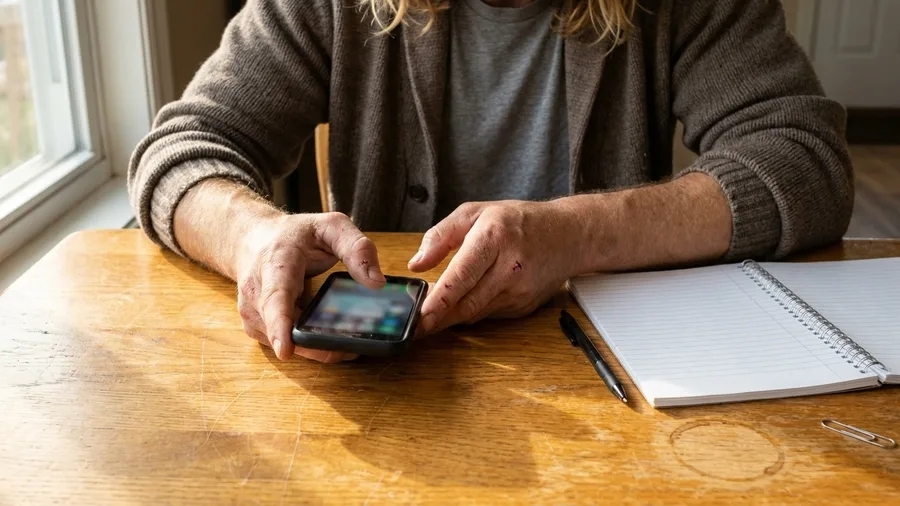
A friend of mine used to start every Saturday the same way: coffee in hand, phone face down, because she didn't want to see the number. When she finally flipped it over and read the balance out loud, the dread she'd carried all morning was gone in about four seconds.
That's the whole routine, and it takes two minutes. Open the banking app before the first purchase of the day, not after. Read the checking balance and write down one figure: your safe-to-spend number. Take the checking balance, subtract the next seven days of known bills, then subtract the $300 buffer you keep there. Whatever is left is what you can actually spend today without touching money that's already spoken for.
Some mornings that number is $180 and the day is easy. Some mornings it's $22, and that's information, not a verdict.
If it's tight, the move is to delay the discretionary purchase, not to move bill money around to cover it. The electric autopay doesn't care that you wanted new headphones. You can wait a day or two for the number to breathe; the bill can't. The question flips from a vague can I afford this to a printed figure you already worked out – before the transaction, not after it clears.
Check it once in the morning, and glance again after any large purchase clears, just to confirm the number you're carrying around is still true. Two minutes, most days less.
💡 Tip: If your pay lands twice a month, subtract the full next-seven-days of bills after the first check too. Rent is due whether or not the money feels new.
2. A daily five-dollar savings sweep

Five dollars. That's the whole number, transferred automatically from checking to savings every weekday, which lands around $100 a month by the time a month is over.
Once today's safe-to-spend figure is a habit, the next weak spot shows up fast: saving only happens if there's anything left after spending, and there rarely is. So treat the $5 like a bill. Set the transfer for weekday mornings, before you've decided anything, and let it go out whether the week felt generous or not. After 30 days, check that checking still clears the $300 buffer. If it does, raise the transfer by a couple of dollars; if it doesn't, leave it exactly where it is. The point isn't the amount. It's that saving stops being a monthly decision you keep deferring and becomes a scheduled line you don't have to think about.
Even $25 a month moved automatically does more than $0 you keep meaning to move.
The Numbers Behind Eight Habits
Daily figures and what they add up to over a month
3. A 24-hour pause on nonessential buys

Write the item down and walk away for 24 hours. That's the instruction – one line in your notes app, the price, the store, the time, and then close the tab.
The rule is simple: nonessential purchases over $50 wait a day before you decide. Essentials don't. Neither do bills, groceries, gas, or a replacement that keeps work or home running – a dead phone charger or a broken work shoe is not an impulse, it's an errand. The $60 jacket you spotted at lunch, though, gets written down and revisited tomorrow, when the wanting has had a night to settle.
This is where the common mistake shows up. People try to talk themselves out of wanting things, and it doesn't work – you can't argue yourself out of a want in the moment it's loudest. What you can do is move the decision to a time when the want isn't standing in front of you. The purchase stops being a reflex and becomes a scheduled choice, and the amount is already known before you ever reach checkout.
The trap is mislabeling. A want wearing a need's clothes – the third pair of shoes in the same color, the upgrade that isn't strictly an upgrade – slides past the pause and out the door. Be honest about which category something falls in.
And know where the line is. If nonessential spending is running a few hundred dollars a month and the pause isn't enough, or if there's debt underneath it that keeps growing, that's not a willpower problem you can out-discipline alone. A nonprofit credit counselor will look at the actual numbers – interest rates, balances, income – and lay out options with nothing to sell you.
For everything else, the pause does the work. You're not saying no. You're saying not yet, which is a decision you can actually keep.
💡 Tip: Exempt anything with a deadline attached — a sale price is not a deadline, a prescription refill is.
⚠️ COMMON MISTAKE
Don't skip the needs-vs-wants tag
A spending log without labels tells you what you bought and nothing about whether it was avoidable. Two seconds marking each purchase need or want is the whole value of the exercise.
4. A nightly five-minute spending log

Five bucks here, twelve there, and the account is lighter than the math in your head says it should be.
The fix is a five-minute log before bed: every purchase into one app or one spreadsheet, each one tagged need or want. Scan the daily and weekly totals without scoring yourself. You are not doing this to feel bad about the $60, you are doing it so the $60 is a choice instead of a surprise.
Small leaks get caught while they are still small, and the end-of-month jolt gets removed before it forms.
Memory vs. Verification
Relying on memory
- You assume the autopay went through because it always has
- The bill amount is whatever it felt like last month
- A failed payment surfaces when the late fee does
- The buffer gets checked when something breaks
- Fun money gets spent until checking feels uncomfortable
Checking it daily
- You see the payment scheduled and cleared
- The amount is matched to the statement each morning
- A failure gets a same-day call to the lender
- The $300 cushion is confirmed, then refilled from the next paycheck
- The $120 allowance is a number you spend down on purpose
5. A morning scan of upcoming bills

A bill showing up early or larger than expected feels like bad luck. It is almost always a calendar you have not looked at yet.
The usual habit is to check autopays only after something bounces, and by then the $35 overdraft fee has already posted. So once a morning, pull up the next 14 days of scheduled autopays and read what is coming. Takes about two minutes with coffee. Anything higher than last month gets flagged right there.
That is the whole point: a future autopay becomes a known hit instead of a hit.
The move is to shift money into checking before the due date, not after the alert lands. Most payroll-to-bill mismatches get solved by moving $80 two days early rather than scrambling on the day.
You are allowed to miss a morning. Pick it back up the next one, and the next two weeks of hits stay visible.
The Cushion and the Fund — At a Glance
🛡️ Checking buffer
$300 above known bills
🏦 Where it lives
In checking, working every day
🧯 Starter emergency fund
$1,000, separate bank
🔒 Debit card
None attached to the fund
♻️ Refill order
Buffer first, savings second
🎯 What the buffer covers
Timing shocks, not disasters
The rule
Refill the $300 from the next paycheck before you add a dollar to savings.
6. A daily bill-buffer check
Keep $300 sitting in checking above your known bills, always.
The trade-off is real: that is $300 you cannot send to savings or a card this month, and it will feel like wasted room. It is not. It absorbs the timing shock when a bill lands on the same day as payroll and the clearing order goes wrong. The emergency fund stays separate, $1,000 in an account with no debit card tied to it, so you are not tempted to raid it. When the buffer dips, refill it from the next paycheck before adding anything to savings.
An irregular expense then becomes a timing problem with a known fix instead of a crisis.
💡 Tip: If $300 feels out of reach, start at $100 and raise it by $50 each time you refill without strain.
7. A daily debt-autopay check
The common belief is that once an autopay is set up, it takes care of itself. It doesn't. An autopay is a standing instruction, and standing instructions fail quietly: an expired card, a switched bank account, a payment amount that changed when a rate adjusted. Memory says it went through. Only the account can confirm it.
So the routine is a short circuit, run the same way every day: open the account, check every debt payment as it shows scheduled, then cleared, and match the amount against the current statement. Scheduled means queued. Cleared means the money left. Both, or it isn't done.
If a payment shows failed or short, call the lender the same day and ask for the late fee to be waived. Fees get waived more often when the call happens before the due date passes. Two minutes of checking today is cheaper than the fee and the credit hit a missed payment leaves behind.
Beliefs That Keep the Worry Alive
8. A daily check on fun money

There is a feeling that any money spent on something you don't need is a small failure, so the wants get buried, and then one tired Friday they come out all at once and the bill money goes with them. That isn't a discipline problem. It's an unnumbered problem.
Once the bills, the buffer and the debts have their known amounts, the only question left is what's actually yours to spend on nothing useful. So give it a number. Set $120 a month for wants, which works out to roughly $4 a day to spend on whatever you like, with no explanation owed to anyone.
Spend it without guilt. That's the whole point of naming it. A want covered by the allowance isn't stealing from the electric bill; the electric bill was already handled before the allowance existed.
Then reset on the first of the next month and start again at $120. The reframe is simple: wants with a known number stop being a leak and become a line you already planned for. The guilt doesn't survive the math.
💡 Tip: Keep the allowance in the same checking account, not a separate one. A second account is one more balance to forget to check.
📆 Build It One Week at a Time
Week 1 — the morning check
Open the banking app before your first purchase and write down the safe-to-spend number.
Week 2 — the sweep and the log
Add the $5 weekday transfer, then log every purchase before bed for seven nights.
Week 3 — bills and the buffer
Scan 14 days of autopays each morning and confirm the $300 cushion is still sitting above them.
Week 4 — debt and fun money
Verify each debt autopay cleared, then set the $120 allowance and spend some of it.
Week 5 — repeat, don't expand
Run all five for another week before adding anything new. Automatic means you stopped thinking about it.
Why the small numbers do the heavy lifting

Sit with what these routines actually do, because it isn't budgeting. None of them ask you to spend less. Each one takes a surprise and replaces it with a number you already knew.
The morning balance check replaces the register question at checkout. The five-dollar sweep replaces the year-end intention to save. The bill scan replaces the overdraft notice. The debt check replaces the late fee discovered a week after the damage.
That's a different project from the one most people think they're signing up for. It isn't about spending less; it's about spending on purpose, which for most households changes the pattern inside the same income. Same paycheck, fewer unknowns.
For context on what a cushion is worth: the Federal Reserve's 2024 survey found roughly 6 in 10 US adults could cover a $400 emergency with cash, and about 13% could not cover it at all. A $300 buffer and a $1,000 fund will not make you immune to a bad year, but they move you into that first group, where an irregular expense is annoying instead of structural.
None of this is a promise of wealth. It's a promise of fewer surprises, and fewer surprises is what the word worry actually means here.
Frequently Asked Questions
How long before these habits feel automatic rather than like extra work?
Most people report the balance check and bill scan take under two minutes after about ten days. The spending log is the slowest to settle, usually three to four weeks. Add one habit a week and do not expand beyond the five core routines until the whole set runs without a reminder.
What if I genuinely can't spare $5 a weekday?
Start at $1 a weekday — $20 a month — and raise it when checking still clears the $300 buffer comfortably. The schedule matters more than the amount; a transfer that actually happens builds the habit that a bigger imagined transfer never does.
Should I build the emergency fund or pay down debt first?
Build the $300 checking buffer first, then $1,000 in the separate fund, then go after the highest-interest debt while paying minimums on everything else. That order stops new debt from forming, which is the part that usually undoes a payoff. When the math and your peace of mind disagree, that call deserves a conversation with a nonprofit credit counselor or a fee-only fiduciary, not a generic rule.
Do I need a spreadsheet, or will an app do?
One app, and specifically the one your bank already has plus a notes app for the 24-hour list. Two tools you open daily beat a spreadsheet you build once and never return to. If you enjoy spreadsheets, that is fine — but keep it to one tab.
Is $300 the right cushion for everyone?
No. $300 covers most timing shocks for someone whose bills are small and steady. Freelancers, households with uneven pay, and anyone with a high-deductible health plan should aim higher, often a full month of bare expenses. Run it against your own bill schedule before committing.
What if a payment already went late before I started checking?
Call the lender the same day and ask directly whether they will waive the first fee and correct the reporting. Many will, once. Then put that exact autopay at the top of your morning glance list for the next three months, because the second miss is the one that costs you.
What Thirty Days of These Habits Changes
The verdict, plainly: the aim is fewer surprises, not zero worry. Eight routines make cash flow predictable enough that money stops being a background hum. A steady paycheck plus low-grade anxiety becomes a steady paycheck plus known numbers, and the first two-minute balance check turns one unknown account into a safe-to-spend figure you actually read.
So pick the single habit that kills the most uncertainty first – almost always the morning balance and bill check – and add one more per week, only once the last one happens without reminding yourself. Building money knowledge works the same way, and these tiny habits for financial literacy stack one at a time.
That reader who believes they were born bad with money ends the month with a number they already know before the coffee is finished. Not a new personality. Just one belief retired.
Do the two-minute check today
Open your banking app before your next purchase, subtract the next seven days of bills and $300, and write the number down. That is habit one, done.
