

Seven out of ten households in the United States live paycheck to paycheck. Picture your street: ten houses, seven of them one missed shift away from trouble.
That is not a character flaw. It is a system that rewards owners and leaves everyone else reacting. The fix is not working harder; it is putting a few automatic rules in place and letting them run for decades.
The rules ahead are simple, brutal in their honesty, and they work whether you earn $30,000 or $300,000. They start with a decision, move to automation, and end with a plan you can check in an afternoon.
Read them in order or jump to the one that hurts most right now. Either way, do not close this page without setting up one automatic transfer.
Quick Tips Before You Start
Name every subscription
Open your phone's subscription settings and your bank app; list every recurring charge before you decide anything.
Print the statements
Pull paper statements for every card and account so you are not scrolling and guessing.
Pick a money date
Block 90 minutes this week, put it on the calendar, and treat it like a dentist appointment you cannot skip.
Automate one thing today
Even $5 a day into a separate account counts; the habit matters more than the amount at first.
Know your one-hour number
Divide your gross pay by 8 to see what one hour of your workday is worth; that is your savings target.
1. Decide You're Done and Learn the Wealth Game

Seven in ten American households live paycheck to paycheck, which means if you feel stuck, you are standing in a very crowded room. But crowded is not the same as permanent. The way out starts with one decision, and then a clear-eyed look at how money actually grows in this economy.
Two things get people to make that decision: pain or clarity. Pain is the 2×4 to the head, the card getting declined at the register, the overdraft notification, the shame you feel before you even check the balance. Clarity is quieter and cheaper. You just look at your life and decide what you actually want, and that decision costs nothing but changes everything.
David's grandmother chose clarity at 30. She sold wigs at Gimbels department store in Milwaukee while her husband worked in a plant, and she decided she was not going to spend her retirement in Wisconsin winters. She picked Florida or California, then worked a plan for three decades and got there. Three decades sounds long. It goes by anyway, and it goes better with a plan.
Once you have decided, learn the actual game. Real estate and stocks are the two escalators to wealth, and the tax laws, incentives, and opportunities in this country are built to push those two asset classes higher. That does not mean the system is rigged against you personally. It means it tilts toward people who own things, so not investing leaves you behind faster than ever.
You do not need to be rich to start owning. Open a low-cost app like Acorns and invest your spare change, or check whether your workplace plan offers a low-cost index fund you can pick today. And if you are married, know where the money is, because the average age of widowhood in the U.S. is 59, and too many people discover after a loss that they cannot find the accounts, the passwords, or the insurance policies. That knowledge cannot wait.
💡 Tip: Write your one-sentence money goal on a sticky note and put it where you see it before you spend. Clarity beats willpower.
| Rule | What it solves | First automatic move |
|---|---|---|
| 1. Decide you're done | Feeling stuck and left behind | Write your one-sentence money goal tonight |
| 2. Pay yourself first | Saving only what's left over | Set a 1% 401(k) or IRA contribution this week |
| 3. Invest simply and leave it alone | Picking investments and cashing out | Choose a target-date fund and automate it |
| 4. Build safety and start now | Emergencies and late starts | Open a money market account and set a $10/day transfer |
| 5. Clean up debt and protect family | Credit cards and paperwork chaos | Automate minimum payments on every card |
2. Write the Automatic Plan and Pay Yourself First

That decision only sticks once the money moves without you touching it, because life is automatic in the wrong direction: if you don't direct your money, something else will. Your phone is a money magnet, and every subscription, app, and one-click purchase pulls cash out on a schedule you never set. Sit down once for an annual money review with Monarch or YNAB and see who is attached to your paycheck; you will find subscriptions you forgot and gym memberships you never use.
Then build three buckets: future, emergencies, and dreams. Put 12.5% of your gross pay into the future automatically, which is exactly one hour out of an eight-hour workday, and 401(k) or IRA contributions come out pre-tax and grow tax-free until you touch them. If you earn $25 an hour, that hour is $25 a day, about $542 a month. Start at 1% if that is all you can do, add 1% a month, and in a year you are at 12% without missing the money.
Fidelity's numbers show what this becomes: 565,000 people have crossed into 401(k) millionaire status, with an average balance of $1.4 million at age 59, after 26 years of saving 14% of income. That is ordinary people spending 86 cents of every dollar and investing the rest. A 22-year-old saving one hour a day will likely never worry about money again, and a 40-year-old starting today still has 25 years of compounding. Waiting is the only move that actually costs you the game.
💡 Tip: Automate the transfer the day after payday. If you never see the money in checking, you cannot spend it.
⏳ The One-Hour-a-Day Ramp
Calculate 12.5% of gross
Take your annual salary before tax and divide by 8 to see one hour of your workday in dollars.
Start at 1% this month
Change your 401(k) deferral or set an automatic IRA transfer to 1% of pay.
Add 1% every month
Log in on the first of each month and bump the percentage by one point.
Reach 12.5% within a year
After twelve months you are saving one hour a day and your spending has quietly adjusted.
Leave it alone
Do not check the balance daily; the automation does the work while you live your life.
3. Invest Simply and Leave the Retirement Money Alone
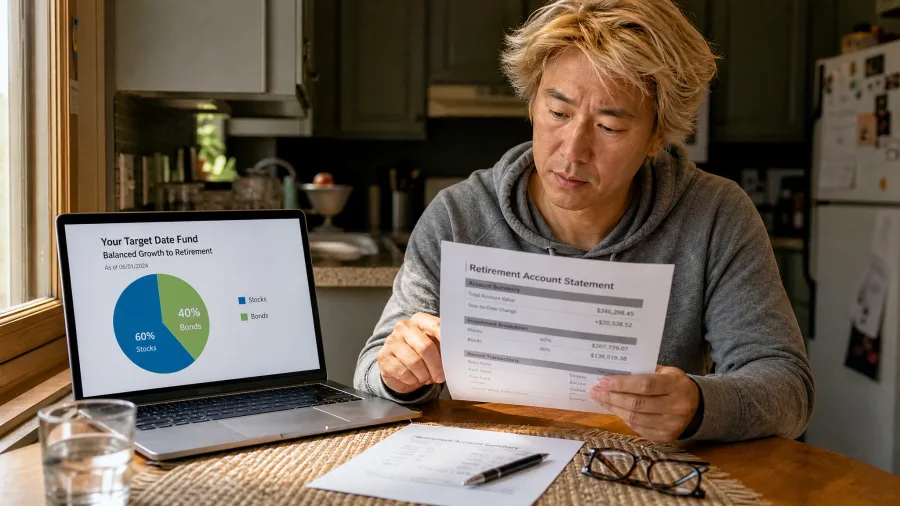
For 99% of people with a 401(k), the answer is a target-date fund: a professionally managed mix of stocks and bonds that rebalances itself to get more conservative as you near retirement. You do not have to pick a single stock. Pick the fund, set the contribution, and then the hardest part is leaving it alone.
Cashing out when you change jobs is the mistake that hurts most. A $10,000 balance cashed out at 30 can cost $50,000 to $100,000 in future value once taxes, penalties, and lost compounding are added up. Roll it directly into an IRA or your new 401(k) instead, and here is the catch: confirm the money actually gets invested. Some plans drop rollover cash into a money market fund and leave it sitting there for years. Also check the new plan's default savings rate, because a 3% auto-enroll versus the 14% you had can cost about $300,000 over a career.
No 401(k) at work? Open a Roth or traditional IRA at Fidelity, Schwab, Vanguard, Coinbase, Robinhood, or Acorns. The 2024 limit is $7,500 if you are under 50, so check the current IRS figure before you set the amount. Automate the transfer from checking the day after your paycheck lands, and check whether a retail job offers a 401(k) even if you plan to leave.
💡 Tip: Look up the expense ratio on your target-date fund. Anything under 0.20% is good; over 0.50% is worth a conversation with HR.
💡 PRO TIP
The 1% Trick That Beats Every Budget
If 12.5% feels impossible, start with 1%. You will not notice 1% of your pay, and after three months you can raise it to 2%. Do that every month and in a year you are at 12%. The plan works because it is automatic, not because it is heroic.
4. Build Safety, Use Index Funds, and Start Now

It is the week the car needs a new transmission, and that is exactly when you find out whether your savings have a safety net under them. Build one: put 3 to 5% of your income into a liquid money market account yielding about 4%, keep it separate from everything else, and touch it only for real emergencies. Then fund your dreams on a timeline. Money you need in one or two years stays in the money market, about five years goes into a balanced 60/40 stock-and-bond fund, and seven years or more can go into stocks.
For the long-term money, skip individual stocks and meme coins and put your core into a low-cost index fund like VTI, which holds about 3,600 stocks in one ticker. A few individual stocks are fine as a small slice, never as the whole portfolio. The math here is the whole point: $10,000 a year is $27.40 a day, and $27.40 a day invested for 40 years at the stock market's 100-year average of about 10% grows to $4,424,000. That is the food delivery, the Ubers, and the forgotten subscriptions.
Find your $27.40 anywhere you like, then run the 100-day challenge: $10 a day into a jar or savings account, just to prove to yourself you can do it. Starting late is not a disqualifier either. A couple each saving $20 a day, $40 total, for 15 years at a reasonable return can approach $500,000. The kids are independent by your 50s, the earning years remain, and it is a catch-up window most people waste.
💡 Tip: Run a 100-day savings challenge: $10 a day for 100 days equals $1,000. That is your first emergency cushion.
5. Clean Up Debt, Protect Your Family, and Act Today

Debt is exactly what makes that decision feel impossible, so run this cleanup plan. It is called DOLP, Done On Last Payment. Pull every credit card out of your wallet, print the statements, and write down each balance and rate.
Pay the smallest balance first regardless of interest rate, because the goal is to cut the number of cards fast, and each one is a trap with late fees and penalty rates. Automate the minimum on every card so you never eat a late fee, and call each company to move billing dates onto your payday. Skip store cards entirely; a 10% discount is not worth 25% interest. Treat 0% balance transfers as temporary, since one missed payment can reset the rate. Then protect the family with a fire drill: know where every account, password, policy, and will lives, because 6 in 10 people have no will, and a will locked in a safe deposit box may never be found.
A first home is still the biggest wealth builder, but it is not your dream home. Buy the smallest affordable place, even a studio or farther out; 40% of buyers get down-payment help from family, so ask. Now act, even badly: automate one hour a day for life, or start with $5. A $12,000 college card debt took three years to clear one payment at a time. The first move beats the perfect plan.
💡 Tip: Use a 13-folder file system: one folder per card, plus will, insurance, and accounts. Label them and keep them in one drawer.
How to Compare Renting vs. Buying Where You Live
Renting usually wins if you plan to move within three years, and buying usually wins if you plan to stay ten or more. But the only answer that matters is the one you calculate for your own zip code.
Start with the full monthly cost of owning, not the mortgage quote the lender hands you. Principal and interest are just the first line.
Add property taxes, insurance, HOA dues, and maintenance at roughly 1% of the home's value per year. A $1,500 mortgage payment can turn into $2,200 a month once those land.
That gap is real cash that used to sit in your pocket or your savings. If your rent is $1,400 and the true cost of owning is $2,200, you are $800 a month further from every other goal.
Now work out your break-even timeline. The question is simple: how many years before buying beats renting once closing costs, maintenance, and likely price growth are counted?
Be honest about the horizon. Most people underestimate how often they move, and a three-year plan rarely rewards a home purchase.
Expect to spend real money upfront, too. Closing costs typically run 2-5% of the purchase price, which is a large hole to dig out of if you sell soon after.
If rent is high and the down payment feels miles away, don't force it. Keep a separate dream account automated, even if it's just $20 a week, and revisit the numbers when your income, your savings, or your local market shifts.
40% of buyers get help with the down payment, from family or assistance programs, so it is worth asking what's available before ruling it out.
For current local figures, use a reputable online rent-versus-buy calculator or talk to a HUD-approved housing counselor. The rules and programs differ by city and state, so check the official source rather than a number a friend passed along.
When Collectors Call and There's No Extra Cash
When there is no extra cash, the first move is to protect essentials, not to satisfy the collector. That means housing, food, utilities, medicine, and minimum secured obligations come before any promise on a debt you can't fund.
Never pledge a payment you cannot make just to end a call. A broken promise can make things worse than an honest conversation.
The call itself can be managed. Request debt validation in writing, and ask for the original creditor, the amount, and the account details. Until they prove the debt is yours, you owe them nothing you have to act on.
Keep a log of every call. Dates, names, what was said, and the number they called from.
If a collector crosses a line, you can file a complaint with the Consumer Financial Protection Bureau or your state attorney general. That is a real lever, and it costs you nothing.
Meanwhile, keep automated minimums running on any active cards. Late fees are the last thing you need while you work through this, and a missed payment can hurt your credit for months.
A 0% balance transfer is not a fix if the payment is not sustainable. If you cannot cover the monthly transfer payment, you have only moved the problem.
Check official sources for any collection rule or legal protection, rather than trusting a number you heard. The rules change, and your state law may go further than federal rules do.
Frequently Asked Questions
What if I truly cannot save 12.5% right now?
Start with 1% of your gross pay. Set it automatically and add another 1% each month. Within a year you will be at 12%, and your spending will have adjusted without you noticing.
Should I pay off debt or invest first?
Capture any employer 401(k) match first because it is free money. Then focus on the smallest credit card balance while keeping minimums automated on the rest. Once the cards are gone, raise your investing percentage.
What is a target-date fund and why is it recommended?
It is a single fund that holds a mix of stocks and bonds and automatically becomes more conservative as you near retirement. It is professionally managed, so you do not have to pick individual investments. Most 401(k) plans offer one.
I am in my 50s. Is it too late to start?
It is not too late unless you give up. A couple saving $20 a day each for 15 years could approach $500,000. Your 50s are a catch-up window because kids are often independent and you still have earning years ahead.
How do I stop lifestyle creep from eating my raise?
Automate a raise split: when your pay goes up, immediately increase your automatic savings percentage. If you never see the extra in checking, you will not spend it.
Automate One Hour a Day and Let the Rest Follow
You do not need a perfect plan. You need one automatic move today. Open your payroll app or bank and set a transfer for 1% of your pay, even if that is $5 a week.
If you are stretched, start at 1% and ramp up monthly. If you have a 401(k) match at work, capture every dollar of it immediately. If debt is crushing you, build a $1,000 starter cushion first with the 100-day challenge, then automate the smallest card payment. The first move matters more than the perfect one.
Set Your First Automatic Transfer Now
Open your banking app and schedule a $5 transfer to savings for tomorrow. That is one hour a day in the making. Then reread rule two and pick your percentage.
