

Three-quarters of the world's richest people are entrepreneurs. Fifteen percent are investors. Seven percent inherited it. Three percent are athletes, entertainers or artists. And zero percent — not one — are people who simply earn a salary.
That breakdown is the whole argument in miniature. The first four groups own something: a business, a portfolio, a trust, a rare skill. The last group owns nothing but their time, and time is the one asset you can't get back.
So the question isn't how to earn more. It's how to start owning things on an ordinary paycheck. The answer is a split — 25-15-50-10 — that works whether you take home $2,000 a month or $6,000, because it's built on percentages rather than amounts.
By the end of this you'll know what each pot does, where to keep it, which account to open, and the exact first move to make on your next payday.
Wealth comes from owning, not from earning

Every single group at the top of the wealth list owns something. That's the whole pattern.
Entrepreneurs own businesses. Investors own assets. Inheritors own trusts. Athletes, entertainers and artists own rare skills nobody can outsource or automate. The percentages behind that list go roughly 75% entrepreneurs, 15% investors, 7% inheritors, and 3% athletes, entertainers and artists. Salaried employees? Zero percent. Not a small slice. Zero.
Here's the uncomfortable flip side of that: if you don't own anything, you're the thing being owned. Your hours belong to someone else's business, and the paycheck you get for them vanishes into food, shelter and transport before you've made a single decision about it. Rent, fuel, groceries, repeat.
But ownership isn't reserved for founders. A fund holding is ownership. A REIT share is ownership. A small side business, a freelance client list, a skill people actually pay for, all of it counts. The barrier was never really capital. It's the decision to convert some of your pay into things that keep paying you back.
That reframe matters before you look at a single percentage, because it changes what the 25% feels like. It stops being a bill you resent and starts being you buying a stake in your own future. Get that switch flipped first, and the numbers later in this split do the work for you.
One split that works on any paycheck
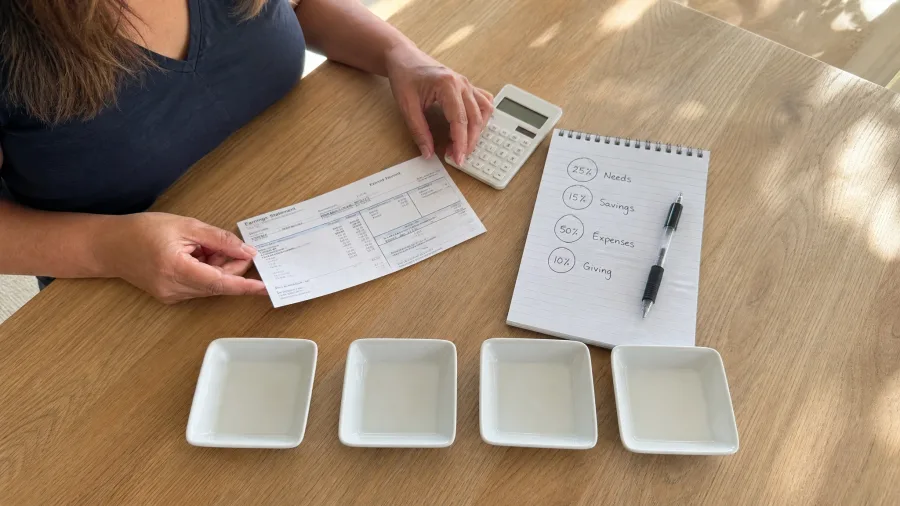
It's a four-pot split at fixed percentages: 25% growth, 15% stability, 50% essentials, 10% rewards. One rule, four jobs, and it works whether you earn a little or a lot.
Growth buys assets that go up in value and produce income. Stability is your buffer for the month that goes wrong. Essentials keep you alive and able to keep working. Rewards is the money you're allowed to enjoy without a scrap of guilt.
And it isn't a theory someone dreamed up last week. This split has been run for decades from a starting point of no money and no qualifications, and the reason it holds is simple: it doesn't care what you earn.
Run it on $2,000 take-home and you get $500 growth, $300 stability, $1,000 essentials and $200 rewards. Run the same rule on $6,000 and it's $1,500 growth, $900 stability, $3,000 essentials and $600 rewards. Same percentages, different scale, pots that shrink and grow together.
That's the whole argument for percentages over fixed amounts. A $500-a-month savings target breaks the moment you earn less. A 25% rule never needs renegotiating. It just scales with whatever lands in your account.
| Pot | Share of pay | What it does | Where it sits | On $4,000 a month |
|---|---|---|---|---|
| Growth | 25% | Buys assets that increase in value and produce income | Tax-advantaged investment account (ISA, Roth IRA, 401k) | $1,000 |
| Stability | 15% | Covers emergencies so you never sell investments at a loss | High-yield savings account, accessible within 24 hours | $600 |
| Essentials | 50% | Rent, groceries, utilities, transport, insurance, clothes | Your everyday current account | $2,000 |
| Rewards | 10% | Guilt-free spending on experiences and people you love | Separate 'joy jar' account with automatic transfer | $400 |
A quarter buys things that pay you back

Growth is money spent on things that go up in value and put money in your pocket. That's the definition, and it's narrower than people think.
Not a mindset course. Not a meditation app. Not some subscription promising to make you a better person. Assets. Things with a market value that tends to rise and a way of paying you while it sits there.
The mechanism is quiet. While you're at work, the assets are working too. A fund holding throws off dividends. A rental property collects rent. A side business brings in clients while you sleep. Give it long enough and those assets can out-earn the job that funds them.
The default paycheck cycle does the opposite. Bills get paid, the rest gets blown on things you can't remember buying, and at the end of the month you own nothing of value. That's why people on genuinely good salaries still feel broke. Salaries rise and the owning stays at zero.
So what if the 25% is only $50 in month one? Send the $50 anyway. The habit and the compounding both start earlier than the amount does, and the amount is the part you can change. The habit is the part that has to exist first.
Starting at 20 beats saving more later

Starting early beats contributing more, and two names make that point better than any argument. Meet Billy and Phil.
Billy starts at 20, putting $200 a month into an index fund for 40 years. He contributes $96,000 in total. Phil starts at 30, putting in $300 a month for 30 years, which comes to $108,000 contributed.
At a 10% average annual return, roughly the S&P 500's long-run average over the last century, Phil ends up with $678,146 at 60. Billy ends up with $1,264,816. Read that again. Billy put in $12,000 less and finished nearly $600,000 ahead, purely because he gave compounding ten extra years to work.
But here's the catch those big numbers hide. Ten percent is a long-run average, not a promise. Returns are nominal, they swing wildly from decade to decade, and a bad stretch right before you need the money hurts far more than a bad start ever does.
So if you're in your thirties or forties and that comparison stung a bit, the answer is still to start this month. Just hold a portfolio whose risk falls as the date you need the money gets closer, because you don't have Billy's forty-year runway to recover from a crash.
Billy invested $12,000 less than Phil and retired with nearly $600,000 more. Time did that, not talent.
— What compound growth actually rewards
Start at the safe end of the risk scale

Buy index funds first, and only climb higher up the ladder once you've actually sorted the bottom rung. That's where a beginner belongs.
Think of growth options ranked by risk. At the bottom sit index funds: you buy a share of the entire market, such as the S&P 500, you don't watch charts or time anything, and you let it sit and grow quietly. Next up is real estate, either a rental property if you have the capital or a REIT if you don't. A REIT lets you own a small share of a building alongside other investors, with no mortgage and no tenant to call.
In the middle sit skills. Copywriting, editing, sales, coding, anything that brings in income. A skill is the fastest return you'll ever see and nobody can take it off you, but it takes longer to build than clicking buy on a fund, which is exactly why it sits higher up. Pick one that maps to work you already understand, expect months rather than weeks, and pitch for your first paid job before you feel ready, because the market pays for evidence rather than certificates.
Above that, online businesses like dropshipping and digital products can pay off big, but they demand effort and a real tolerance for failing a few times before something lands. Individual stocks are a small hobby unless you've done genuine homework.
And the top of the ladder is speculation: Bitcoin, Ethereum, NFTs, gold, wine, sneakers. They can gain or lose value overnight, so never risk more than you can afford to lose.
The account you choose decides the tax bill

Put the money in a tax-advantaged account before you put it anywhere else, because the wrapper decides how much of the growth you actually keep. The account is the difference between the gains being yours and the gains being shared with the tax office.
In the UK, the stocks and shares ISA takes up to £20,000 a year and everything inside it grows tax free. You don't get it by accident: you pick it as an option when you open the account, so tick that box or the default cash version is what you end up with. A workplace pension is the other half of the UK picture. It typically takes 5% from you and adds 3% from your employer, grows untaxed, and is taxed when you withdraw.
In the US, the Roth IRA is funded with money that's already been taxed, grows tax free, and comes out tax free in retirement, with an annual cap of $7,000 for anyone under 50. The 401k comes out of your salary before tax, grows untaxed, and any employer match should always be taken, because that's free money on the table. One Roth IRA reportedly grew past $5 billion on early bets on PayPal and Facebook. That's proof of what the wrapper can do over decades, not a plan to copy.
Outside the UK and US, find whichever equivalent account your country offers, then confirm the current rules and limits with your tax authority or the provider, because these change.
Here's the mistake that wastes all of it. People open the right account, deposit every month, and leave the money sitting as cash. Uninvested cash in a tax wrapper is still cash, and it earns nothing.
💡 PRO TIP
A common expensive oversight
Opening the account is step one, not the finish line. If the money lands as cash and never gets invested, you've done the paperwork and skipped the part that grows.
Automate the transfer, then stop fiddling
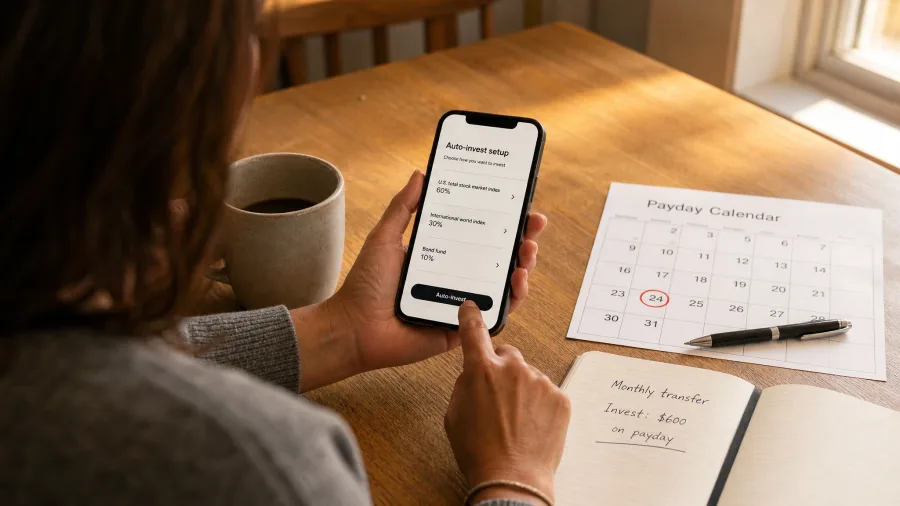
Automate a monthly transfer from your bank to the investment platform and date it to payday, so the cash never sits in your current account long enough to get spent. Pairing that transfer with a short Sunday money ritual keeps the rest of your cash flow from unravelling between paydays. Then set up the funds once and leave them alone.
The classic beginner portfolio is three funds. A US stock index fund, which is VTSAX if you're in the US. An international fund like iShares MSCI World, ticker IWDA, which covers Europe, Japan and Canada. And a bond fund like iShares USD Treasury 7-10yr, IBTM, for stability. Pick accumulation share classes rather than distribution, so dividends reinvest automatically instead of landing in your account as cash you'll spend.
Allocation is a dial, not a rule. 90% stocks and 10% bonds is aggressive. 80/20 is milder. The mix that gets demonstrated is 60% S&P 500, 30% world, 10% bonds. As you get older, bonds take up a bigger share, because you have less time to recover from a crash.
Now the upkeep a demo tends to skip. Check the fund's expense ratio and the platform's fee before you commit a penny, because a cheap fund on an expensive platform isn't cheap. Start at whatever monthly amount the fund's minimum allows. And rebalance roughly once a year rather than reacting to headlines, which is the whole point of automating in the first place.
A five-month buffer stops one bill wrecking it
You need a cash cushion of about five months of core expenses before you invest seriously, and the 15% slice builds it. List your core monthly costs first: groceries, rent, utilities, transport, work internet. That gives you a baseline. A $1,500 baseline times five is a $7,500 target, funded at 15% of every paycheck.
Why five months rather than two? Because problems arrive in clusters. A car repair, a medical bill and a dead laptop can all land in the same fortnight. With no buffer, an emergency means selling investments at the worst possible moment, and you lock in the loss exactly when you can least afford it.
One young man learned this at 18. He needed a car to get to work, so he borrowed for a used VW Golf, and used the extra to fit a new stereo. Three months later the engine blew. He borrowed again just to keep the job, and that debt cost him about a year.
If you're starting from zero, build a small starter cushion before the first investment, then fill to five months while the 25% keeps running. For most people the real problem isn't money itself. It's stability.
Stability Fund — At a Glance
🎯 Target
5× monthly baseline
💵 Example
$1,500 × 5 = $7,500
📆 Funded by
15% of each paycheck
⏱️ Access
Within 24 hours
🏦 Where
High-yield savings, FDIC insured
📈 Rate example
4–5% with no penalty
The rule
If the money isn't available within a day, it isn't a stability fund.
Where the buffer lives: fast, safe, earning

Keep the stability money in an account you can reach within 24 hours, with no market risk, that still pays interest. Those three rules run in order, and an account that breaks one of them isn't a buffer.
Speed comes first. No lock-ups, no notice periods, no early-withdrawal penalties, because the moment you need this money is the moment you can't wait for it. Then zero risk: not stocks, not crypto, not long-term bonds. The market may be down the exact week the boiler goes, and something that can drop 20% is not a buffer, it's a second problem.
It also has to earn something. Leave it in a current account and inflation quietly eats it while it waits. High-yield savings accounts were paying roughly 4-5% with no withdrawal penalty. Rates move, so check what's on offer today before you open anything, rather than assuming last year's number still stands.
The named options are SoFi, Ally and Marcus by Goldman Sachs, all FDIC insured. In the UK, look for an easy-access savings account from a bank covered by the Financial Services Compensation Scheme. Same rules, different names.
Three stacking tactics fill it fast
Run three tactics at once and the buffer fills in months rather than years. None of them is clever. The trick is doing all three every month instead of picking a favourite.
Start with the paycheck sweep. Move the 15% the second your income lands, automated with a standing order or scheduled transfer. You never see it in your spending account, so you never spend it. That's the whole mechanism, and it's why it beats willpower.
Second, the replacement promise. Say a $250 wing-mirror repair comes out of the fund. The next paycheck tops it straight back up, so a hit becomes a dent rather than a permanent hole. Third, save by spending. Round-up apps push the difference from each purchase into savings: $3.60 rounds to $4, and 40 cents goes in. Cash-back rewards from a card you pay off in full every month go to the fund too.
Once the fund hits target, decide what happens next before it gets there. You can roll the 15% into growth or redirect it to the rewards pot. Pick one now, so the money doesn't just drift.
Capping essentials at half forces the cuts

Because half your income is enough to keep you alive and working, and the ceiling does the cutting for you.
Here's the stat that should stop you cold: more than 60% of Americans who earn over $100,000 annually are still living from one paycheck to the next. Read that again. Six figures, and nothing left. So salary clearly isn't the variable being managed here. Spending is.
So what counts as an essential? Housing costs, food shopping, power and water bills, getting around, cover, and clothing. That's the list. It is not takeout on a Tuesday because you're tired, not the Amazon subscription you forgot existed, not the gym you haven't visited since January, and definitely not the four streaming services you keep meaning to cancel. Those live somewhere else, and somewhere else only gets 10%.
The method takes about an hour: open your bank statements and cancel anything that isn't helping you live, work or stay healthy. That's it. No spreadsheet gymnastics required.
And why 50%? Because ordinary households already spend 60 to 70% of income on what they believe is essential. Block lifestyle at half and the difference has to show up somewhere.
Picture two friends in a photo. One is wearing the designer shirt and the expensive watch and has $43.20 in his account with overdue credit card payments. The other has over $1,000 in investments and a buffer sitting behind it. Wealth is what you don't see.
Where the 50% line gets tested
Survives the cap
- Clothes for work, not the wardrobe refresh
- Insurance premiums, including the boring ones
- Transport that gets you to the job
- Minimum debt payments before the extra ones
- A $1,500 core month leaves $2,000 under 50%
Moves to the 10% pot
- Grocery spend that is really convenience food
- The second car used only at weekends
- Upgrades that arrived with a raise
- Anything you cannot name in one breath
- $200 of takeout on $2,000 essentials
Housing and transport are where the money is

Those two lines are where the real money hides, and both can be attacked head-on instead of nibbled at with small cuts.
Housing comes first. Renegotiate your rent every single time the lease ends. Landlords would much rather keep a paying tenant than go through re-listing, cleaning and showing the place to strangers, and even a rent freeze saves you thousands over a couple of years. Ask before you sign, not after.
House hacking goes further. Rent out the spare room, split a place with friends, or move back in with your parents while you build the buffer. Aim to keep housing at half the essentials pot or less, so the rest of the 50% has room to breathe.
Transport is the other big one. Car payments are one of the great wealth killers, right up there with a bad mortgage. Buy used and reliable, a car that's already taken most of its depreciation hit, and only step up to something nicer when it costs under half the essentials pot.
In a walkable city, dropping the car entirely frees hundreds a month across payment, insurance, maintenance and parking. Cutting small coffees doesn't come close to that number. Not close.
Rules, not willpower, decide the purchase

Three fixed questions replace willpower at the moment of temptation: is it an impulse, is it brand or value, and will it improve your life.
Question one: is this an impulse purchase? If it isn't, and it's on your essentials list, buy it and stop feeling guilty. If it is, apply the seven-day rule. Pause, then ask yourself again a week later. Most of the wanting fades in seven days. If it's still there, it might be real.
Question two: brand or value? Value is cost per wear, and the maths is brutal. Sixty-dollar boots worn a hundred times are 60 cents a wear. Two-hundred-dollar trainers worn twice are $100 a wear. A cheap shirt that comes apart after a wash is also waste, just cheaper waste.
Question three: will this improve your life, or is it for impressing someone or killing boredom? Buy the first deliberately and skip the second entirely.
Repeat those three a few times and they start running automatically. That's the whole point, and why the answer here is a system rather than a stricter budget. It's about being intentional, not being tight.
Ten percent is a strategy, not a weakness

You can spend on fun, and the plan actually depends on it: a deliberate reward fund is what makes the other 90% survivable.
Look at the numbers. 92% of people reportedly overspend after intensive saving sprints, and it's not hard to see why. Saving with zero joy feels like punishment, and a plan that feels like punishment gets quietly abandoned by March.
So spend the 10% on the highest-value categories: vacations, hobbies, nights out and experiences, and gifts for people you love. A vacation isn't a waste, it's health spending. One man ignored that for years and ended up with stress-induced shingles, and his first ski trip came shortly after the diagnosis.
The mechanics are simple. Open a separate account and nickname it your joy jar. Set an automatic 10% transfer every month, which is $200 on $2,000 and $1,000 on $10,000. Don't top it up from growth, stability or essentials. If it hits zero, you wait for next month, and that's fine.
When the pot is small, prioritise experiences over things. A ski trip with your wife, a theme-park day with your son, a golf weekend with friends, those outlast any car or designer gear by a mile.
⚠️ COMMON MISTAKE
The one rule you can't break
Never refill the rewards pot from growth, stability or essentials. If it's empty, wait for next month — that constraint is what makes the other three pots safe.
Then raise income and run the loop again

After the first month you run it again, because the four pots are a loop rather than a one-off budget, and the lever that moves all four at once is income.
The cycle goes 25 growth, 15 stability, 50 essentials, 10 rewards, and each pot feeds the next. Fill the buffer and it rolls into growth. Get a raise and every pot lifts in absolute terms without you changing a single percentage.
On $4,000 take-home that's $1,000 growth, $600 stability, $2,000 essentials and $400 rewards. Swap in your own number and the same four percentages tell you exactly where every dollar goes.
Why income beats stock-picking: the people who build wealth are the ones consistently putting more in over time, not the ones hunting the cleverest fund. That side-hustle money goes straight back into the 25%, not into the reward pot.
Once a year, sit down and review three things: the percentages against your actual spending, the fees on your funds, and the bond share as you get closer to needing the money.
The numbers behind the rule
When half your pay can't cover the rent

Add up what you actually spend on rent, food, transport and bills. That number is your real essentials figure, and if it's more than half your take-home, you don't have a 50% problem, you have a gap. The cap is a target to work towards, not a bill you owe, so there's no point squeezing your rent into a neat 50% on paper when it plainly doesn't fit.
Here's what not to do: don't wipe out the other three pots to make the maths look tidy. That leaves you with nothing growing and nothing set aside, so the moment things recover you're starting from zero again. Shrink all three in proportion instead.
On a $2,000 month, that might mean a $20 growth transfer instead of $100. Smaller, yes, but it still goes out, and the habit lives on until your income catches up.
The faster fix on a low wage is almost always the income side. The skill you're building in the growth pot usually moves the number more than one more round of cutting, because there's a floor to how little you can spend and no ceiling to what you can earn.
One thing to refuse outright: don't paper over the gap with a credit card. That takes a tight budget and turns it into expensive debt at exactly the wrong moment. Check official sources for any support you're entitled to before you assume there's nothing there.
Clear the expensive debt before the 25%

If the interest rate on your statement is higher than what you honestly expect the market to return, pay the debt first. That's the whole test. Anything in credit-card territory, say 20% or more, beats a stock market assumption of 10% every single time, and it beats it without any risk at all.
So while a balance is sitting there, redirect your stability contributions above a small starter cushion into the debt. Keep paying every minimum on time, because a missed payment costs you far more than the interest you're chasing.
That starter cushion matters more than it sounds. Keep a few hundred pounds or dollars aside so a flat tyre doesn't land back on the card the week after you've cleared it.
Once the balance is gone, switch that slot straight back to the stability fund and let it build towards the five-month target. If you skip that step, the system stays permanently unfunded and you're back here in a year.
And watch the trap: clearing the card, then running the balance straight back up. Once is a lesson. Twice means the spending pattern is the real problem, and no payoff plan fixes that. The questions you need to ask are about where the money goes, not how fast you can clear it.
📋 Set up the split in five steps
Open the stability account
Pick a high-yield savings account with 24-hour access and no withdrawal penalty.
Set the automatic transfers
Schedule 25% to growth, 15% to stability and 10% to rewards on payday.
Choose your growth funds
Pick an index fund, an international fund and a bond fund, using accumulation share classes.
Cancel unused subscriptions
Go through bank statements and cut anything that isn't helping you live, work or stay healthy.
Run the purchase questions
For any non-essential, apply the impulse check, the brand-or-value check and the life-improvement check.
Frequently Asked Questions
Does the 25-15-50-10 rule work on a low income?
Yes, because it's percentages rather than amounts. If 50% won't cover rent and food, start with your real essentials figure and shrink the other three pots in proportion — a $20 growth transfer still keeps the habit alive. The fastest fix is usually the income side, not another cut.
Should I pay off credit card debt before investing?
Compare the rate on your statement with what you expect the market to return. Credit-card rates are high enough that paying them off wins by a wide margin. Keep every minimum paid on time, hold a small starter cushion, then switch that money back to stability once the balance is gone.
How big should my stability fund be?
Five months of core expenses. Add up groceries, rent, utilities, transport and work internet to get a monthly baseline, then multiply by five. A $1,500 baseline gives a $7,500 target, funded at 15% of each paycheck.
Where should I keep the stability fund?
A high-yield savings account with 24-hour access, no withdrawal penalty and a rate that beats inflation. SoFi, Ally and Marcus by Goldman Sachs are FDIC insured examples that were paying roughly 4–5%. Rates move, so check the current one before opening.
What if I'm in my 40s and haven't started investing?
Start this month, but hold a portfolio whose risk falls as you get closer to needing the money. That means more bonds and fewer stocks than a 20-year-old would hold. The compounding is shorter, but the habit still beats waiting another year.
The first move is one automatic transfer
If you do nothing else this month, set up the growth transfer. Open a tax-advantaged account, choose an index fund, and schedule 25% of your pay to leave your current account on payday. Start with whatever the fund's minimum allows.
Then run the test. No buffer? Build the starter cushion before anything else. A card balance? Clear it before the 25% gets serious. Essentials eating more than half? Your next hour goes to bank statements and the cancel button.
The split works because it's a system, not a burst of willpower. Set the transfers, let the pots fill, and check back once a year.
Run the numbers on your own paycheck
Take your last take-home pay and multiply it by 0.25, 0.15, 0.50 and 0.10. Those four numbers are your next month's plan — and the first one is the transfer to schedule today.