

You wheel a flatbed cart out of the warehouse club loaded with fifty pounds of flour and four gallons of olive oil, feeling like you cracked the code to modern survival.
It feels like thrift. It feels like winning.
Then you spend the next six months watching three of those oil gallons sit dark and cloudy in the pantry while the flour grows weevils in the back corner.
The math only works if you actually use the stuff before it turns.
For households under four people, the giant packages are rarely a bargain—they are just an expensive way to store garbage.
Let us look at why the bulk discount is a trap for smaller homes, and how to spend less without renting a storage unit for toilet paper.
Quick Tips Before You Start
Check Your Storage
Measure your pantry depth before buying any multi-pack.
Track Use Rates
Write down how long a single jar actually takes your home to finish.
Split With Friends
Divide warehouse club packages with a neighbor instead of hoarding them.
Check Unit Prices
Calculate the price per ounce on the regular shelf before grabbing the giant size.
1. The Perishable Expiration Trap
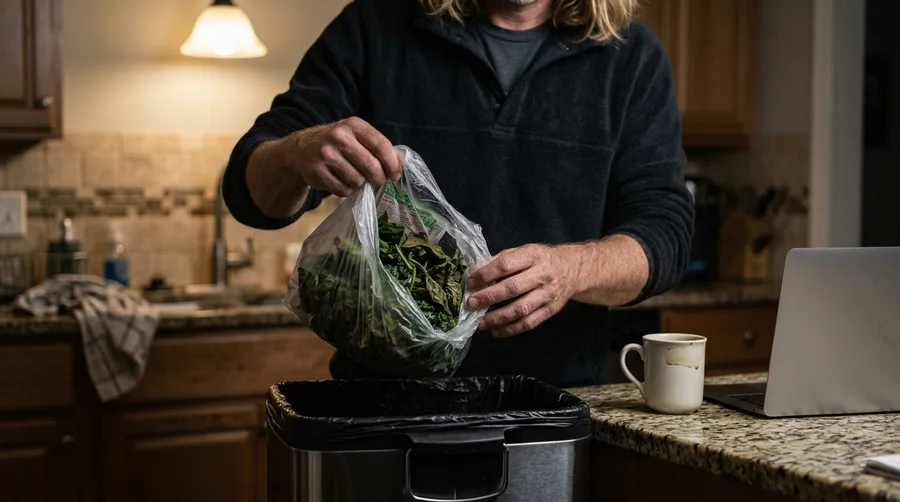
Buy the three-pound bag of organic spinach because the price per ounce drops by half compared to the small clamshell.
Half of it turns to green sludge in the crisper drawer by Thursday.
The math is brutal when food rots in your kitchen.
Saving 40 cents an ounce on greens means nothing if you throw away four dollars of slimy leaves into the compost bin, because the discount only applies to what actually gets eaten.
Fresh produce has a ticking clock that small households simply cannot beat alone, no matter how good your intentions were at checkout.
The trade-off is clear: you trade a lower sticker price for actual food waste, and your cost per edible serving ends up higher than if you had just bought the small, expensive bunch.
This week, check your garbage can before you shop to see what you are really paying for.
If wilting vegetables are a weekly feature in your kitchen, stop buying the family size entirely.
💡 Tip: Buy single-head produce for one or two people, even if the unit price is higher.
⚠️ COMMON MISTAKE
The Warehouse Club Membership Fallacy
Paying $60 a year for a membership only saves money if your annual volume offsets the fee. For a single person or couple, you often have to buy junk you do not need just to justify the card.
2. The Hidden Cost of Storage Space

You look at the massive pack of paper towels sitting right in the middle of your living room floor, and your home suddenly feels a little bit smaller than it did yesterday.
Your apartment has square footage that costs real money every month, meaning your living room is quite literally some of the most expensive warehouse space you could possibly rent.
If an extra-large bulk purchase forces you to live in frustrating clutter or drives you to look at a self-storage unit down the road, any upfront savings from the wholesale discount vanish instantly.
We solved this by setting up a simple two-shelf rule in our hallway closet: if a backup item does not fit on those specific shelves, it does not enter the apartment.
Keep your floors clear instead of turning your living room into a discount grocery aisle, and let your home breathe again.
The Bulk Math Reality
Federal Reserve and Consumer Spending Data
3. Altered Consumption Patterns

The common myth is that having more food in the pantry saves you trips and stretches every dollar further.
In reality, having three giant jars of peanut butter on the shelf subtly changes how fast your household consumes it, since abundance quietly removes all restraint and encourages casual waste.
When you own an industrial-sized box of snack crackers, you eat them simply because they are there rather than out of actual hunger, driving your monthly grocery waste up by roughly 15 to 20 percent.
Stop buying the mega-packs this week, and stick strictly to standard sizes that force you to treat the food as a deliberate choice instead of an endless supply.
Consumption Shift — At a Glance
🍫 Snack Intake
+35% higher
🥣 Portion Size
Unmeasured
📉 Net Savings
Wiped out
The Rule
Easy access to bulk snacks directly increases your household consumption rate.
4. Cash Flow and Upfront Tied Capital

I once walked out of a wholesale warehouse club with $185 worth of bulk olive oil and giant bags of oats, completely forgetting that my electric bill auto-drafted the next morning and left my account sitting at zero.
Sound familiar? People often fall into the trap of spending fifty dollars extra on bulk items during a Saturday grocery run, forgetting that cash was already earmarked for gas, groceries, or utilities for the rest of the week.
buying twenty pounds of coffee beans costs $160 upfront instead of $12 for a single bag, which quietly locks your available cash into a cardboard box in the pantry instead of keeping it in your checking account where an actual emergency can reach it.
The fix is to calculate your true monthly liquid needs before letting a warehouse club clear out your bank account on a Saturday morning, ensuring you never trade your financial safety net for a basement full of oats.
Keep your cash flexible rather than turning it into stale pantry goods you will never finish.
💡 PRO TIP
The Cash Flow Rule
Never spend more than 5% of your weekly grocery budget on bulk stock-up items that you will not finish in thirty days.
5. My Own Freezer Burn Mistake

We have all talked ourselves into buying far more than we can use because the upfront price looked impossible to pass up.
I bought a ten-pound log of ground beef at a wholesale club because the per-pound price was $3 lower than the local grocery store, shoved it into our small apartment freezer behind a stack of frozen pizzas, and completely forgot about it.
Six months later, I pulled out a grey, frost-encrusted brick that smelled like old cardboard and threw $45 straight into the trash, wiping out any savings I thought I made.
Next time you look at a massive wholesale package, check your actual freezer capacity first and ask yourself if you will realistically eat all of it before the quality turns.
6. When Your Numbers Need Professional Guidance

Sometimes household spending issues go deeper than a bad trip to the wholesale club.
If your monthly cash flow is so tight that buying a regular box of cereal feels stressful, no amount of bulk optimization will fix the underlying budget gap.
When debt minimums consume half your income and groceries are putting you on a credit card float, take a step back.
Sit down with a fee-only fiduciary or a nonprofit credit counselor to look at your actual numbers before buying another membership card.
Getting an objective pair of eyes on your fixed expenses changes the entire financial picture, turning an overwhelming maze into a solvable math problem.
Best For / Skip If
7. The Ticking Clock on Pantry Staples

Four months is usually the tipping point before giant bulk sizes stop saving you money and start costing you product.
Oils go rancid, whole wheat flour loses its flavor, and spices turn to tasteless dust because oxidation happens quietly behind cupboard doors.
That giant container of extra virgin olive oil you bought to save thirty percent starts tasting bitter by month four because sunlight and oxygen get into the plastic jug.
Buy what you finish in thirty days.
8. Can You Start With the $25 Floor?

Can you actually build a cushion when you only have a few extra dollars to spare at the end of the week?
You can, and it starts by setting aside just $25 a month instead of spending it on bulk goods you will never finish before they spoil.
Consistency beats warehouse club hoarding every single time because small, repeatable choices protect your cash flow better than massive upfront purchases that tie up money you might need for bills tomorrow.
If your grocery budget is tight this week, protect it by buying exact portions instead of falling into the bulk trap.
9. Quarterly Reviews and Pantry Audits

I used to dread the quarterly pantry sweep because it meant confronting three pounds of stale organic lentils I bought during a late-night financial optimization phase.
Every three months, pull everything out of your pantry and look at what actually got eaten instead of what you wished your household consumed.
You need to check three specific things during this audit: expiration dates, duplicate opened packages hiding in the dark corners of the back, and items that sat completely untouched since the previous season. When specialty flour and bulk spices sit past their prime, you are not saving twenty cents by buying the larger size; you are just paying to store future garbage.
Write down the exact dollar total thrown away.
Seeing that number in black and white cures the bulk-buying impulse faster than any lecture ever could. When I finally added up $45 of spoiled oats and rancid oils in one afternoon, the warehouse club membership suddenly looked a lot less like a bargain.
Adjust your shopping list based on your actual consumption reality, not on the comforting fantasy of being a household that bakes its own bread from fifty-pound sacks.
Check your shelves before buying more.
10. Automate Your Grocery Lists to Block Impulse Buys

Set up a strict digital grocery list on your phone and stick to it religiously before you step foot in any store.
End-of-aisle displays at big box stores are specifically designed to trigger impulse buys of oversized items you never planned to purchase, draining $30 or $40 from your pocket on things that often spoil.
Digital lists remove that in-store temptation by keeping your focus locked on exact quantities instead of browsing the aisles.
I used to wander without a list and lose track of my spending entirely until I forced myself to log every item digitally.
Takes about two minutes in your notes app before leaving the house, and it keeps your cart aligned with your actual cash flow rather than store marketing.
11. Is Buying in Bulk Ever Actually Worth It?

Is bulk shopping actually just a massive scam designed to make us spend more?
It is not a scam at all, but it is built strictly for large families or shared households working through massive volumes every single week. If you live alone or with a partner in a two-person home, the math flips completely against your bank account.
What I believe now is that buying less is often the smarter financial move. Take 15 minutes today to audit your pantry before you drive out to any warehouse club this weekend.
12. Give Yourself Permission to Scale Back

For a long time, I felt like failing at the $60 warehouse membership meant I was failing at basic adulting.
You do not have to optimize every single dollar of your household budget by playing wholesale warehouse games if it makes you miserable.
It is completely okay to walk past the bulk aisle and buy the regular single box of cereal, even if the unit math says you are paying an extra 12 cents per ounce.
The tiny extra cost of buying smaller portions is often cheaper than the $30 cart of oversized items that eventually goes bad in the back of the pantry.
Scale back without guilt when your lifestyle does not match industrial quantities, and pick just one small area to simplify by this weekend.
13. The Fallacy of Saving Money on Household Cleaners

It is completely normal to think buying giant cleaning supplies is always a smart move, and nobody should feel bad about having a crowded cabinet.
People often assume non-perishables like household cleaners or paper goods never go bad, so stocking up feels like free money. A gallon jug of dish soap looks like a bargain until it sits under your sink for four years. The reality is that giant plastic jugs degrade over time, pump dispensers break halfway through the bottle, and giant packs of paper towels absorb ambient humidity in small apartments until they feel damp.
You are not saving money if you throw half of it away.
I once bought a two-gallon refill box of floor cleaner because the price per ounce dropped by forty percent. It leaked into the cabinet, rusted the hinges, and I ended up throwing away half a gallon of degraded soap because the pump mechanism rusted shut. The math only works if you actually use the product before it breaks down or goes bad.
Buying in bulk here creates storage clutter and chemical degradation instead of actual savings.
Buy the standard size that fits your actual under-sink storage without creating a safety hazard. Keep your utility areas manageable this week instead of playing Tetris with industrial chemical jugs.
14. Why This Month is the Best Time to Reset

Cancel your warehouse membership auto-renewal right now before the annual fee hits your account.
Most families lose money on bulk buying because the yearly subscription cost sits around $60 to $120 before you even purchase a single oversized box of cereal. If you only save $40 a year on paper towels, that membership is quietly draining your actual cash flow instead of protecting it.
The timing matters because retailers rely on that automatic charge slipping past your notice while you are busy managing regular monthly bills.
Take control of your kitchen storage and your credit card statements today by turning off automatic renewals on any club card you did not use at least six times last year.
If you need those bulk items eventually, check your local grocery store sales or discount markets instead of locking your cash into a yearly fee.
15. My Own Shift Away From Warehouse Clubs
I canceled my wholesale club membership three years ago after calculating that I spent $120 a year in fees to save maybe $40 on olive oil and paper plates.
Switching back to standard grocery runs felt like a step backward at first.
Then our grocery bill dropped by $70 a month simply because nothing was rotting in the back of the pantry anymore.
Frequently Asked Questions
Is buying in bulk ever worth it for a single person?
Only for non-perishables with an indefinite shelf life like white rice, salt, or canned beans, provided you have adequate storage space and strong self-control.
How do I calculate if a bulk item is actually cheaper?
Always look at the unit price label on the shelf—compare price per ounce or price per single item rather than the total sticker price of the large package.
What should small households never buy in bulk?
Avoid bulk fresh produce, whole-grain flours that turn rancid quickly, cooking oils in massive jugs, and perishable dairy or meats that risk freezer burn.
How can I save money without a wholesale club membership?
Shop standard grocery store sales cycles, buy generic store brands, plan your weekly meals around seasonal produce, and use digital grocery lists to stop impulse buying.
Where to Go From Here
You do not need an industrial warehouse membership to run a smart kitchen.
Start with this week's grocery trip: buy only what your household will comfortably finish before next month, and keep your cash where you can actually use it.