

Most 401k advice is either too generic to act on or too complicated to follow. This is neither.
Your retirement money is on the line, and the rules are simpler than the finance industry makes them look. You do not need a team of advisors or a degree in economics. You need to know how to start, how much to put in, how to invest it, what to do when you change jobs, and which mistakes to avoid.
The payoff is real: a few percentage points of extra savings and a few tenths of a percent in lower fees can mean hundreds of thousands more at retirement. Here are ten moves that actually matter, in the order you should make them.
Quick Tips Before You Start
Start now, even small
A $100 monthly contribution started today beats a bigger one started in five years.
Capture the full match
Find your plan's match formula and contribute at least enough to get every dollar.
Check expense ratios
Low-cost index funds and target-date funds usually beat the expensive options.
Leave old accounts alone
Roll them over or consolidate, but never cash out just because you changed jobs.
Read the plan document
Match caps, loan rules, and early-withdrawal exceptions are all spelled out there.
1. Starting at 25 Beats 35 by $78,600

Starting early is the single biggest lever you have, and the math is almost unfair. Put $100 a month into a 401k earning 7% a year and by 65 you land at about $170,200 starting at 35, about $248,800 starting at 25, and about $359,450 starting at 18.
The gap does not come from contributing more, because the contribution is identical. It comes from compounding: the earlier dollars get more decades to double and redouble, and those later doublings swamp everything you add along the way.
That is the tradeoff nobody mentions. Start late and you can still get there, but you will have to put in more each month to catch up. In your 30s or 40s you cannot rewind the clock, so start today and automate the contribution so it happens without willpower.
💡 Tip: Set your contribution as a percentage of pay, not a dollar amount, so it rises automatically with your salary.
| Option | What happens | Taxes and penalties | Best for |
|---|---|---|---|
| Leave it with old employer | Account stays invested as-is | None now; taxes later on withdrawal | Small balances or good fund options |
| Transfer to new employer | Moves into new plan | None if done as a direct rollover | Keeping one login and one balance |
| Roll to an IRA | Moves to an individual retirement account | None if direct; taxes on withdrawal later | More investment choices |
| Cash out | Money goes to you | Income tax plus 10% penalty before retirement age | Almost no one |
2. Take the Full Employer Match First

The moment you sit down to set your contribution percentage is the moment most people leave free money on the table. Your employer's match is the closest thing to free money a 401k offers, and getting all of it is the first move, before anything else.
Employer match formulas run 50%, 100%, 25%, or none at all. Say you earn $100,000 and the plan matches 50% of contributions up to 6% of pay: you put in $6,000, they add up to $3,000. Not $6,000, and anything you contribute above that 6% earns no extra employer money.
So open the plan document or benefits portal and hunt down the exact formula and the pay cap it applies to. Then set your contribution to at least the percentage that captures every matched dollar, because anything less is a pay cut you chose.
Employer Match — At a Glance
💼 Match formulas
100%, 50%, 25%, or none
📊 The 50% match, line by line
$6,000 you + $3,000 them = $9,000
💰 Lowest contribution that captures it all
6% of pay
🚫 Where the formula lives
Plan document or benefits portal
✅ Match vesting
May take years – ask HR
Why it matters
A 100% match doubles each matched dollar; a 25% match adds 25 cents – check your plan.
3. Save 10% to 15% After Capturing the Match

Once the match is captured, the next question is where the extra money should go, and the answer is not automatic. You have three solid places for it: keep funding the 401k, use a Roth IRA for flexibility and tax treatment, or use an HSA or 529 if those fit your situation.
The right pick depends on your tax bracket, how much flexibility you want, and whether the money is strictly for retirement or for another goal like a child's education. Higher bracket today often favors the pre-tax 401k; wanting access and tax-free growth later can favor the Roth.
A common guideline is to save 10% to 15% of your pay for retirement, match included. Treat that as a target, not a ceiling.
do not let the match cap become your stopping point. Hitting 6% to get the match and then quitting leaves decades of compounding on the table. The match is the starting line, not the finish.
💡 Tip: Roth IRA contributions can be withdrawn anytime without penalty, which adds flexibility a 401k does not have.
💡 PRO TIP
The 10% to 15% Rule
After you capture the full match, aim to put away 10% to 15% of your pay for retirement. If that feels steep, increase by one percentage point each raise until you get there.
4. Skip Age Formulas and Diversify Broadly

You have heard the standard line about investing by financial objectives, risk tolerance, and age, and it is more complicated than it needs to be. Your 401k money has one job: grow safely. That's it.
That holds whether the money is for early retirement or a child's wedding, and your risk tolerance for retirement money should be low no matter how old you are, because you depend on it. So diversify across stocks, bonds, cash instruments, domestic and international funds, small caps, large caps, and the conservative and aggressive options in between.
A simple starting mix is 70% broadly diversified stock funds and 30% bond funds, then adjust as you learn. Do not go all-in on small caps in your 20s or all bonds in your 50s. Spread it out.
💡 Tip: A low-cost target-date fund does this diversification for you automatically—check its expense ratio first.
Investing Inside Your 401k: Simple vs. Overcomplicated
Simple and diversified
- Low-cost index funds or a target-date fund
- Mix of stocks and bonds across regions
- Same approach at any age
- Review once a year, then leave it
Overcomplicated and risky
- Chasing hot sectors or small caps only
- Switching funds based on headlines
- All bonds near retirement or all stocks in your 20s
- Paying high fees for 'expert' management
5. Don't Cash Out; Leave, Transfer, or Roll Instead

You have four options: leave it with the old employer, transfer it to your new employer's plan, roll it to an IRA, or cash out.
Cashing out is the one to avoid. Say you pull $10,000 before retirement age: you owe income tax on the full $10,000 plus a 10% penalty, so $1,000 vanishes to the penalty alone before the tax bill even lands, and the compounding on that money stops for good.
The other three options do not differ much in outcome, so pick whatever is most convenient. If several old accounts are cluttering your paperwork, consolidating them is worth the hour it takes.
Moving the money into your new employer's plan keeps one login and one balance to watch, which is a reasonable preference, not a rule. Just do not touch the cash.
Where Your 401k Money Goes When You Cash Out Early
6. High Fees Eat Hundreds of Thousands—Pick Cheap Funds

Diversifying broadly is one thing; paying a fortune for it is another. Every fund in your plan carries an expense ratio, and that is just the annual percentage quietly taken out of the fund's assets. You never see an invoice for it. It gets skimmed off the top before your return ever reaches you, year after year, whether the market is up or down.
Here is the math that should make you sit up. On a $100,000 balance, a 1% expense ratio costs you $1,000 a year. A 0.1% fund on the same balance costs $100. That $900 difference does not just vanish once. It compounds against you for decades, and over a full career the gap can reach hundreds of thousands of dollars. That is real retirement money going to a fund company.
So open your plan menu and compare the expense ratios of every single fund. Then favor the low-cost index funds and target-date funds. Cheap is not always best, but when two funds track similar things, the cheaper one wins by a wide margin over time.
💡 Tip: Your plan's fee disclosure document lists every fund's expense ratio—find it in your benefits portal.
The Cost of Getting It Wrong
7. Don't Borrow: Loaned 401k Money Stops Growing

Picture a Tuesday afternoon where the car dies and the mechanic wants $4,000 you do not have. Your plan allows a 401k loan, so you take it. That solves the afternoon. It does not solve the retirement math. The moment that money leaves the account, it is no longer invested, and it stops growing.
A plan may permit loans, but permission is not a recommendation. The whole point of the account is compounding, and a loan takes a chunk of it out of the game right when it should be working hardest. There is a bigger catch too: if you leave the job with an outstanding loan, the plan may demand fast repayment, and getting the rules wrong can turn that loan into a taxable withdrawal. Read the plan document before you sign.
The better move is build a small emergency fund first. If you are already in a bind, pause extra investing or cut expenses before you touch the 401k. Protect the growth engine.
📋 The Order of Operations for Your 401k
Contribute enough for the full match
Find your plan's match formula and hit the cap.
Aim for 10% to 15% of pay
Increase contributions with each raise until you get there.
Pick low-cost funds
Compare expense ratios and favor index or target-date funds.
Diversify broadly
Spread across stocks, bonds, domestic, and international funds.
Leave old accounts invested
Roll over or consolidate, but never cash out.
Check rules before early retirement
Review the plan document and IRS rules before any early withdrawal.
8. Early Withdrawal Costs Taxes Plus 10%—Leave It Alone
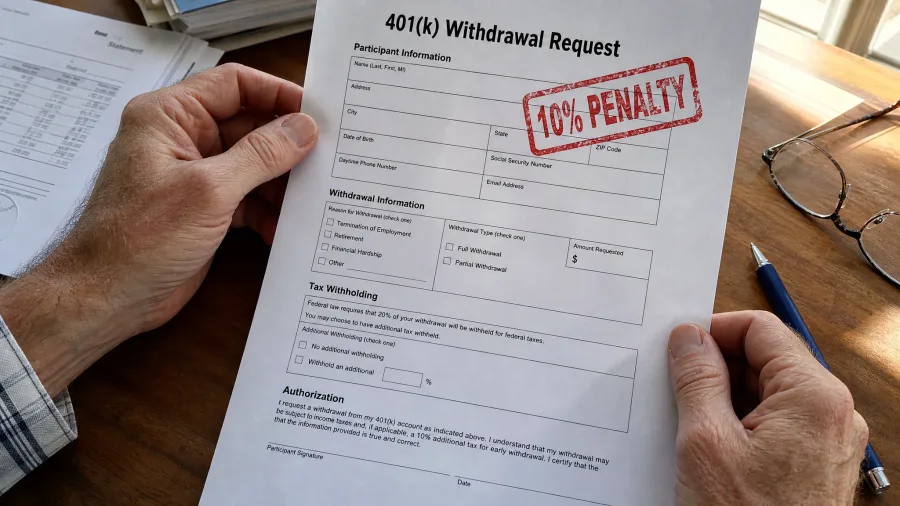
A loan at least comes back. A withdrawal never does, and that is the difference that should stop you cold. Take out $10,000 before retirement age and $1,000 goes straight to the 10% penalty, plus you still owe income tax on the full $10,000. That is a double hit before the money even reaches you.
The penalty applies before retirement age, with some limited exceptions you should check with your plan and the IRS rather than assume. And the lost compounding often stings more than the penalty itself, because that money spent its whole life meant to double.
Treat the 401k as a last resort. Ask about hardship rules before you touch it, and leave the rest to grow.
9. Raise Contributions With Every Raise and Barely Feel It

If you want to save more without wrecking your budget, stop waiting for the perfect month to start. The cleanest move is to raise your contribution percentage every time you get a pay raise. The raise does the funding for you.
A 3% raise on a $60,000 salary is $1,800 more a year. If you bump your contribution by one percentage point, that is about $600 going into the 401k. You still take home more than you did before the raise, and the increase is paid for before you ever get used to spending it. That is the whole trick. Lifestyle creep is what eats raises, so you have to beat it to the money.
Check whether your plan offers automatic annual escalation and turn it on. That way you do not have to rely on willpower every January. Then aim for at least one percentage point a year until you reach 10% to 15% of pay.
Keep it up long enough and the contribution jumps become the process, not the sacrifice. You adjust to the new number in a couple of paychecks, and your future gets richer quietly in the background.
💡 Tip: Set your contribution as a percentage of pay, not a dollar amount, so it rises automatically with your salary.
Know the Annual Limit and Catch-Up Rule

There are two limits you need to know, and they are not the same number. The employee deferral limit caps what you can put in from your paycheck. The total limit includes your employer match and other contributions on top. Mixing them up is how people accidentally over-contribute or leave room on the table.
Do not trust a number you remember from last year. Limits change, and they are adjusted periodically. Check IRS.gov and your plan's benefits portal for the current figure. Knowing the exact cap means you can plan your contributions to hit it evenly across the year, rather than accidentally maxing out in September and losing match money in the final months.
If you are 50 or older, catch-up contributions may be available. The amount and rules change, so verify the current figure rather than relying on what a coworker told you.
High earners should also ask whether the plan allows after-tax contributions. Not all do, and the rules are specific. Ask before you assume.
Retiring Before 59½ Needs Rule of 55 or SEPP

Because the whole trick to retiring early is getting at your money without setting a chunk of it on fire. So here's the hard part, and it's where a lot of people get burned: your 401k has an age lock on it, and 59 1/2 is the number on the door.
The 10% penalty isn't a suggestion. Pull $10,000 out at 50 and you lose $1,000 to the penalty, and you still owe income tax on the whole $10,000, so the real hit is worse than the headline. That's retirement money you just handed back.
There are two legitimate ways around it, and both come with strings.
The Rule of 55 lets you take withdrawals from the plan of the employer you left in or after the year you turn 55, penalty-free. Notice the catches: it only covers the plan you separated from, not some older 401k, and the plan has to actually allow partial withdrawals. Many don't.
The other road is a 72(t) SEPP, a series of substantially equal periodic payments. Set it up right and the penalty goes away, but you're locked into the schedule, and breaking it can trigger retroactive penalties that sting.
Get written confirmation from your plan and a tax pro before you rely on either. Plan rules vary, and the IRS rules are strict.
Frequently Asked Questions
How much should I contribute to my 401k to retire early?
At minimum, contribute enough to get your full employer match. Then aim for 10% to 15% of your pay. If you want to retire early, push toward the higher end and increase your contribution with every raise.
What is the difference between the employee deferral limit and the total 401k limit?
The employee deferral limit caps what you can contribute from your paycheck. The total limit includes employer match and other contributions. Check the current figures on IRS.gov and your plan's benefits portal.
Can I withdraw from my 401k before age 59½ without penalty?
In limited cases, yes. The Rule of 55 may allow withdrawals from the plan of the employer you left in or after the year you turn 55, if the plan permits it. A 72(t) SEPP may also avoid the penalty if done correctly. Verify both with your plan and a tax professional.
Should I roll my old 401k into my new employer's plan or an IRA?
Either can work. Rolling to your new employer keeps one login and one balance to watch. An IRA may offer more investment choices. The key is to avoid cashing out, which triggers taxes and a 10% penalty before retirement age.
How much do 401k fees really cost me?
A 1% expense ratio on a $100,000 balance costs $1,000 a year. A 0.1% fee costs $100. Over decades, the difference can reach hundreds of thousands of dollars, so compare expense ratios before you pick funds.
The Order That Makes the Biggest Difference
You do not need to get every detail perfect. You need to get the order right.
First, capture the full employer match. Then push toward 10% to 15% of your pay. Keep fees low by choosing inexpensive funds, diversify broadly, and leave old accounts invested instead of cashing them out.
Before any early-retirement move, check the plan document and IRS rules. The Rule of 55 and 72(t) SEPP can work, but only if you follow them exactly.
Do those things and your 401k will do the heavy lifting for you.
Check Your Match and Fee Today
Log into your benefits portal, find your employer match formula, and compare the expense ratios of your funds. Two minutes now can mean thousands later.