
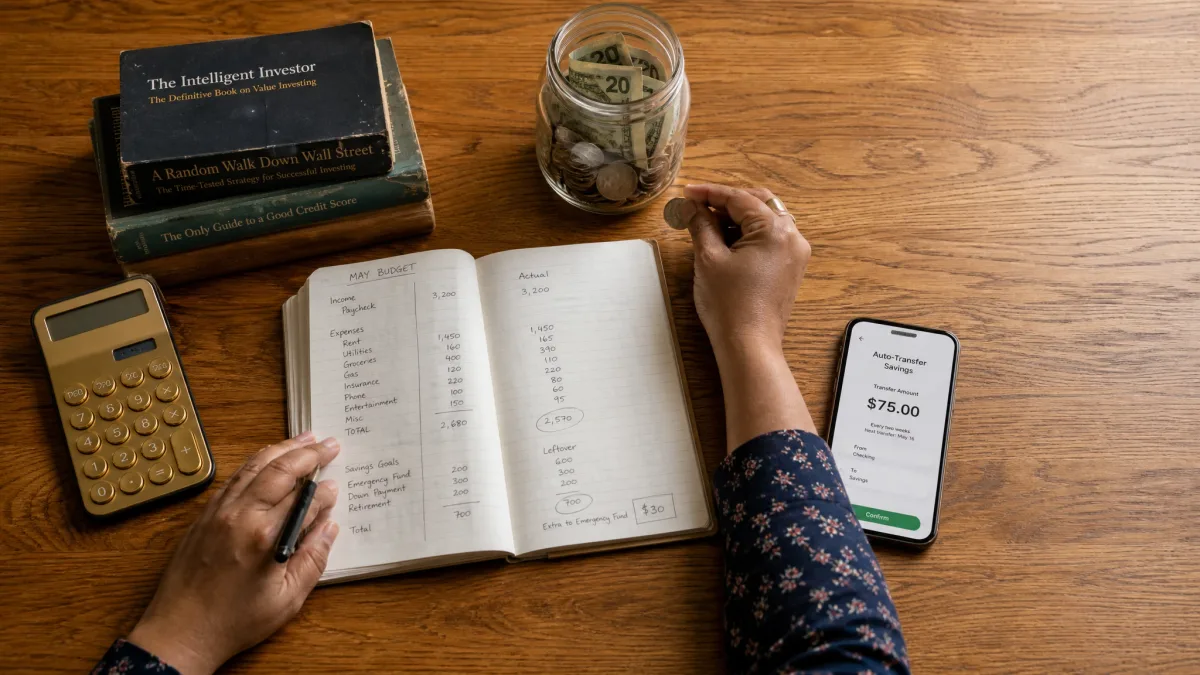
Every headline says the same thing: now is a terrible time to make money. The market is weird. Housing is impossible. Your paycheck barely moves. You've heard it so often you've started saying it yourself, and you keep waiting for the market to get better before you do anything.
Here's the thing. Wages have grown about 2x over a lifetime while housing grew about 9x. That gap is real, and it's not your imagination. But the people who build wealth in messy markets aren't waiting for a clean one. They're buying when things are on sale.
Austin housing is down about 30%. A famous NFT that sold for $60 million at the peak trades near $19,000 today. That's what a sale looks like when everyone else is panicking. The rules below are the ones school never taught you, and each one comes with a first move you can make this week.
Quick Tips Before You Start
Check the math, not the vibe
Run the rent-versus-buy numbers on paper before you accept anyone's 'always buy' advice.
Get one credit card
Pick a major-bank card with no annual fee and pay the full balance every month.
Automate 10%
Set an automatic transfer of at least 10% of after-tax income into investments on payday.
Skip the status buys
If you can't afford it without buy-now-pay-later, you can't afford it.
Name your limit out loud
Before a night out, tell friends you're paying only your share.
1. Buy Fear and Rent When the Math Wins

That gap between wages and housing prices is why waiting for a better market is the most costly thing you can do right now, because the sale is already happening while everyone else insists it's a terrible time to buy anything.
Wages grew roughly 2x over a generation while housing grew about 9x, so the money in your pocket buys a lot less house than it did for your parents. The buying rule here is old and blunt: get scared when everyone else gets greedy, and get greedy when everyone else gets scared. Baron Rothschild put it as buying when there's blood in the streets, especially your own. It feels wrong in your gut, and that discomfort is the whole reason it pays.
Look at what's actually marked down this minute. Austin housing is running about 30% below its peak, and an NFT that sold for $60 million now trades near $19,000. Those are assets on clearance for people paying attention, not proof that money is impossible to make. The catch is that you have to act while the mood is ugly, because by the time the news calls it safe, the discount is gone.
Then comes the home question, and the numbers genuinely don't favor forcing it. Mortgage rates sit around 5 to 8%, the US is short about 3 million homes, wages are flat, and plenty of rental markets have more supply than tenants. Renting can be the smart financial call, not a sign you failed at adulthood. Before deciding, run the numbers on whether renting is throwing money away instead of trusting the slogan. Use that supply: before you renew, ask your landlord for a lower rate and get competing quotes from nearby buildings, because a landlord who wants to keep you will negotiate. Put the difference between rent and a mortgage into investments instead of chasing a down payment you can't quite afford.
💡 Tip: Set a calendar reminder 90 days before your lease ends. That's when landlords are most willing to cut a deal to avoid a vacancy.
🌱 GROWING TIP
Let the market come to you
Keep a short watchlist of things you actually understand and check prices monthly. When everyone else is panicking, you'll already know what a good deal looks like.
2. Learn Money's Language and Use Credit as Leverage

Not a hot stock tip. You need to speak the language of money, because you can't make more of something you don't understand.
Here's a quick test: do you know the real difference between a debit card and a credit card? The average American reads at about a sixth-grade level and handles finances at roughly a high-school level, so most people never had it explained. Debit cards build no credit history, earn no rewards or cashback, and give weaker fraud protection. If someone drains your debit card, the bank treats the missing money as your problem. Credit card fraud gets reversed in a couple of clicks.
Credit cards only turn dangerous when you carry a balance, rack up interest, or use them for wants over needs; pay in full every month and they're just a tool. Get any major-bank card early, even for your kids in high school, and don't obsess over perks. Think of it as a ladder: resources, then knowledge, then wealth, then investing. Keep debit for cash withdrawals, and know that wealthy people use debt secured by assets, never personal guarantees.
Debit vs. Credit: What They Actually Do
Credit card (paid in full monthly)
- Ladder rung: credit history is graded by length of account, not spend
- Skip the annual-fee perks card until you clear a no-fee one for 12 months
- Dispute clock: issuers must resolve billing errors in 60 days
- Liability capped at $50 on unauthorized charges
Debit card
- Zero credit file means zero score, even with a perfect paycheck
- Rewards paid on debit usually require a linked checking balance
- Liability rides on when you report: $50 within 2 days, $500 beyond
- Overdraft fees hit here first: keep cash withdrawals to the ATM
3. Keep Your Paycheck While Building With Other People's Capital

Credit is the first rung, but the bigger climb is earning, and here the myth flips: you don't need your own money to start a business. You suffer from not knowing how to get money, not from a lack of it, and the richest people rarely fund everything from their own cash. What you need is access to capital, not capital itself.
You also don't have to quit to go find it. Roughly nine in ten startups go under within any given five years, yet founders who kept an income while building had a 33 percent higher success rate, because fear-driven decisions sink companies and a steady paycheck lets you think clearly. So build on the side until your side hustle's cash flow covers your living costs, then leave. Make it a profit project, not a passion project.
If you want to lead, pass the CEO test: sell a dream big enough that talent wants to join, diagnose the world the way a doctor does, and decide well under pressure. As an employee the same logic pays. Ask your boss how your work becomes revenue and how you could make more of it; if a $100 sale yields $20 profit, ask to keep $5 of that $20 for what you brought in.
That conversation beats jumping ship. Staying and diagnosing your pay can land a 25 to 50 percent raise, while job hopping used to bring 20 to 25 percent. The catch is that you have to actually ask, with a number and a reason, not just hope someone notices.
📈 From Side Hustle to Full-Time Business
Keep the job
Never quit before you have a product or service someone has already paid for.
Fund it with salary
Put at least 10% of after-tax income into the venture and keep 3-6 months of expenses untouched.
Prove profit
Track unit economics: if a $100 sale costs you $80, you have $20 profit to reinvest or pay yourself.
Match your living costs
Wait until side-hustle cash flow covers 100% of your monthly living costs for 6 straight months.
Leave when it's stable
Quit only after the business replaces your salary and has a buffer of 6 months of business expenses.
4. Leverage, Rules, Fixers, Signals, Partners, and Risk Build Wealth

Picture the moment you're grinding through a sixty-hour week and wondering why the guy who owns your laundromat, who works just as hard as Jeff Bezos, isn't worth billions. That's your answer. Hard work alone doesn't build wealth, and with AI making mid-level execution common while online creators grew 47 percent in a year, effort alone matters even less. Naval put it well: don't graze like a cow nonstop; be the lion, sprint and rest. And passive income is a myth, since vending machines break, get broken into, and only pay at scale. About 87 percent of Americans dislike their work, which is why they chase an idea that doesn't exist.
What separates people is a handful of practices. Don't monetize your hobby; love the game of business and pick boring industries over glamorous ones, since the Airbnb founders weren't passionate about mattresses. Look at the numbers: SAG-AFTRA has about 187,000 members, over 80 percent don't qualify for health insurance, and the average actor earns around $23,000, while about 99 percent of people in finance earn their full income from the job. Respect the rules too. In Monopoly you need a full color set, then four houses before a hotel, and the algorithm isn't fair but it is the rule. Be a fixer, not a freeloader: when the boat leaks, patch it, say it's my fault, and solve your boss's biggest pain point.
Who you surround yourself with matters as much as any spreadsheet. Friends earning over $100,000 correlate with about 10 percent higher earnings and 2.9 to 5 percent more investing, the same way CrossFitters beat party people at getting in shape. Say your limit out loud before a night out. And watch the signals: after 9/11, lipstick sales rose 11 percent, because people cut big luxuries and keep small ones, so a beauty spike can hint at a downturn.
Partners count as a money move, too. Married couples earn about 30 percent more and build nearly three times the net worth of singles, and 64 percent of women say they won't date a man earning less. Find someone playing a different game, and remember money is a neutral accelerator, good in good hands and bad in bad ones. On dates, the asker pays or offers, and it's better to win than to be right. Have the hard conversations and sign the prenup, and pair a visionary with an implementer.
Finally, seek big problems with manageable risk, what you might call hair on the deal. More small businesses close each year than open, which tells you people are too risk-averse, not too bold, so the move is a real bet you can survive, not a lottery ticket.
💡 PRO TIP
Say the awkward thing once
Tell friends before the night starts: I'm saving hard, so I'm covering just my share. You'll often find someone else in the group has been waiting for permission to say the same.
5. Invest in Yourself, Automate Index Funds, and Skip Status

This is the investing rung, and the first dollar you keep should go into you. With little money, your own upside is unlimited and it compounds, so put the first chunk into learning before you put anything into the market.
After that, go low-cost and low-turnover. Index funds tracking the S&P 500 through something like Vanguard, which charges no fees on its trading platform, beat trying to pick stocks, so avoid single-stock bets unless you're fine losing it all. A diversified portfolio runs roughly 60/40 stocks and bonds mid-career, or 80/20 if you're younger, spread across the US and emerging markets like India, China, Russia, and Brazil. Long-run averages land near 10 percent, and $100 held since the 1970s is worth about $25 today.
Know what you own. A stock is upside in a company, like buying at $10 and hoping for $15; a bond is lending $100 for a promise of $120 over five years, clipping coupons either way. Hold both so bonds pay when stocks crash and stocks capture the good years. Then follow the stages: yourself, public index funds, private and alternative assets, then owning or building the company. Day trading and options are pro tools, not side hobbies. Pay yourself first by automating at least 10 percent of after-tax income.
And stop spending to look rich. Most Coachella influencers are paid to be there, while about 64 percent of ordinary ticket holders used buy-now-pay-later because they couldn't afford the ticket. The goal is being rich, not looking it.
💡 Tip: Set the automatic transfer for the day after payday, not the end of the month. What's gone before you see it doesn't get spent.
Frequently Asked Questions
Should I buy a house right now?
Run the math for your city. With mortgage rates at 5 to 8%, a shortage of about 3 million US homes, flat wages, and excess rental supply in many markets, renting can be the smarter financial call. It doesn't make you a failure; it makes you someone who did the math.
Is it bad to use a credit card?
Only if you carry a balance, pay interest, or use it for wants instead of needs. Paid in full every month, a credit card builds your credit history, earns rewards, and gives you stronger fraud protection than a debit card.
How much should I invest each month?
Automate at least 10% of your after-tax income into a diversified index-fund portfolio. Set the transfer for right after payday so it happens before you can spend it. If you do that consistently, you're ahead of most people.
Do I need a lot of money to start a business?
No. What you need is access to capital and knowledge of how to get it. Keep your job, fund the venture with your salary, and wait until side-hustle cash flow covers your living costs before you leave.
What's the difference between a stock and a bond?
A stock is a bet on a company's future upside, like buying at $10 and hoping for $15. A bond is a loan, like giving $100 for a promise of $120 over five years, and it keeps paying whether prices move or not. Hold both so one covers the other.
Your First Move Depends on What You Already Have
Pick your starting point by situation. If you have no credit, open one major-bank card this week and pay it off in full every month. If you have a little cash but no investments, automate 10% of your after-tax income into a low-cost index portfolio and leave it alone.
If you have a side hustle, keep the paycheck until the hustle covers your living costs, then decide. Knowing which money move comes first keeps that paycheck working in the right order instead of scattering it. And wherever you are, stop buying things to look rich. The people you're trying to impress aren't paying your bills.
That leaves one rule to apply this month: buy when others are fearful, starting with the smallest asset you control, which is you.
Pick one move and do it today
Open your banking app and either apply for a major-bank credit card or set an automatic 10% transfer. One click now beats a perfect plan next year.