

The example household brings home $4,200 a month – and already $2,450 of it is spoken for before anyone opens a fridge.
You know the rest of the story. The budget app was fine on the 1st, and by the 20th you were filing it under discipline, as if the problem was you. It usually was not. Six envelopes holding $1,020 cannot pay a $1,450 rent, a spreadsheet cannot stop a purchase it only records afterward, and a 50/30/20 ratio cannot see a $500 grocery line coming. The method broke, not the person using it.
So the five methods are ranked on two questions only: what each one keeps asking of you after setup, and how much of your real spending it leaves unmanaged. Worth the effort means it survives a real month, not a clean planner page.
By the end you will know which of the five fits your month, and the one dollar amount to move this week.
Quick Tips Before You Start
Write down fixed bills first
Rent, car payment, student loan, insurance, phone, utilities: $2,450 before any method gets a vote.
Test it for one full month
A method that has not survived a 30-day cycle with an irregular week in it has not been tested.
Automate before you track
One automatic transfer beats twelve categories of data entry you will abandon by the 20th.
Keep one review date
Pick a single day, set a phone reminder, and look at three numbers only.
Round everything
The $4,200, the $400, the $200 twice a month: round numbers you can recall beat decimals you have to look up.
1. Cash envelopes break on online bills
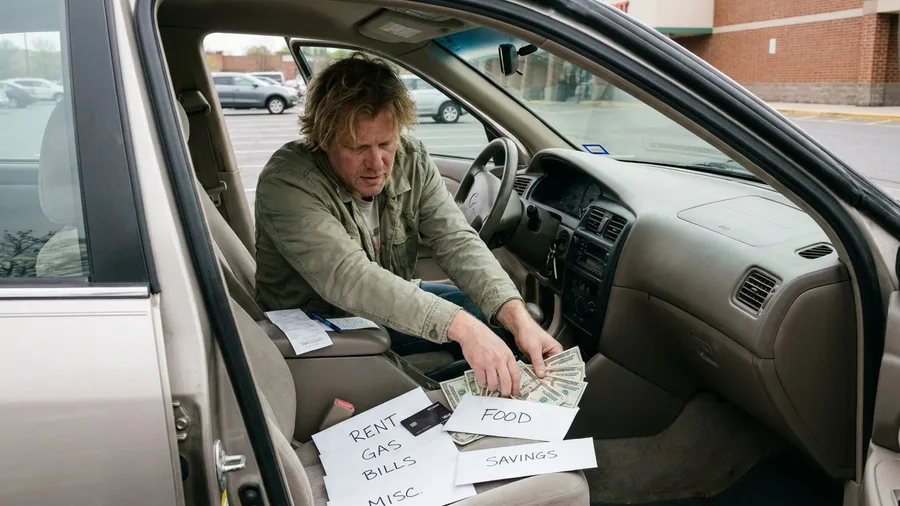
Pull out the receipts on a Friday night and count the envelopes: whatever cash came home short is gone, and no app will ever show you where. That is the check-in this method actually allows, and it tells you something a spreadsheet cannot. If the shortfall keeps landing on groceries, you are watching the $500 line drain without a single record of what took it, and by week two of the next month you are refilling the same envelope out of the same account.
Six envelopes hold $1,020 in total – groceries $500, gas $160, dining $120, household $100, personal $80, and $60 for the kids – refilled on a weekly ATM run. Against that sits $2,450 of fixed bills that never pass through a hand: $1,450 rent, $140 for the phone and internet, the subscriptions, the car insurance renewed online. Those leave by card or transfer, outside the envelopes, unmanaged. So the cash-in-hand fight covers a slice of the month, and the biggest payments float past it untouched. A digital envelope system can hold those card and transfer bills while still forcing spending awareness.
💡 Tip: If you try envelopes anyway, keep only the dining and personal envelopes in cash at $120 and $80, and leave groceries on the card.
| Method (rank) | Monthly effort | Best for | Where it breaks |
|---|---|---|---|
| 5. Cash envelopes | Weekly ATM trip to refill six envelopes | In-person spending leaks only | Online bills and card payments sit outside it |
| 4. Spreadsheet tracking | 15-20 min a week, 12 categories | Detail-minded readers | Records spending after the money has left |
| 3. 50/30/20 | One setup decision, then nothing | A first method after no tracking | No line inside the buckets, so overspend hides |
| 2. Zero-based budgeting | 60-90 min at the start of each month | Steady, known income | An uneven paycheck makes the plan stale fast |
| 1. Pay-yourself-first | About 20 min once | Discipline on cards already in place | No ceiling on the remaining $3,800 |
⚠️ COMMON MISTAKE
Cash cannot pay your rent from a wallet
The $1,450 rent, $140 phone and internet, subscriptions and car insurance all leave by card or transfer no matter what the envelopes say. A method that does not include your biggest fixed bills is not managing your money, it is managing your pocket money.
2. Spreadsheets tell you after the fact

Tracking spending in a spreadsheet is a record, not a budget, and the difference is timing.
Envelopes fail because they can't hold the bills that leave by card and transfer. A spreadsheet can hold anything, so coverage is not its problem. Here is the move in one flat sentence: you open the sheet on a set day each week, log the last seven days of spending across 12 categories, and it takes 15 to 20 minutes. That is the whole ask, and it is the same ask every week for as long as you keep the budget. It is not an unreasonable amount of time. It is just a task that has to happen forever, on a schedule, before the report is accurate.
Now the timing. Every entry goes in after the money has already left, so what you build is a faithful map of the past. The grocery line will show $500 for the month, and it will show $500 only once the $500 is spent. That is a good report on the same $4,200 household the rest of this list is built around. It is not a brake.
The gap between knowing and deciding is where this method earns fourth. The $500 grocery total finishes getting committed in week two, a cart at a time. What the spreadsheet does is surface that finished number on the 28th, when three days are left, the account is thin, and nothing in the sheet has the power to undo a purchase from a fortnight ago. You find out on time and too late at once.
What keeps it off the bottom is a single condition, and it is a real one. For a reader who genuinely opens the sheet twice a week, the spreadsheet is the cheapest option here and the most flexible, because there is a line for anything. A one-off $180 car repair, a $60 school fee, a category that exists for one month and never again. It bends to the spending instead of forcing the spending into six slots, and that counts for a lot in a month that does not repeat itself.
So who it suits: detail-minded readers with irregular categories and no allergy to data entry. They get full coverage, moderate recurring effort, and zero prevention.
The effort is 15 to 20 minutes, twice a week, forever, and it buys you hindsight with everything visible in it. If the idea of a weekly 15-minute log makes you tired before you start, that is real information. It means this method will not be the one still running for you by month three.
💡 Tip: Set a repeating two-minute calendar block on Sunday evening. A spreadsheet opened on schedule beats a better spreadsheet opened in a panic.
🗓️ Zero-Based: A Month From Start to Finish
Gather the last two statements
Pull two months of bank and card statements so every category has a real number behind it.
List the $2,450 of fixed bills
Rent $1,450, car $310, student loan $220, insurance $180, phone and internet $140, utilities $150.
Fund savings at the top
Allocate the $400 savings goal before anything flexible gets a dollar.
Set aside sinking funds
Move $75 for car repairs and $60 for holidays monthly so the repair bill is not a surprise.
Allocate the rest to zero
Assign every remaining dollar in the $4,200 to groceries, gas, dining, household and personal lines.
Do the mid-month check
On the 15th, compare two or three lines against the plan and move money before the month decides for you.
3. 50/30/20 is simple but too coarse

One sentence does the whole thing: $2,100 to needs, $1,260 to wants, $840 to savings and extra debt paydown.
That is 50/30/20 on $4,200, and it deletes the logging entirely. No weekly session, no cash run, no twelve-line ledger – just three numbers you can carry in your head through a busy month. The cost after setup is close to zero, which is why it outranks every method that asks for a task you can skip.
What the ratio hides is everything inside the buckets. There is no line for groceries, gas or dining in any of the three, so a $120 dining month quietly becoming $260 sets off nothing. It gets absorbed into the 30% and disappears, and you never feel it happen.
So treat it as the start, not the finish. Pick one category you already know is loose and watch that single number for the next 30 days, without building a whole system around the rest. That one watch is the whole assignment. If you want it tighter still, make the $400 savings goal the first $400 you move on payday, before the ratio has a chance to eat it.
The honest limit is a $1,260 wants block that may need to shrink. With variable income, or a credit card balance carrying interest, the ratio gives you no mechanism for shrinking it – and if the balance is real, run the split against your own numbers before you trust it.
💡 Tip: Rewrite the three buckets as seven lines once: needs become rent, car, loan, insurance, utilities; the rest stays a bucket.
4. Zero-based budgeting buys control with time

The calendar is the trap here, and it comes for you on a bad month.
Most people dread zero-based budgeting because sixty to ninety minutes at the top of every month sounds like homework that never ends, and one blown evening with the numbers feels like proof they cannot do it. When it holds, though, a planner sitting down with a full $4,200 working sheet can name every dollar before it leaves, and that visible accounting is what makes saving feel within reach rather than lucky. There is also a type of person for whom the session becomes a monthly ritual they actually keep.
Strip the dread away and the work itself is simple. Two figures do the heaviest lifting in that sheet, both tiny and both monthly: $75 for car repairs and $60 for holidays. Those sinking funds are the mechanism that a single growing account cannot match, since money set aside by name cannot be quietly absorbed when something else asks for it, and an unexpected repair bill stops being the emergency that throws you back to a blank sheet with nothing set aside for it. The car payment of $310 is no longer the only car cost planned for when the repair finally lands.
The $400 savings goal in this planning goes at the top, funded the moment the plan is built, instead of being whatever is left at the bottom of the month. The real cost of that is a calendar that will not move, because when the paycheck changes size or date as the months go by, the plan goes stale long before the next session, leaving every dollar dedicated to a month that has already changed. As a practice, this method keeps nearly everything tracked and gives you real control, but one bad month can knock the whole thing off course. Readers worried about that time cost should see how little zero-based budgeting really takes.
💡 Tip: If your income moves around, budget on the lowest reliable month and treat anything above it as unbudgeted until it lands.
Where These Methods Quietly Fall Apart
5. Automation wins because it needs no willpower

One with nothing due on it after setup. The monthly review or weekly logging can be skipped and nothing breaks, which is why it survives a month that goes sideways. Set a transfer of $200 on the 1st and again on the 15th, $400 in all, with about 20 minutes of setup once, and $3,800 stays spendable out of the $4,200.
Why this matters now: the $400 savings goal is met before any spending decision gets made, and waiting does cost something. Moving the transfers to the start of the month means less of the paycheck is exposed to the 20th, so the compounding clock on your savings starts sooner. That is the trade-off worth naming: the method has no ceiling inside the $3,800.
If you carry card balances, the leftover is not safe to leave unmanaged, and uneven paychecks will turn a fixed transfer into a returned payment and a fee. On a known, steady income, this method is the one that survives every bad month without a single meeting.
💡 Tip: Schedule the transfer for payday morning, not the last day of the month. Same amount, completely different survival rate.
💡 PRO TIP
Pick the method by your weak spot
If your leak is online spending, skip envelopes and use automation. If your leak is invisible categories, keep the spreadsheet but add the automatic $400. Match the method to the failure, not to the planner you liked the look of.
Frequently Asked Questions
Why do cash envelopes always fail for me by the second week?
Usually because most of your money never becomes cash. Rent, insurance, phone and every subscription leave by card or transfer, so the envelopes only govern a slice of your spending while charging you a weekly ATM trip to govern it. If the debit card stays in your wallet, the envelope system is not really running.
Is tracking my spending in a spreadsheet actually a budget?
It is a report, which is useful but different. A spreadsheet with 12 categories and 15 to 20 minutes a week shows you what happened after the money left, so an overspend surfaces near the end of the month with no room left to fix it. It earns its place when paired with one automatic transfer that happens before the tracking has anything to record.
Is the 50/30/20 rule good enough to bother with?
It is a fair first step and a poor final one. On $4,200 it gives you $2,100 of needs, $1,260 of wants and $840 to savings and extra debt paydown, with almost no recurring effort. What it cannot do is catch a $120 dining month drifting to $260, because there is no line inside the buckets to trip.
Is zero-based budgeting worth the monthly time it takes?
For a steady, known income, yes. Budgeting the full $4,200 down to zero takes 60 to 90 minutes at the start of the month plus one check around the 15th, and in exchange the $400 savings goal and the sinking funds for car repairs and holidays get funded before spending starts. On uneven pay it often collapses, because the plan goes stale before the month ends.
What is the lowest-effort method that actually works?
Automating the transfer. Two transfers of $200 on the 1st and 15th fund a $400 monthly goal in about 20 minutes of one-time setup and leave $3,800 spendable, with no weekly task and no monthly session. The catch is that nothing caps the remaining $3,800, so it works best once card discipline is already in place.
Should I pay off debt or save first?
There is no universal order, and this is one place to run your own numbers with a fee-only fiduciary or a nonprofit credit counsellor rather than take a rule from a list. A common split is a small starter cushion first so a surprise does not go on a card, then the highest-interest debt, then the fuller emergency fund.
The One Method Your Next Paycheck Can Hold
A steady paycheck and no card balance riding along: pay-yourself-first takes rank 1. A tight or uneven month where the total keeps moving: zero-based takes rank 2, because every dollar gets assigned before it can wander. And a first month with nothing tracked at all: 50/30/20 is rank 3, cheap enough that you will actually finish it.
This week, open a separate savings account and schedule $200 for the 1st and $200 for the 15th. That is the whole first move.
The method that survives the 20th is the one with nothing due on it – no envelope run, no log to catch up, no allocation session to reschedule around a bad Tuesday. The $400 is already inside the $4,200. The only question left is whether it moves on the 1st or gets spent before the 20th.
Rank Your Own Five This Week
Open your bank app, add up your fixed bills, and work out which of the $4,200 examples on this page your paycheck can actually hold. Then set one automatic transfer before you close the app.
