

Why does your budget keep failing when you're doing everything right? You balance it on payday at $4,200, $482 free after every bill, and by the 19th the grocery line is gone and the account doesn't match the spreadsheet. Here's what this settles: willpower was never the variable being tested.
You walk in believing the collapse is a character problem, that steadier people simply try harder. The $600 repair that broke the month was never in the plan to begin with. Neither was the assumption that every week looks alike, nor savings sitting last in line, nor a partner spending from the same pot with no agreed rule. The plan failed first. You failed second.
By the end you'll know which assumption cracked your month, plus a one-page reset: one structural change to start this week, a one-month test that survives a $20 slip, and a rule for adjusting a category instead of blaming yourself.
A budget that dies by mid-month was drawn for a month that never shows up, and every wrong assumption in it can be redrawn.
The $4,200 Budget — At a Glance
🏠 Fixed bills
$2,310
🛒 Variable essentials
$650
💳 Debt minimums
$250
📺 Subscriptions
$85
💰 Intended savings
$300
📅 Annual costs (monthly)
$123
Real flex pot
After all fixed lines and the sinking fund, $482 remains for flexible spending.
Annual costs are missing from the monthly plan
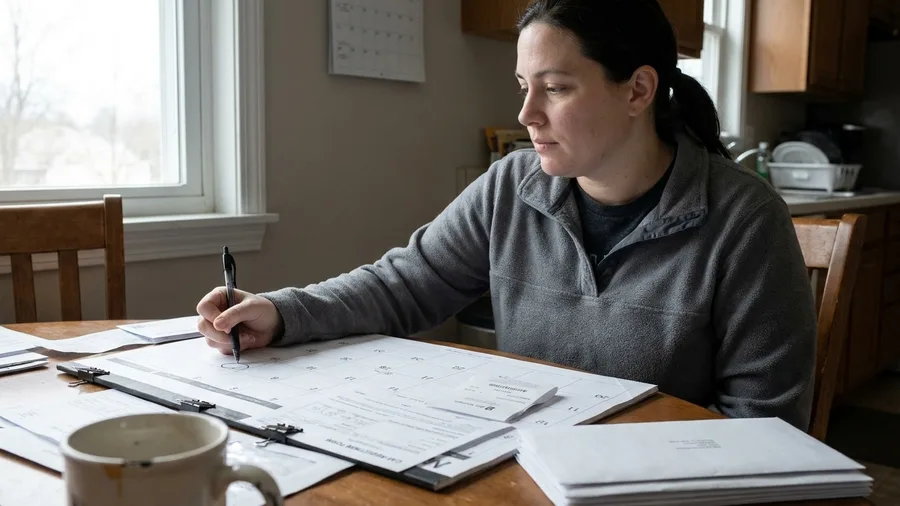
Because the plan counts the bills that come every month and quietly skips the ones that come once a year, and those annual bills still have to be paid out of the same account.
Add up a $4,200 take-home month and it looks tight but workable. Rent takes $1,450, utilities $260, the car payment and insurance together $520, the phone $80 — $2,310 in fixed bills. Groceries and gas run $650, debt minimums $250, subscriptions $85, and the plan sets aside $300 for savings. That leaves $605 of breathing room, and on paper the month closes.
Then you look at the year instead of the month. Car registration is $180. Gifts across birthdays and holidays come to $400. Medical costs you don't schedule run $300. Car repairs, the kind that arrive without warning, add up to $600. Together that's $1,480 a year, or roughly $123 every month — and that $123 has to come out of the same $605.
Take it out and $482 is the real flex pot, not $605.
So picture the month the $600 repair lands. There's no sinking fund holding anything back for it, so the repair eats the entire $482 — and then $118 more that belongs to next month. The budget is broken before the month it breaks in, and the reader standing in a repair shop with a $600 estimate is carrying money that was never there.
That gap you hit around the 19th isn't a discipline gap. It's a $123 line nobody drew.
One exception worth naming: if you already keep a separate annual-expenses account and pay these bills from it, your monthly plan is honest about the year and this doesn't describe you.
Every month is treated as identical
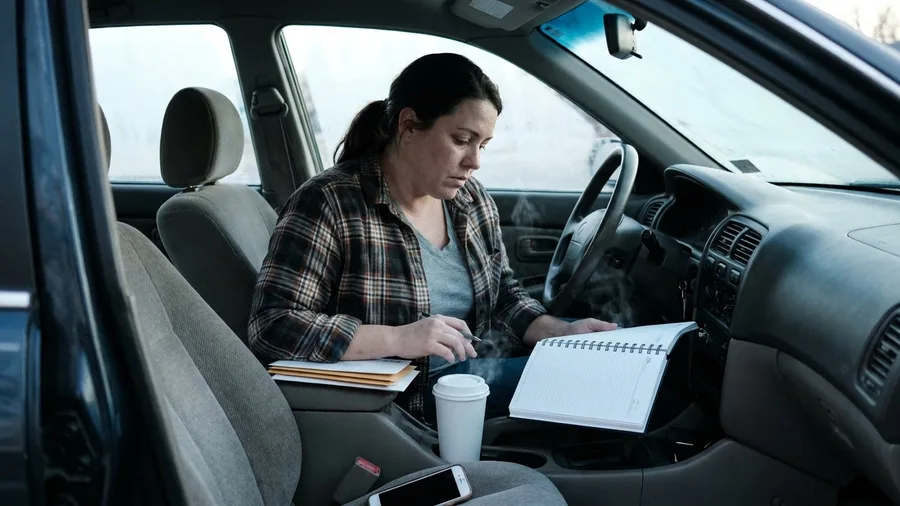
Because a plan built on one number describes one month, and income dips and bills don't hold still long enough to match it.
The $4,200 is where you start, not what you're handed every time. Overtime dries up in a slow quarter. A shift gets cut. A refund you counted on lands two weeks late. Copy the same plan into a month that comes in $300 light and the flex pot is $182 instead of $482 — and the plan still says $482 on every line. It can hit from the other side too: income flat, but the car needs a $250 repair, so the fixed lines are all still there with one of them $250 larger than the plan states.
Here's the mechanism. By the second week the plan is describing a month that stopped existing, so every choice you make is measured against a total that's wrong. You can be technically over budget while behaving exactly like someone who isn't — and that's what makes it feel like a personal failure.
A band fixes it where a single number can't. Set the flex pot at a range instead of a point: $380 in a thin month, $560 in a full one, with the fixed lines pinned at their known values. The difference gets absorbed by the band rather than by a plan that snaps. You're not budgeting wrong — you're budgeting against a stale number.
Some households genuinely do have identical months: a salaried income, flat bills, and a month of expenses sitting untouched as a buffer. For them the single number is accurate, and nothing here needs changing.
The Math Your Budget Is Missing
Savings is left as whatever remains

Because savings is the last thing the plan pays, so it only happens in the months that leave something behind — and the month rarely does.
The $300 supposed to go into savings is treated like a leftover, while rent is due on the 1st whether or not anything is left. Worse, the $300 competes directly with the $482 flex pot, and everything in the month makes its bid first. A $22 takeout dinner on a late Wednesday. Fifteen dollars of extra groceries because the store was out of the cheap cut. By the 30th the $300 has arrived as whatever the flex pot didn't eat, and most months that's $0.
The damage isn't only the $300. A budget that never produces a visible saved dollar in the account starts to look pointless — and a pointless budget is easy to abandon in week three. That's the real mechanics of last place: you quit a plan that never showed you a result, not a plan that was too tight.
The households that save automate it. They schedule the $300 transfer for payday, so the money leaves with the rent instead of surviving to month end. If setting transfers on payday is the step you keep postponing, automating every financial decision shows what it takes off your plate. The flex pot then starts at $182 instead of pretending it's $482 — smaller, but honest about what's actually left to spend.
That's the reframe: $300 is not the reward for a good month, it's a fixed bill the month fits around, the same status as the $1,450 rent.
⚠️ COMMON MISTAKE
Don't pay yourself last
Treating savings as whatever remains after spending is the single most common budget design flaw. Move the $300 out on payday morning, before the flex pot can bid for it.
Categories are too vague to guide a decision

A category is too vague to guide a decision when it holds more than one kind of purchase, and $500 labelled groceries is three budgets wearing one name. It is the food you cook, the takeout you grab on the way home because it got late, and the detergent, foil and paper towels that have nothing to do with eating. All of it posts to a single number.
That number cannot answer a question at the shelf.
When the grocery line reads $500 spent, the plan cannot tell you whether you have $0 left for food or $140 for food and $0 for takeout. It authorizes nothing and it blocks nothing. You stand in the aisle with a full cart and no information, guessing against a total that stopped being useful somewhere around the 12th.
A vague line can only tell you, on the 24th, that you already went to the store too often.
The fix is three named lines inside the same $500, not a dollar more of restriction: $320 for groceries, $110 for takeout, $70 for household supplies. Each one matches what is printed on the receipt, so each one tells you what it covers. Now the grocery balance says you have $46 for food this week, and the takeout balance says you have $30 for the nights that run late.
The total is identical. The difference is that one version can be argued with at the aisle and the other can only be audited after the fact. If you already run named envelopes that reconcile back to your receipts, your categories are specific enough to work. If yours are broad titles like food, fun or miscellaneous, the vagueness is the reason the line vanishes before you do anything that feels like overspending.
The budget tracks spending after the choice

A category with a name is only useful at the moment money is about to leave, and most budgets are built to be read afterward. That timing is why tracking doesn't stop you from overspending. The spending log is a record of what you already did.
Picture the grocery run. The $500 line is already at $500 and the week needs one more bag of food, so the $64 trip goes on the card and gets sorted Sunday evening. The report arrives after the useful moment has gone, and all it can do is describe the gap you are now standing in.
Now flip the order with the numbers you already have. Variable essentials total $650, split $500 groceries and $150 gas. Before you go in, the question is which of those two lines this trip is paid from and what is left on it. If groceries has $120 in it, the store has a ceiling before you ever touch a cart.
That is the whole difference. Sunday night explains how the overspend happened. The doorway check keeps it from happening in the first place.
The reason runs on plain mechanics. A budget that only records has no power to stop a purchase, because by the time the number moves, the money is gone and the decision is history.
This one comes free with what you're already doing, so it only applies if you haven't set it up. If you already glance at a category balance before spending, the check exists. What's left is upkeep, not redesign.
Tracking After vs. Checking Before
Tracking after the purchase
- Tells you what you already spent
- Explains last Sunday's overspend
- Category is already empty
- Useful moment has passed
- Creates a report card, not a boundary
Checking before the decision
- Tells you what is left to spend
- Refuses the overspend at the door
- Category balance is visible before you shop
- Answers the question at the aisle
- Creates a guardrail, not a grade
Restriction makes one slip feel like failure

A hard number at the shelf with no give in it turns a $20 overage into proof of personal failure, and that reading, not the $20, is what ends the month. Groceries land at $520 against a $500 line and the plan has nowhere to file the $20. So the $20 stops being a number and becomes a verdict.
The sentence that follows lands quietly on the 12th: I already blew it. From there the remaining $482 of flex pot has nothing left guarding it. The month is written off with nineteen days still to run, and the writing-off costs far more than the overage ever did.
The structural answer is a line built to be spent. Carve $60 out of the $482 and call it flex, unassigned, no receipt required. Now the $20 fits inside a number that was always meant to take a hit, and the plan is still standing on the 13th.
People who keep this working read the overage as a data point and pick up the next morning. Groceries sits at $0 and the plan keeps going. It doesn't restart on the 1st.
What that requires is a shift in how you read the number. A budget with no room for a slip has bet the entire month on a perfect one, and no month is perfect.
💡 PRO TIP
Name a $60 flex line
Build a $60 unassigned flex amount into your $482 pot. When you go $20 over on groceries, it lands in a line designed to absorb it — instead of writing off the whole month.

Because nobody wrote down whose money it is, so whoever gets to the till first spends it. The $605 left after the bills and the $482 that remains once the annual fund is carved out are the real subject of negotiation in a shared household, and a plan that names neither hands the whole pot to the swiftest spender.
Picture the sequence. Your partner picks up groceries on Tuesday, a birthday gift for a coworker on Thursday, a coffee on the way in on Friday, and nothing in the plan breaks because nothing in the plan had a boundary to break. You find out at the register on Sunday, card declined over a $40 basket, doing arithmetic you thought you had already done.
That is not a discipline problem between two people. It is an unwritten rule being enforced by nobody.
The fix is to write the rule down in two pieces. First, a personal amount for each adult, carved out of the $482 – $75 apiece, $150 total, spent on whatever, no questions and no reporting. Second, one shared flex line both people can see, with a number on it, that neither person can blow through alone.
What that changes is where the argument lands. Instead of standing in a checkout line holding a receipt and a bad feeling, the two of you are looking at a line that says $180 and deciding together whether it needs to be $220 next month. The $482 turns into a figure you both agreed to, not a mystery you each discover separately.
If it is just you in the household, none of this applies. The whole pot is one person's decision and the only rule you need is the one you already have.
Convenience costs are not in the plan
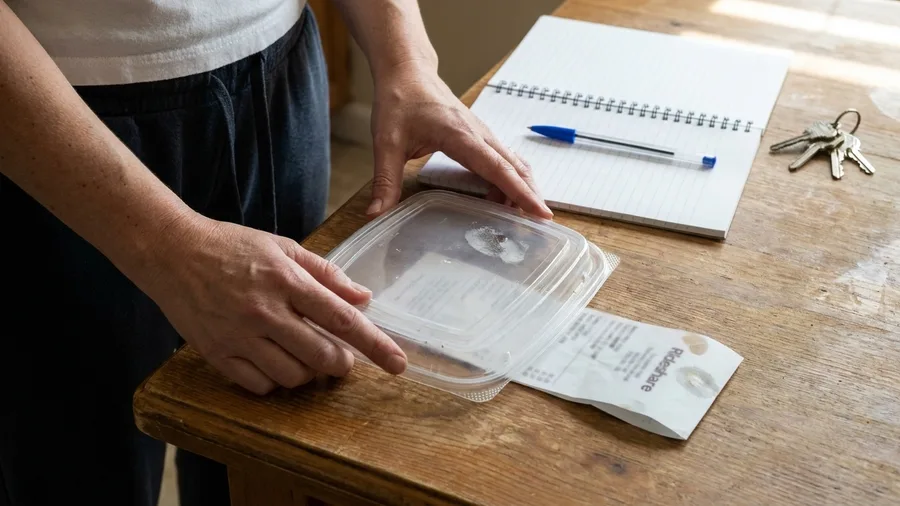
Because the plan silently assumes a week that never actually happens – a kitchen open and a cook with energy at 8pm, a bus that shows up, a Saturday with nothing on it. When the week runs late, the money to buy your way out of it has to come from somewhere, and the only somewhere is the $482.
It goes in small amounts, which is why it hides. A $22 takeout on the night you finished work at seven and still had a school form to sign. An $18 rideshare after the 6:40 didn't come. Neither shows up as a line, so neither shows up in your head, and by the 22nd the pot is $200 lighter and you can't point to a single purchase big enough to explain it.
That is the part that stings. Because there is no line for it, each of those nights feels like a small personal failure, and a thing that feels like a failure gets hidden rather than counted. You stop opening the banking app. The plan loses contact with the account, and the account was the only honest witness.
The fix is to price the late week in advance. Put $60 a month inside the $482 under a name like 'running late' – enough for two or three of those nights – and the $22 takeout becomes a budgeted purchase instead of a small defeat. You spend it the same way. You just stop flinching.
If your time genuinely is flexible, or you already pay someone to cover the cooking and the driving, the assumption holds and this line is not for you.
A budget with no room for a slip is a budget that has bet the whole month on a perfect one.
— What budget designers keep repeating
No review means the budget dies silently

By putting ten minutes on the calendar each week and looking, because every fix described so far is a design change that quietly reverts within about two months if nobody checks it. A plan with no review does not fail loudly. It drifts, and one week you notice the account and the spreadsheet are describing two different lives.
The check is small enough to actually happen. Pick a day – Sunday night works for a lot of people – open the balances next to the plan, and look at three things only: groceries against the $500, the flexible pot against the $482, and whether any annual cost has come due from the $123 fund. That is it. Ten minutes, not an evening.
One rule keeps it usable: no categorising backlog older than seven days. If receipts have been piling since the 3rd, the check is fiction by the 17th, because you are reviewing a month you can no longer remember making decisions in.
Then make one adjustment for the coming week. If groceries came in short, move up to $40 across from the flex pot – and never out of the $300 savings or the $123 annual fund, because those two are the lines the whole plan is protecting.
The people who keep this going do not rely on remembering it. They put it on the calendar as a recurring ten-minute event, same day, with a reminder, because a check that depends on memory stops in the first busy week – which is exactly the week it was needed. And it is not a verdict on the seven days just spent. It is what lets the plan be wrong and corrected, rather than wrong and abandoned.
🔄 The Weekly 10-Minute Review
Cap the backlog at seven days
If receipts predate last week's check, close them out first – otherwise you are reviewing a month you can no longer remember.
Read the three lines in order
Groceries first, flex pot second, sinking fund third. Stop after three – a fourth line turns ten minutes into an evening.
Set the adjustment ceiling
Move no more than $40 in either direction between groceries and flex. Bigger gaps mean the plan is wrong, not the week.
Protect the two locked lines
$300 savings and $123 annual fund never absorb a shortfall, even when the flex pot is empty and the month still has days left.
Reset the reminder, not the memory
Recurring event, same day, alert on. The check that stops does so in the first busy week – confirm next week's is already on the calendar.
Frequently Asked Questions
Is it really not my willpower?
Correct. A budget that collapses by mid-month is almost always a design flaw — missing annual costs, vague categories, savings last, or no shared-money rule. You can't discipline your way out of a plan that doesn't match your actual month. Fix the structure first, and willpower becomes a minor factor instead of the whole game.
How much should I put in a sinking fund for annual costs?
Add up your irregular yearly costs — car registration, repairs, gifts, medical — and divide by 12. In the example here, $1,480 a year becomes $123 a month. That $123 comes out of your leftover before you calculate your flexible spending pot.
Should I pay off debt or save first?
It depends on your interest rates and your cushion. If you have no emergency fund, build one month of bare expenses first — for many households that's $2,000 to $3,500 — so a surprise doesn't become new debt. After that, paying down high-interest debt (anything above roughly 7-8%) usually beats saving beyond the cushion. Run your own numbers or ask a fee-only fiduciary.
What if my income changes every month?
Plan a range, not a point. Set your fixed lines at their known values and plan your flexible pot as a band — $380 in a thin month, $560 in a full one. When income dips, the flex band absorbs it instead of the whole plan breaking.
Carve out no-questions personal amounts from the flex pot — $75 each, for example — plus one shared flex line both people can see and neither can exceed alone. That turns the $482 into an agreed number instead of a surprise, and the disagreement moves to the plan rather than the receipt.
How often should I review my budget?
Weekly, for 10 minutes. Same day each week, account balances open beside the plan. Compare the two lines that move most — groceries and the flexible pot — and make one adjustment for next week. A review that depends on remembering it stops in the first busy week, so put it on the calendar as a recurring event.
One structural change to make this week
Start with one line this week: move $123 into an annual-expenses sinking fund on payday, right alongside the $300 savings. Before you open that account, separating sinking funds from emergency cash explains why the two balances should never share a home. That's the change that gives the $600 repair somewhere to land that isn't next month's rent.
Then run it for one month with the $123 transfer, a $60 flex line and a $60 convenience line inside the $482. Measure the month on whether the review happened four times, not on whether you were perfect. A $20 overage on the $500 grocery line is a normal slip; the plan resumes the next day, not the next month.
At month's end, adjust a category's amount when it has been wrong three weeks running, and drop a category whose line has gone unused for two months. A wrong number is fixed by a number, never by resolve.
The $600 was never your character showing through. It was a line the plan hadn't drawn, and the same $600 this month costs $123 instead of the whole flex pot.
So come back to the question you started with. You weren't doing everything right, because the plan you were handed couldn't be done right. This month it can, with a $123 annual line, a flex line that expects a slip, and ten minutes on the calendar every week.
Add the sinking fund line today
Open your budget right now and add a $123 monthly line for annual costs. Then recalculate your real flex pot. That's the whole fix — one line, ten minutes, done.