

The neighbor mentions their free checking, the coworker brags about the free phone, and you're left wondering what you're doing wrong. Nothing. They either read the terms or the bill hasn't landed yet.
A free checking account really is $0, until the balance dips under $1,500 with no direct deposit coming in, and suddenly there's a $12 monthly fee and a $35 overdraft charge waiting. That is the shape of nearly every free offer you'll meet.
The headline price is never the whole price. Each one relocates the cost somewhere quieter: a condition you have to keep, a subscription that auto-renews, a minimum you have to spend, installments spread over two years, a nightly resort fee, or a sales pitch dressed as a class.
So the useful question isn't whether the label says free. It's what you'll still owe once the free part ends, and which single action keeps that from happening.
By the end you'll be able to price eight common offers and run a quick three-question test before you sign anything. You don't have to audit all eight right now. Start with whichever one is actually on the table.
The Checks That Save You The Most
Cancel window is shorter than the trial
A 7-day trial often needs a cancellation made on day 4 or 5 to process in time. Set the reminder two days before the end date, not on it.
Keep a card off file
If a service won't start without a card, use one you can lock or set a $1 limit on. Then a surprise $14.99 charge fails instead of posting.
The two ways to dodge the $12 fee
Direct deposit into the account, or keep the balance at $1,500 every day, not just on statement day. The $35 overdraft applies per item, so one slip can cost $70.
Locked features cost more later
If export and sync are locked on the free tier of a $9.99/month tool, your data is held hostage at day 14. Export a test file before you rely on it.
Fees stack on top of fees
A $29 resort fee and $45 valet are charged per night, and taxes apply to both. A 3-night 'free' stay can carry $222 in fees before you park a car.
Leave before the pitch starts
A 2-hour seminar with a 45-minute pitch usually takes the hard sell in the final 20. Decide on a walk-out time before you sit down, and the $1,200 program stays unpurchased.
Accounts and credit
This first theme covers the two places where free is most often a condition: your checking account and your credit score. Both offers look like a public service, and both have a bill attached.
The checking account bill arrives as a monthly fee if you miss a balance or direct-deposit condition. The credit score bill arrives as a monitoring subscription you didn't mean to keep. Different mechanisms, same lesson: the free part is the hook, and the condition is the cost.
1. Free checking charges $12 unless you keep $1,500
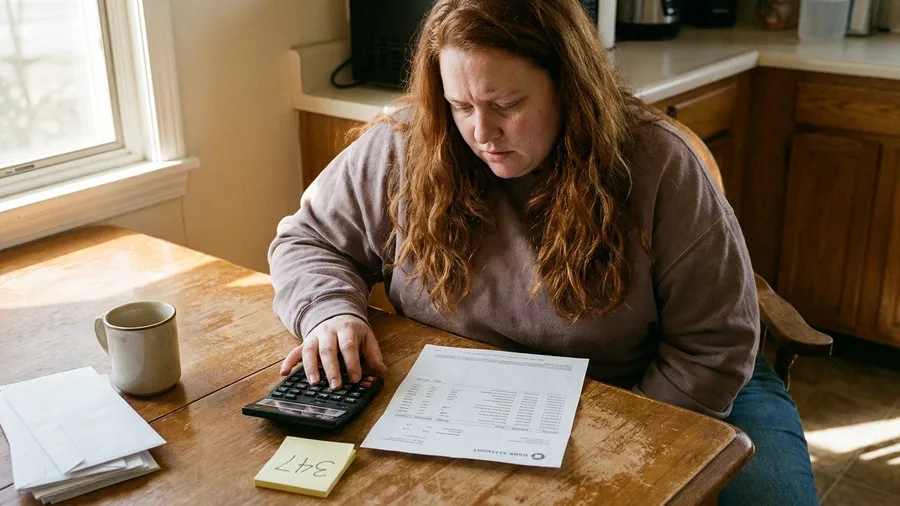
Twelve dollars. That's the bill that arrives the moment your balance dips one dollar under $1,500 or a direct deposit stops landing, and it shows up again every month after that.
So the free part isn't the account itself. It's the condition attached to it: $1,500 stays parked, or your paycheck keeps hitting, or the waive disappears and the maintenance fee takes its place. An overdraft is a separate charge of $35 a pop, which means one slip past the balance line and you've paid the monthly fee plus the overdraft in the same week. Parking surplus cash in a zero-yield account is another quiet drain, as the true cost of keeping cash in checking shows.
This account fits a direct-deposit earner who keeps a $1,600 floor, a hundred bucks above the waiver line so the alert fires while there's still room. Before you sign, find the waiver terms in the fine print and set that low-balance alert yourself, because the bank's own notices tend to arrive on the wrong side of the threshold.
💡 Tip: Set your low-balance alert at $1,600, not $1,500. The alert needs to arrive before the fee, not with it.
| Offer | What is advertised | Typical hidden cost | Who it can still suit |
|---|---|---|---|
| Free checking | No monthly fee | $12 monthly fee if balance falls below $1,500 or no direct deposit | Direct-deposit earners who keep a $1,600 buffer |
| Free credit score | Free score and monitoring | $19.95/month after trial; free report separate at AnnualCreditReport.com | People who will cancel before the trial ends |
| Free trial | 7 days free | $14.99/month after day 7; card required at signup | People who set a day-6 cancellation reminder |
| Free software | Free tier or 14-day trial | $9.99/month after trial; export and sync locked on free tier | People who can finish in 14 days without export |
| Free shipping | Free shipping on orders over $35 | $15 in cart filler to reach $35; standard shipping is $6.95 | Shoppers who already need $35 worth of items |
| Free phone | Free device with plan | $240 device cost over 24 months; $60/month plan vs $45 SIM-only | People who need the $60 plan anyway |
| Free hotel night | Free night certificate | $29 resort fee per night and $45 valet parking per night, plus tax | Drivers who park elsewhere and skip extras |
| Free seminar | Free 2-hour class | 45-minute sales pitch for a $1,200 program | People who can leave without buying |
2. Free credit score trial renews at $19.95 a month

Asking for a card number does not mean the score costs money today, and it does not make the offer a scam. It means the free part has an end date, and the card is how the company bills you once that date passes.
The genuinely free credit report is a separate thing, and it lives at AnnualCreditReport.com, which federal law requires the bureaus to provide at no charge. Many everyday expenses like bank fees and credit report charges should cost nothing, yet quietly bill you anyway. A free score offer is a different product, usually bundled with credit monitoring, and the trial converts to $19.95 a month when it runs out. The card you type in at signup is the billing authorization for that first charge, not proof the score itself is free.
The setup that takes the willpower out of it: find the exact date the trial ends and put a calendar reminder two days before it, so the reminder lands while you can still cancel for $0. If you only want the report, skip the score product and go straight to AnnualCreditReport.com. If you want the score, note the cancellation date and the $19.95 monthly price somewhere you will actually look, then leave the account alone until that date arrives.
The price of the score offer is the renewal date plus $19.95 a month, not the free look you get first. Anyone who only needs the report has no reason to hand over a card at all.
What the free offers actually charge
Trials and software
Free trials and free software are the most common places where the bill arrives quietly. The offer is real, the product works, and the charge shows up because you didn't cancel in time or because the free version won't let you leave with your data.
Both are timing problems. One has a deadline you can put in a calendar. The other has an exit cost you can test before you commit.
3. Free trials renew at $14.99 before you notice

There is a small knot of dread when you sign up for a 7-day free trial and hand over the card, because some part of you already knows you might forget. That dread is worth listening to, and the fix is smaller than it feels.
A card-secured trial runs 7 days and then bills $14.99 a month. The cancellation deadline is day 6, because day 7 is the day the paid subscription starts. You do not have to be the person who remembers; you have to be the person who sets a calendar reminder for day 6 the moment you sign up.
If you genuinely cannot commit to checking a reminder, cancel immediately after signing up. You still get the trial window, and you remove the renewal date from the equation entirely. That is not failing to use the trial well. That is using it exactly as far as you can right now, without letting $14.99 start billing in the background.
💡 PRO TIP
Test the exit before you enter
For any free software, create a test project with sample data and try to export it before you import anything real. If export is locked, you've just found the price of free.
4. Free software locks your data after 14 days

Before you import a single real file, test the export on sample data. Drop in a fake spreadsheet, run the export button, and see whether the file actually comes out usable. This is the check people skip, and skipping it is the mistake that costs them later.
Here is the trap in how free software usually works. It runs fine for 14 days, then it costs $9.99 a month if you stay. That part is clear enough. The part that hides is what happens to the work you put inside it.
The free tier disables export and sync. So the file you built lives in the tool, and the button that would carry it back out is grayed off. Leaving can mean losing access to the very data the tool is holding.
The wrong way to start is to sign up, import the real data on day one, and only think about the exit when the 14 days are nearly gone. By then your work is inside, and the choice becomes pay $9.99 or walk away from it. That deadline arrives after your data is already committed, which is exactly what makes the lock-in bite.
The fix costs ten minutes. Test export first, before any real data goes in. If the export is blocked or the file comes out unusable, you know the price of leaving before you owe anything.
This suits people who can finish the whole job inside 14 days without needing export or sync – a quick one-off task, say. If your work will live in the tool longer than that, or you'll need it back out, the free tier isn't really for you, and that's fine to admit before you start.
The price of free software shows up at the exit or the renewal: $9.99 a month to stay, or locked data if you go. Find that out on the sample file, not on your real work.
💡 Tip: Keep your data in a plain spreadsheet as a backup. If the free tool locks export, you still have your work.
Free offer: worth it or skip it?
Worth it if…
- You meet the condition anyway, like direct deposit or a $60 plan you already need.
- You'll set a calendar reminder for the cancellation deadline and actually cancel.
- You can test the exit before you commit, like exporting sample data from free software.
- You set a $0 spending limit before a free seminar and stick to it.
Skip it if…
- You'd only keep the account to avoid a fee you can't meet the condition for.
- You only need the free credit report, which you can get at AnnualCreditReport.com.
- You'd buy $15 of filler to save $6.95 on shipping.
- You're going to the seminar hoping to buy something, or worried you will.
Shopping and travel
This theme covers the offers that feel like a reward: free shipping on your cart and a free night at a hotel. Both are real, and both come with a condition that costs money.
With shipping, the cost is the filler you buy to cross the minimum. With the hotel, the cost is the fees charged per night, per car, plus tax. Neither shows up in the headline.
5. Free shipping costs $15 more in cart filler

I once added a $9 phone case to a $28 cart to cross a shipping threshold, and then spent an evening asking myself why I owned a phone case I didn't need. The math was right there and I still got it wrong, so try the numbers before you click.
A free-shipping offer usually means a $35 minimum, and standard shipping on its own is $6.95. Take a $20 cart. To qualify, it jumps to $35, which means $15 of filler you didn't set out to buy.
So the real comparison is $15 of unwanted extras against $6.95 to just ship what you came for. That is the question, not free versus paid – the paid option is often the cheaper one.
This is where your own numbers matter more than any rule of thumb. Before you add filler, do the subtraction in your head: how far is my cart from the minimum, and is that gap less than the $6.95 I'd pay to ship it honestly? If the gap is $15 and shipping is $6.95, pay the shipping.
If a purchase is big enough that the filler is something you actually wanted anyway, the minimum works in your favor. When it isn't, there's no professional to call – just your cart total and one subtraction. Run it and buy only what you came for.
All figures are typical examples from the offers in this article.
6. Free phones hide $240 in device installments

Because the $240 device is split across 24 months, and the plan you sign up for carries the subsidy – $60 a month instead of $45 for SIM-only.
I sat down with that $15 monthly gap once and multiplied it out, and the gap alone came to $360 over two years on top of the $240 device. Compare the full 24-month total against buying an unlocked phone and running a $45 SIM-only plan.
It suits people who'd pick the $60 plan anyway; for everyone else the installment and the plan upgrade are the price, paid slowly over two years.
7. Free hotel nights charge $29 resort fee

A free hotel night does not mean a free stay. The room rate drops to $0 and the property recovers the cost at the desk, the parking garage, and the checkout folio, the same way an installment plan recovers the price of a phone in monthly slices instead of one lump at purchase.
Expect $29 a night in resort fees and $45 a night for valet parking, and taxes ride on top of both because they are fees, not room rate. On a short stay the extras can run past what a budget room would have cost outright.
The cost lands at the point of use: per night, per car, plus tax, charged on the folio, never folded into the headline rate you saw advertised.
Before you book, pull the property's fee schedule and read the parking options. Drivers who park on the street or in a public garage and skip the extras keep the room genuinely free; everyone else is paying a nightly rate in disguise.
Review it at checkout, not after. Check the folio line by line for the resort fee, the parking charge, and the tax on each, because charges you spot at the desk are far easier to dispute than ones that clear a week later.
Sales events
The last theme is the one where the product isn't the offer at all. The free event is the sales pitch, and the price is the program it's designed to sell.
It still suits some people: those who can walk out without buying. The trick is to decide that before you go in.
8. Free seminars sell $1,200 programs

A free financial seminar is a sales event with a class attached to the front of it.
The belief that gets people into the seat is that they are attending a lesson. Two hours in, roughly 45 minutes of it turns into a pitch, and the actual product being sold is a $1,200 program offered before anyone reaches the exit.
The free event's real price is that pitch and the $1,200 decision it is built to produce, so the question is not whether the information is any good but whether you can walk out without signing anything.
This suits people who can take the free hour and leave the offer on the table. It is not a neutral class, and anyone going in hoping for unbiased guidance is going to be disappointed by the last 45 minutes.
Set a spending limit of $0 before you walk in, write it on a note where you can see it, and decide ahead of time that the answer to any offer at the event is no. The seat is free; the decision is what costs.
💡 Tip: Set a $0 limit before you attend. If you feel the urge to buy, leave and research the program for a week.
🎤 How a free seminar sells a $1,200 program
The free 2-hour presentation
You attend a no-cost class on a financial topic, with no obligation to buy.
The pitch starts at 75 minutes
The last 45 minutes shift from education to an offer for a $1,200 program.
The close happens in the room
The event is built to get a decision before you leave, not after you've had time to think.
You leave with the choice
You can walk out without buying, but only if you decided that before you walked in.
Frequently Asked Questions
Is a free checking account actually free?
Only if you meet the condition. Most free checking accounts waive the $12 monthly fee if you keep a $1,500 balance or set up direct deposit. Miss either one and the fee applies. Read the waiver terms and set a low-balance alert above the line.
Why does a free credit score ask for my card?
Because the score offer is a subscription product with a free trial, not a free report. The card authorizes the $19.95 monthly charge after the trial ends. If you only need the report, use AnnualCreditReport.com and skip the score.
What's the catch with a free trial?
The renewal. A 7-day free trial typically converts to $14.99 a month on day 7 if you don't cancel by day 6. Set a reminder for day 6, or cancel immediately after signing up if you only need one use.
Is free shipping worth hitting the minimum?
Usually not unless you already need the items. If standard shipping is $6.95 and free shipping requires a $35 minimum, a $20 cart would need $15 in filler to qualify. Pay the $6.95 and skip the filler.
How is a free phone not free?
The device cost is spread over 24 months, and the plan you need costs more. A $60 plan versus $45 SIM-only means the phone's price includes $240 in installments plus $15 a month for two years. Compare the 24-month total to buying unlocked.
What does a free hotel night really cost?
It depends on the fees. A $29 resort fee and $45 valet parking per night, plus tax, can add up to more than a budget room rate. Add those fees for each night before you book.
Ask three questions before you sign up for free
no free offer is priced until you know what you owe after the free part ends. The renewal date and the price are the first two things to find, before anything else on the page matters.
Ask three questions of every offer. What do I pay after the trial ends? What must I buy or keep to qualify? And what does canceling or leaving cost me? If any answer is missing, the offer isn't ready to sign.
The $12 checking fee after a missed $1,500 condition is the same pattern as the $19.95 monitoring renewal, the $14.99 trial, the $15 in cart filler, the $240 phone, the $29 resort fee, and the $1,200 seminar. The bill moved. It never disappeared.
So start with the date and the number, and put both in your calendar. A free checking account is only free once you know what it costs when the balance drops. Find that out first, and the word free stops surprising you.