

$200 a month, in an index fund, at an 8% annual return, for 45 years, comes to just over one million dollars. That is arithmetic, not a lucky break.
You can be forgiven for thinking this stuff is for other people. Schools do not teach it, friends repeat half-truths, and family members treat investing like skydiving without a parachute. So it is worth saying plainly: index fund investing for beginners is a few clicks, a small monthly amount, and time doing the heavy lifting.
Here is what is coming. We will knock down the myths, explain what an index fund actually is, find an account that shelters the tax, pick a cheap broker, and walk through a real $10,000 portfolio you can copy with your own currency and your own fund names.
You do not need a finance degree. You need a bank account, a spare hour, and the willingness to start smaller than feels impressive.
Quick Tips Before You Start
Pick the account first
Choose the tax-sheltered wrapper before the fund, so growth is sheltered from day one.
Ignore hot tips
If it trends on financial social media, it is noise. Stick to broad, cheap index funds.
Read the expense ratio
That is the yearly charge. Lower is better, and two funds tracking the same index means you take the cheaper one.
Automate the monthly buy
Set a standing order for the day after payday so you never forget and never time the market.
Leave it alone
The best-performing portfolios are usually the ones people opened and then ignored for a decade.
1. The Investing Myths You Were Told Are Wrong

That arithmetic sounds nice, but plenty of people never start because of three warnings they picked up years ago. So before any account gets opened, those warnings need dismantling, one at a time.
Teachers said investing is for rich people who hire professionals. A friend said you need the financial newspapers and a screen full of charts. And family said it is too risky, that you would lose the lot. None of that holds up for a broad index fund held for decades rather than months.
Here is the part that stings. The average actively managed fund returns about 2 percentage points a year less than the market, and it still takes its fee in a year when it loses your money. So leaving it to the professionals does not protect you. It quietly costs you.
Index investing asks for very little money, takes minutes to set up and pays a reasonable return over the long run, mainly because nobody is being paid to guess. Put $200 a month into a broad fund at an 8% return and 45 years later you are past a million dollars.
This one is for anyone who has never bought a fund because they assumed they were not qualified. You are. The qualification was never a licence or a spreadsheet, just a decision to start.
💡 Tip: Write down the last thing someone told you about investing. If it discourages you from starting, it is probably a myth.
| Feature | ETF | Index fund |
|---|---|---|
| Trading window | All day, on the exchange | Once, at end-of-day price |
| Minimum investment | One share (often under $100) | Often $3,000 at Vanguard |
| Typical charges | Usually no commission at big brokers | May have a transaction fee |
| What you own | A basket of stocks | The same basket of stocks |
| Best for a beginner | Monthly contributions from a salary | Lump sums already sitting in cash |
2. An Index Fund Buys The Entire League Table
Picture a football league table, and the answer gets simple fast.
The better a team plays, the higher it climbs, and the worst teams drop out of the league entirely. An index works the same way, only the teams are companies. The S&P 500 is a list of 500 of the largest US public companies, with Amazon, Google, Apple and Tesla near the top, and the poor performers swapped out for better ones.
One click buys the whole table. A few disasters get offset by the winners, and that balance is the entire product rather than a side effect. The S&P 500 averaged 13.6% a year over the past decade, which is higher than usual, and a 20-year holding period has never produced a loss on an S&P 500 fund.
So why does anyone still buy single stocks? Usually for fun, or to own young companies that have not made the index yet. Keep that as a small side bet, never the main plan.
3. Wrap Your Index Funds In A Tax Shelter
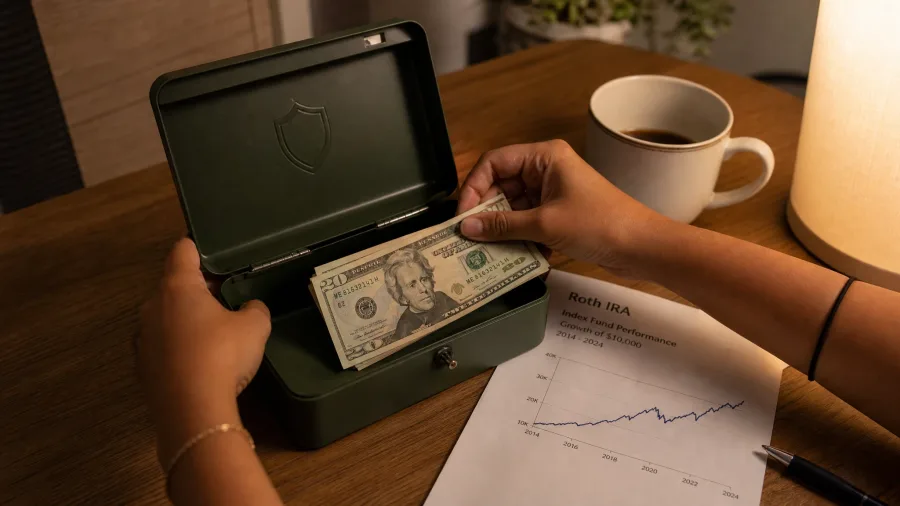
The night you finally go to buy that fund, you will be asked which account to open, and that choice matters more than the fund itself. Pick the tax-advantaged one first.
The names change by country: a Roth IRA in the US, a Stocks and Shares ISA in the UK, a TFSA in Canada, a Super in Australia. They are capped because they are powerful, so check your tax authority's page for the current allowance instead of trusting a number you heard somewhere.
The mechanism is simple. Put money inside the sheltered account, then buy the index fund inside it, and the growth stays yours. The catch is that an unused account protects nothing. The advantage only exists once the money is in.
💡 Tip: If you already have a tax-sheltered account from a previous job, check if it can be reused instead of opening a fresh one.
⚠️ COMMON MISTAKE
Never buy the fund first
Beginners often buy an index fund in a regular taxable account, then realise they should have used the shelter. Selling to move it can trigger tax. Fund the sheltered account first, then buy inside it.
4. Lump Sum Or Monthly? Depends On Your Cash

With the account open, the next thing to settle is timing, and the answer depends on your bank balance, not on which method sounds cleverer.
A lump sum is riskier in the short term, but if the investment is expected to grow, waiting around buys you a worse average price. Dollar-cost averaging means buying at highs and lows so the average evens out, and it is what most people end up doing because they invest straight from each paycheck.
Take someone with $10,000 already sitting in savings and a 30-year horizon. Placing one order today beats dripping it in over a year and hoping for a dip. Someone with no savings does the opposite: puts in what they can each month and gets on with life.
So the lump sum suits savers with a long horizon, and monthly buying suits anyone investing out of salary. Both work. Waiting for the perfect moment does not.
💡 Tip: If you have a lump sum and are nervous, split it into three orders over three months. You give up a little return for a lot of calm.
5. An ETF And An Index Fund Are One Basket
An ETF and an index fund are two ways to buy that same table, which is why the choice between them is smaller than it looks.
ETF stands for Exchange Traded Fund, and it is bought and sold on the exchange throughout the day. An index fund trades once, at a price set when the trading day closes. Both hand you a basket of stocks, often tracking the identical index, so this is plumbing rather than philosophy.
For a beginner with little money, ETFs usually win: lower minimum investment and, at many brokers, no trading commission, which matters when a $3,000 fund minimum is most of your savings. If you buy automatically each month and hold inside a tax-sheltered account, you can ignore the whole distinction.
ETF vs index fund: which fits your situation
Choose an ETF if…
- You are starting with under $1,000
- You want to buy a little each month from salary
- You prefer no minimum investment
- Your broker offers commission-free trades
Choose an index fund if…
- You already have a lump sum of $3,000 or more
- You like an end-of-day price, not a live one
- You are happy to set it and forget it
- Your platform charges no fee for fund dealing
6. Time Is The Ingredient That Does The Heavy Lifting

Time is the real secret ingredient, and it's the one input you can't buy later at any price. A decade's head start beats a bigger salary almost every time.
Compounding runs in two phases. Early on, your contributions do the work. Later, the gains take over and your money starts earning on money it already made. Here's the DRIP investing snowball in numbers: $250 a month at 8% takes 42 years to pass $1 million. Keep paying in another ten years and you pass $2 million. That extra decade more than doubles the pot.
There's a tipping point in there you'll feel when it arrives. At some stage the interest you earn in a single year is more than the $3,000 you paid in across twelve months. When that flips, the snowball is rolling on its own.
And if you're under 18, you don't have to wait. A parent can open a custodial account in the US or a Junior Stocks and Shares ISA in the UK. That puts compound interest to work years before you'd otherwise start. All of this is why a small early contribution can beat a large late one. It isn't motivational fluff; it's what the calculator shows.
The road to a million at $250 a month
Illustrative figures based on an 8% annual return; actual returns will vary.
7. Owning The S&P 500 From Outside The US

That snowball rolls outside America too, and it's simpler than people expect. You can own the S&P 500 from anywhere in the world.
A UK-based investor buys a UK-listed fund tracking the S&P 500 and owns a slice of Apple, Amazon and the rest. You get a piece of the biggest companies on the planet in one cheap purchase, priced in your own currency. No US broker, no exchange-rate headaches on every trade.
The catch is names and tickers. They differ by country while the index tracked is identical, so search for the index itself, not for someone else's ticker. The local version of VOO will carry a different symbol but the same underlying holdings. Look up something like an S&P 500 tracker on your own broker's platform and check the fund factsheet confirms it follows the same index.
Then ask your broker how dividends and withholding tax are handled where you live. Do it in a two-minute customer service chat, not on a forum thread from three years ago.
Quick example: someone in the UK searches their broker for S&P 500, finds a local fund with a 0.09% charge, and buys it in pounds. Same companies, same index, no US account needed.
💡 Tip: Use your broker's fund screener, type 'S&P 500' and sort by expense ratio. The cheapest result tracking that index is usually the right one.
Four investing myths, corrected
8. Work Out The Monthly Number First
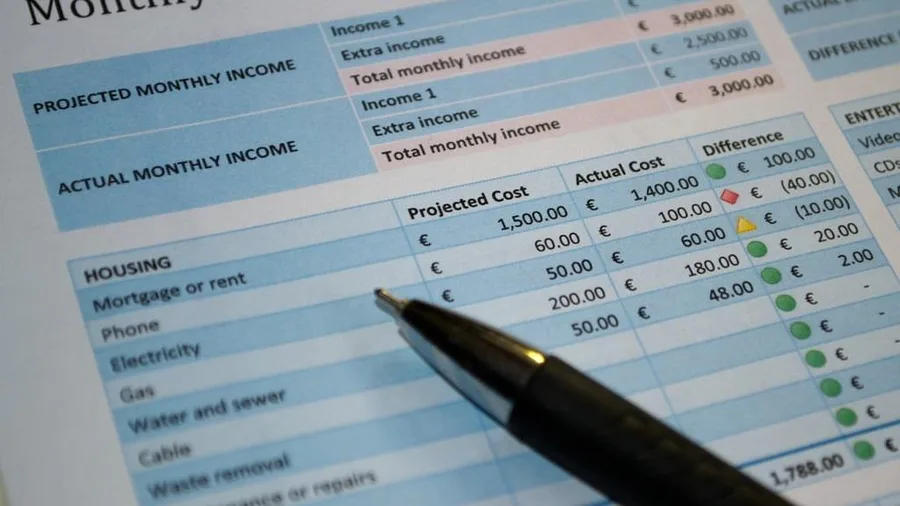
That's the question that turns the idea into a plan you can start this month.
Run the arithmetic before you browse a single fund. Take $250 a month at 8%. That reaches over $1 million in 42 years, and over $2 million if you keep it up another ten. Want it sooner? Invest more and you shorten the timeline directly.
You don't need a spreadsheet. Free compound-interest calculators online do this in seconds: type in the monthly amount, the assumed return and the years, and read the final balance. Move the monthly figure up and watch the years come down. That's where you find your own number instead of copying someone else's.
Then be honest about it. 8% is an assumption, returns vary year to year, and the output is a planning tool, not a promise. Treat your number as a target, not a guarantee.
9. Pick A Big Cheap Brokerage And Read The Fees
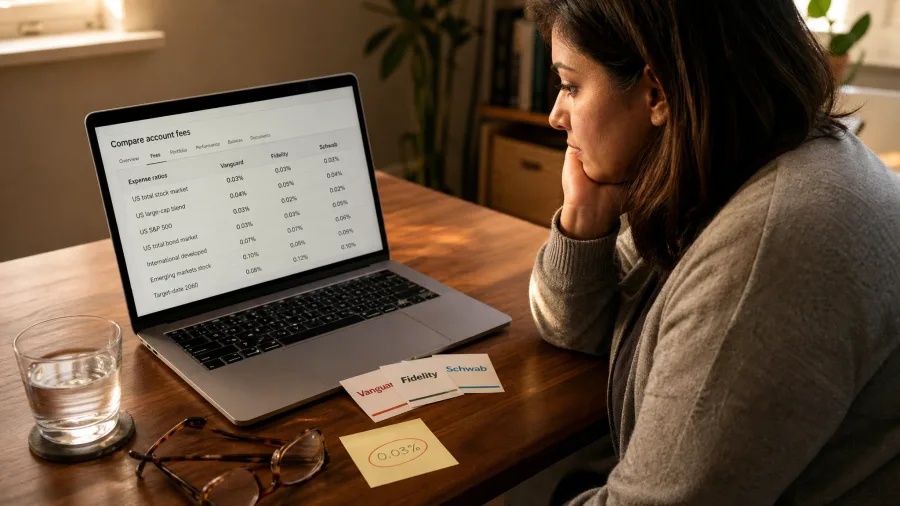
The moment you've got your monthly figure in mind, the next screen asks you which broker, and the answer is boring on purpose. Pick one of the big three: Charles Schwab, Fidelity or Vanguard.
Vanguard carries the reputation, and for good reason. Its founder, John Bogle, is credited with pioneering the index fund, and the firm built its name on low-cost funds. On every fund page, read two things: the expense ratio, which is the yearly charge, and the average returns panel. Keep the fees low, but never pick the fund with the biggest recent number. Past performance doesn't guarantee future returns.
A simple rule saves you hours: if two funds track the same index, take the cheaper one and move on.
💡 Tip: If two funds track the same index, take the cheaper one and move on. That single rule saves you hours of browsing.
💡 PRO TIP
The 0.1% difference compounds
A 0.04% expense ratio versus a 0.6% one sounds trivial, but on a $200,000 pot over 30 years the gap runs into tens of thousands. Check the number before the star rating.
10. How To Read A Fund Menu Without Panicking

A fund list looks overwhelming the first time you open it, but it's really just a few categories wearing too many names.
Bonds sit at the low-risk, low-return end and should grow as a share of your portfolio as you get older. Balanced funds let you pick your retirement year and rebalance for you, listed in five-year steps: convenient, but you hand over control.
Company size and location is where the practical options sit. VFIAX tracks the S&P 500 with a $3,000 minimum. VTSAX holds 3,586 US stocks with a $3,000 minimum. Their ETF versions, VOO and VTI, carry no minimum at all, which matters if you're starting small.
Emerging markets carry a risk level of 5 and deserve a small slice at most. Sector funds for energy, health care or real estate are a bet, not a core holding. So scan the menu for the plain market-wide funds first, and leave the spicier ones for later, if ever.
11. A Worked $10,000 Portfolio You Can Copy
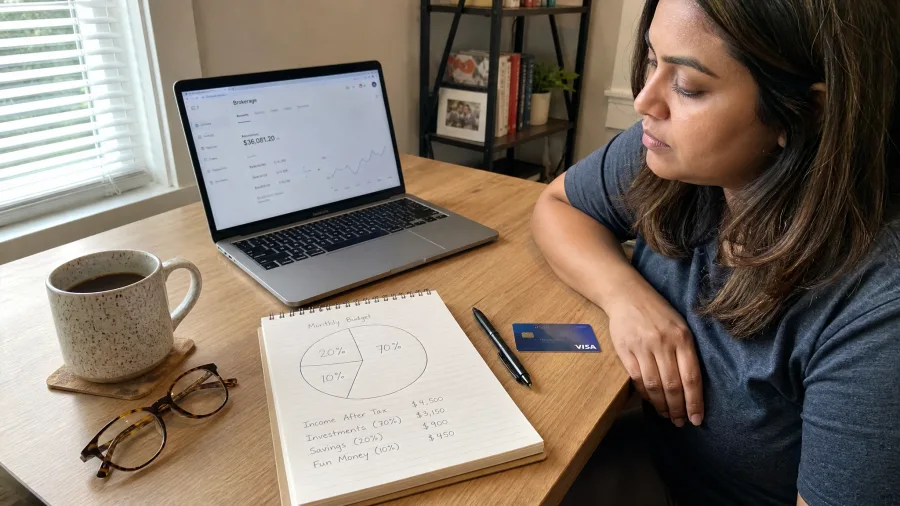
Once you have a cheap brokerage account and a fund shortlist, the next thing you want is a plain answer to what you actually buy, so here is a portfolio built on $10,000 you can copy almost word for word. Four orders, ten minutes of clicking.
Put $5,000 into an S&P 500 ETF, the biggest single slice by far. Add $2,000 to a total US stock market fund, $2,000 to a home-country index fund (the FTSE 100 is the UK example), and $1,000 to a global bond fund. That lands you at roughly 70% US, 20% international, 10% bonds.
The 70/20/10 split is built for someone decades from retirement who can sit through a bad year without selling. Tilt it if your situation differs: more bonds if retirement is close or market swings keep you up at night, fewer if you have 30 years to let the dips recover.
The percentages matter far more than the fund names. Local versions tracking the same indexes do the same job, and the exact ticker is a detail, not the point. Run the same dollar figures through whatever your broker lists.
What those four orders really buy is a slice of Apple, Amazon and Tesla plus HSBC, BP and Unilever, all sitting in one account after four clicks. You are not picking winners. You are buying the whole field and letting the arithmetic do the work.
💡 Tip: Write your target percentages on a sticky note and keep it near the laptop. It stops you fiddling when a headline spooks you.
Opening The Account: What They Ask For
Before you can place that first buy, the signup form wants a few things, and it pays to have them sitting on the desk before you start.
You will need a government photo ID, your tax identification number, proof of address such as a recent utility bill, and a bank account in your own name. Nothing exotic, but miss one and the whole thing stalls.
Verification is not instant. Expect to wait a day or two. Register with exactly the name and address that appear on the bank account you plan to fund from, because a middle initial mismatch is enough to hold everything up.
Then get the order right: link the bank or transfer the money, wait for it to clear, and only then place the buy. A buy order fired against uncleared funds may simply get rejected, which is frustrating when you thought you were done.
If verification does stall, contact the broker's support rather than opening a second account somewhere else. Two half-verified accounts is worse than one that is genuinely stuck.
Rebalancing: Putting The Mix Back On Target
Left completely alone, that 70/20/10 mix drifts as markets move, so a once-a-year check is all it takes to put it back where you aimed it.
Pick a date you will remember, compare the actual percentages with your target, and correct if anything is more than a few points off. The mechanism is simple: sell the slice that has grown overweight and buy the one that has fallen behind.
Or steer your new monthly contributions at the laggard instead, which avoids selling altogether and is often the cleaner move. You are nudging the ship rather than rebuilding it.
There is one shift from accumulation to dividend income you should not skip: raise the bond share as retirement gets closer. The 70/20/10 example suits someone decades out, not a permanent setting you set and forget for forty years.
If all of that sounds like admin you know you will never do, a balanced or target-retirement fund rebalances for you. You pay for that in control, not necessarily in fees.
Selling: What You Owe When You Cash Out
Eventually, rebalanced or not, you will sell, and what you owe depends entirely on where those funds sat while they grew.
Inside a Roth IRA, ISA, TFSA or Super, there is no tax on the gain. That is the entire reason for using the wrapper in the first place, and it is the reward for keeping the account tidy for decades.
Outside one, the gain is taxable, and how long you held the shares can change how it is treated. Check your own tax authority's page for the current rates and thresholds rather than trusting a number from a forum.
Keep every purchase record: price, date and amount. Years later, when you sell, that paperwork is how the gain gets worked out, and losing it is the kind of administrative mess nobody has time for.
The habit that avoids most of the stress is simple. Sell only when you need the money, not when a headline scares you.
Frequently Asked Questions
How much money do I need to start index fund investing?
You can start with the price of a single ETF share, often under $100, or set up a monthly contribution of $50. Some index funds have a $3,000 minimum, which is why ETFs are popular for beginners with smaller amounts.
Is 8% a realistic annual return to plan with?
It is a reasonable long-run assumption for a broad stock index fund, but it is not a guarantee. The S&P 500 averaged 13.6% over the past decade, which is higher than usual. Plan with 8% and treat anything above that as a bonus.
What if I already have debt?
Pay off high-interest debt first, especially credit cards. No index fund reliably beats a 20% interest rate. Once the expensive debt is gone, start investing with whatever is left each month.
Can I lose all my money in an index fund?
A broad, diversified index fund held for decades has historically recovered from every dip. A 20-year holding period in an S&P 500 fund has never produced a loss. You can lose money in the short term, which is why you should not invest money you need within five years.
Do I need to check my portfolio every day?
No. Once a year is enough for most people, plus a quick look if you are rebalancing or changing contributions. Daily checking leads to tinkering, and tinkering tends to cost returns.
Run the calculator, open the account, place the first buy
Here is the honest verdict. If you are starting from scratch, open an account at Charles Schwab, Fidelity or Vanguard, buy an ETF tracking a broad index, and set up a monthly contribution. That is the whole plan, and it beats waiting for a better moment.
If you already have a lump sum and a long horizon, put it in now rather than dribbling it across a year. The arithmetic favours time in the market.
Then do one thing this week: open a free compound-interest calculator, type in what you can afford each month at 8%, and see your own number. It takes five minutes, and it is the moment the idea stops being abstract.
The million is not the point. The point is that the plan is boring, repeatable, and available to you today.
