

The second $2,400 lands at 12:01 a.m. on the 15th, the rent goes out that afternoon, and the savings balance still reads what it read last month.
You have heard pay yourself first about a dozen times, and you have tried it the way most people try it: sweep whatever is left at the end of the month. On a $4,800 take-home, the 28th sweep moved $0 in three months out of four and $60 once.
The advice was never the problem. A version with no fixed date, no second account, no set amount and no cushion behind it simply produces nothing.
$400 leaves on the 1st and the 15th, from a free no-minimum savings account at a different bank, before spending gets a vote, and it does not get raised above $400 until a $1,000 cushion is sitting there.
By the end you will know which version fits your pay, and you will have the settings to copy on your next payday: the account, the amount, the day, where irregular bills go, and when to raise the number.
| Point | Payday transfer (works) | Leftover saving (fails) |
|---|---|---|
| When the money moves | $400 out of each $2,400 check on the 1st and 15th | Manual sweep on the 28th |
| Where it sits | Free, no-minimum savings account at a second bank | The main account's home screen |
| How much is decided | Flat $400 set once | Whatever is left over |
| Result over four months | $3,200 moved on schedule | $0, $0, $60, $0 |
| Irregular bills | Separate $150 repair/insurance fund and $80 holiday fund | Pulled from savings when a repair or December lands |
| Safety net | $1,000 starter buffer sits untouched | None, so one repair empties the pot |
| When the amount changes | $50 more per paycheck after a raise or three clean months | Re-decided after each month, which never happens |
The transfer lands on payday, not the 28th

The day you move it matters more than the amount you move. Payday is the one window all month when the balance is still unclaimed, and a transfer that fires there wins by default; one scheduled for later has to beat everything else to the money.
Picture the $4,800 arriving as two $2,400 deposits, the first on the 1st and the second on the 15th. The version that holds pulls $400 out on each of those dates, within hours of the deposit clearing, while the balance still reads like a full paycheck and nothing has been promised to anyone. Twenty-eight days later the same account tells a different story. Rent at $1,450 is already gone, the $310 car payment has cleared, utilities took $180, groceries ran $520, the phone bill took $65, and the small daily card taps have chipped away at whatever sat between those numbers.
By the 28th the sweep is not competing with savings. It is competing with the last of the month, and it loses.
That is the whole mechanism, and it explains the $0 in three months out of four with a single $60 landing once. None of those months were a failure of will. The $60 happened in whichever month had a little room left after everything else had already named its price, and the three zeros happened when nothing did.
If your pay lands on a schedule, this is not a close call. Move the number the same day the check clears, before your own spending gets a look at it. The one reader this does not apply to is someone whose income has no fixed date at all. Without a payday to attach the transfer to, a scheduled pull cannot be set, and a sweep late in the month may be the only method the account will allow.
⚠️ COMMON MISTAKE
The most common way this fails
Setting the transfer for the day after payday. Overnight, the balance looks spendable, and the money is already gone by morning.
A separate bank keeps the money out of reach

Keeping the $400 where you can see it is the fastest way to un-save it. The amount is the same either way; where it sits decides whether it stays a claim or slides back into the pile you spend from.
The version that works opens a free, no-minimum savings account at a different bank and sends the $400 there each payday. Money moving between the two institutions takes a business day, so the $400 shows up in savings a day after it leaves checking. That delay is not an inconvenience to work around. It is the pause between wanting to spend and being able to, and it is short enough that a genuine emergency transfer still clears inside a day.
Now the other version. The $400 is moved on time, to a savings sub-account inside the app you already have open, and it lands one thumb-length from the checking balance on the same home screen.
It is available in seconds for takeout, a grocery run, or a card tap at the register.
The money never really left, which is why the balance that looked protected in the morning is $400 lighter by Friday and nobody can point to a decision. If you genuinely need every dollar accessible the same instant, or your savings account doubles as your checking account, this restriction will get on your nerves, and that is a fair reason to think about it before you set the transfer. But the same $400 is being moved in both cases. The bank you send it to is what keeps it moved.
💡 PRO TIP
Automate the transfer, then stop looking at it
Set the $400 transfer once and leave it alone for six months. The weeks you check the balance daily are the weeks you talk yourself into pausing it.
A flat amount holds; a vague target does not
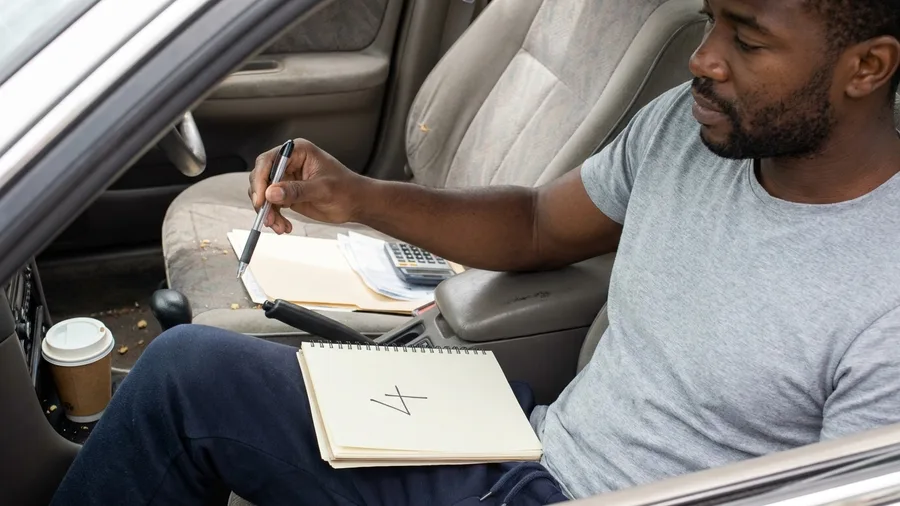
A set dollar figure wins for anyone on steady pay, and it wins because it gets decided once instead of every month. You choose $400, you set it to repeat, and it keeps going out whether you were paying attention that week or not.
"Whatever I can spare" has no number to repeat. There is no trigger, no automatic pull, and no figure for the bank to act on, so every month the amount gets renegotiated against whatever that month's spending has already asked for. In the example, that negotiation produced $60 once and nothing three other times, not because the person was careless but because the question arrived at the wrong end of the month, when the answer was always already spent.
Fix the number and the rest of the budget writes itself by subtraction. Take the $4,800, take $400 off the top, and $4,400 is what remains to cover rent, the car, utilities, groceries, the phone, the separate transfers for irregular bills, and anything you actually want. That subtraction is the spending plan, and it forces every larger grocery week or delivery order to fit inside a stated number instead of quietly shrinking an unnamed remainder.
Steady work makes this easy. A salary or twice-monthly wages hits the same figure often enough that $400 behaves predictably.
Commission, shift work and irregular pay are the real exception. On a lean month a hard $400 can bounce, and a returned transfer is a worse outcome than a smaller one. If your pay moves, use a percentage of each deposit or a per-deposit floor instead, so the transfer scales down when the check does and still fires every time.
Leftover saving gives spending first claim on payday

It comes to nothing because everything else gets paid first, and the order is the whole story. On the 1st and 15th, the working version has the $400 out the door before rent, groceries or the phone bill get a look at it. Savings holds first place in the queue, which means it never has to compete.
The failing version hands in the same $4,800 and puts savings at the back. Rent takes $1,450. The car payment takes $310. Utilities take $180, groceries take $520, the phone takes $65, and daily spending takes whatever a week of ordinary life takes. Every one of those is a legitimate bill, which is exactly why savings loses: nobody is going to stiff the landlord to keep a savings transfer, so the transfer is what gives way.
By the time the month is done assigning the money, there is nothing unassigned left to sweep.
This matters because it moves the blame off you. If you have tried saving what was left and watched it land at $0 three months running, you did not fail a willpower test. A disciplined person who pays bills in order still arrives at savings last, because the bills run in a fixed sequence and savings sits at the end of it.
The fix is not to try harder at the bottom of the queue. It is to automate every financial decision so savings moves to the top of it.
Think about where the 28th lands in that sequence: after rent has cleared, after the card taps, after the groceries. The sweep is asking what survived, and on a real month very little does. Move the $400 to the 1st and 15th and it stops asking.
The claim order that decides whether savings survives
Same $4,800. Only the position of the savings transfer changes.
Figures are the article's $4,800 monthly take-home example.
The failing version lets spending set the number
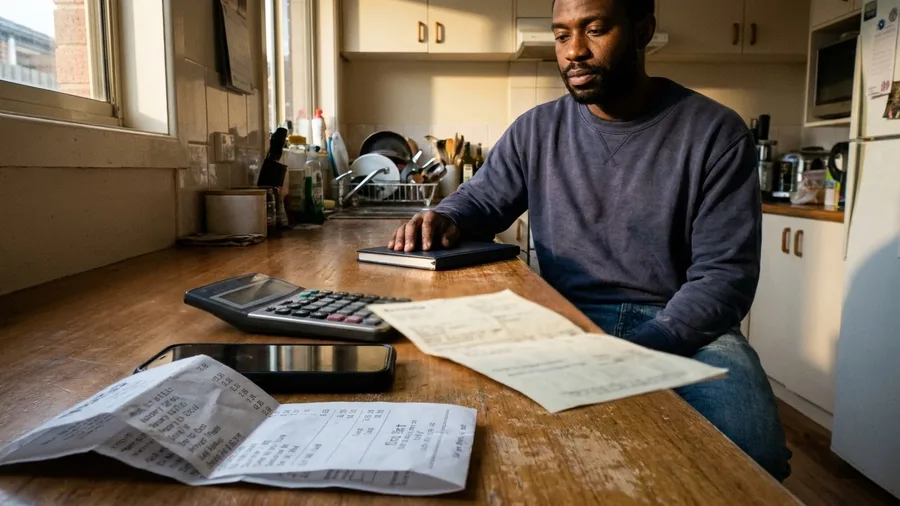
Whoever goes first sets the number. When the $400 leaves on the 1st and 15th, everything else in the month is spent out of the $4,400 that remains, so a heavier grocery week or a second takeout order has to fit inside that $4,400 or get declined at the card reader.
When saving is whatever is left, the month runs open-ended and savings take the residue, which in this example was $0 in three months out of four and $60 once. Nothing had to be refused to make that happen. A bigger cart at the store or a delivery order on a Wednesday does not break a savings rule under the leftover version, because there is no rule to break; it just shrinks an unnamed remainder nobody wrote down.
That is the part worth sitting with: leftover saving quietly licenses the bigger week. The spending feels normal in the moment, and only the balance at the end of the month records what it cost.
For a reader already spending well under their income, this was never really about total spending. Leftover saving can still produce a balance, and a decent one. The difference is control: in the leftover version the amount is decided after the fact, by whatever survived, and in the fixed version the $400 is decided before the month starts and holds that shape whether the month was calm or expensive.
Two versions of the same paycheck
Payday transfer
- $400 leaves on the 1st and 15th, automatically
- Savings account sits at a second bank
- The flat amount is set once, not renegotiated
- A $1,000 buffer absorbs the first repair
- Spending has to fit the remaining $4,400
Leftover sweep
- Manual sweep on the 28th, if you remember
- The balance stares back from the main app
- No number, so each month gets re-decided
- One car repair resets progress to zero
- Spending runs first and savings absorbs the residue
The buffer decides which version you can run

You can need the money back, and a $1,000 buffer sitting in that same savings account is what makes the difference between borrowing from the plan and wrecking it. Without one, a car repair pulls the $400 straight back out, and by month two the whole thing gets quietly abandoned. Automation did not fail. It had no shock absorber.
So the order is buffer first, transfer second. Get $1,000 into the account before you raise the transfer above $400, and before you treat that $400 as something the month depends on. Until it is there, the transfer is real but fragile, and one bad Tuesday can end it.
If you carry debt, do not flip the whole thing around to chase a leftover sweep. Minimum payments belong in fixed costs, the $1,000 stays where it protects the transfer, and if the debt makes $1,000 impossible, make the transfer smaller or start it later. Which debt to attack first depends on rates and terms you can read on your own statements; a nonprofit credit counsellor can walk the order through with you if it is not obvious.
🗓️ The order to set this up in
Confirm the payday dates
Write down the exact dates your 1st and 15th deposits land, including weekends.
Open the second account
Free, no minimum, at a different bank from your checking account.
Build the $1,000 buffer
Park $1,000 there first, by any transfer method that works for your pay rhythm.
Schedule the $400
Set the automatic transfer for each payday morning, not the day after.
Split the irregular bills
Add $150 a month to repairs and insurance and $80 to a holiday fund.
Leave it alone for a quarter
No pausing, no peeking. Three months is the first honest read on whether it holds.
Too large a transfer breaks the version that works

The right number is the biggest transfer that still clears rent, the car payment and the phone on your worst month – not the biggest transfer you can imagine making. That ceiling is lower than most people guess.
On a $4,800 month split into two $2,400 checks, the example plan moves $400. Double it to $800 and the arithmetic stops working: rent alone is $1,450, and after the car payment of $310, utilities of $180, groceries of $520 and that $65 phone, an $800 transfer leaves nothing but air where the rest of the month should be. The $800 version bounces long before the $400 version ever does, and it is not because the reader was careless. It is because the number was sized against hope instead of against the lowest-pay month.
The bounce is what turns a planning error into a money error. The example bank charges $35 per overdraft item, and a returned automatic transfer can trigger one – so the failure costs the fee, costs the missed transfer, and thins the cushion for the retry two weeks out. Now the second attempt is smaller, later, and made by someone who no longer trusts the setup.
Which is why $150 that keeps landing beats $600 cancelled in month two. The question was never how much can I save this year – it was what clears fixed costs every single month, including the lean ones. Size for that, and the transfer keeps showing up.
Irregular bills need their own transfer, not the pot

Predictable bills that arrive a few times a year get their own small transfer – they do not get paid out of the long-term savings the $400 is building.
Car repairs, insurance and December are not emergencies, they are dates. Treating them like emergencies is what empties the pot: one $700 repair pulled from savings wipes out nearly two months of transfers and makes the whole plan look like it never worked, when what actually happened is that a known bill landed in the wrong account. The working version funds them in advance – a separate $150 a month sinking fund for the car repair and insurance, and $80 a month for December – both kept apart from the $400. By the time the bill arrives, the money already has a name on it.
If there is only $100 a month to move, resist building three pots. One labeled irregular-bills pot with a written split inside it – so much for the car, so much for December – carries the same rule without the admin. The $400-scale example earns its separate $150 and $80 claims because those bills land at different times of the year, and keeping them apart tells the reader at a glance which one is short.
Separate or combined, the point holds: a bill that has its own funding line never reaches into the long-term pot.
Where the $4,800 monthly take-home is assigned
The article's worked example, allocated not measured
Allocations from a $4,800 example budget, rounded.
Change the amount when pay changes, not in January

The transfer stays fresh if it moves up when pay moves up, or after three straight months where the savings balance never dipped back into it – not on a January resolution.
The trigger is what separates the two versions. The working setup names its events in advance: a raise, or three clean months where the $400 was never pulled back. At that point the adjustment is $50 more per paycheck, which on two checks a month is $100 more a month – roughly $1,200 more banked in a year if it holds. The failing version waits for a good month, and a good month has no definition, because leftover saving has no threshold to cross. Every month gets judged after the money is gone, so nothing ever fires and the fresh start slides to January and keeps sliding.
There is one check that tells the reader the number has gone stale, and it costs nothing to run. Look at the savings balance. If it has not moved in a quarter – not up, not touched – the transfer is too small, the account is not separate, or the amount is being quietly pulled back each month. All three show up as the same flat line.
The review itself takes ten minutes, twice a year, on the two events above. Nothing else needs watching.
The $400 transfer at a glance
💵 Amount
$400 per paycheck
📅 Trigger
1st and 15th, automated
🏦 Destination
No-minimum savings at a second bank
🛡️ Buffer first
$1,000 before any increase
⚠️ Ceiling
Must clear $1,450 rent on a low month
📈 Next raise
$50 more per paycheck
The number that matters
$1,000 in the account matters more than $800 a month in ambition.
Frequently Asked Questions
Does the day I move the money really matter?
Yes, if your income lands on a schedule. Payday is the only moment the balance is still uncommitted. By the 28th, rent, groceries and every small tap have already claimed the money, which is why a dated sweep in the example moved $0 in three months out of four.
Why can't I keep it in my regular savings account?
You can, but you will probably spend it. The balance on your banking app's home screen is spendable in seconds. A second bank adds a one-business-day delay, which is enough of a pause to stop a takeout impulse and short enough to still handle a real emergency.
How much should I actually move on payday?
Start at $400 on a $4,800 take-home, or roughly the largest transfer that still clears fixed costs on your lowest-pay month. An $800 attempt bounces long before $400 does, and a $35 overdraft fee plus a missed transfer sets you back further than a small number ever would.
Should I build the buffer or start saving first?
Buffer first, automation second. The $1,000 keeps the $400 transfer from turning into an overdraft the first time the car needs work. Without it, one repair pulls the transfer back out and the plan gets abandoned by month two.
What if I need the money back before I have built anything up?
That is what the buffer is for. With $1,000 sitting in the account, a repair comes out of savings rather than off the transfer. If you would need far more than $1,000 back, the transfer is too large for your current fixed costs.
I have debt. Does that change any of this?
Minimum debt payments belong in fixed costs, not in the savings transfer. If debt makes a $1,000 buffer impossible, shrink the transfer rather than swapping the whole plan for a leftover sweep. Which debt to attack first depends on your rates and terms, so run the order past a nonprofit credit counsellor or a fee-only fiduciary.
Run the payday transfer if your income arrives on a schedule
The verdict is simple. If your income arrives on a schedule, you run the payday transfer. The leftover sweep is for people whose pay genuinely has no date attached, and even then it is a fallback, not a plan.
So take the first step, and it takes about fifteen minutes: open the free, no-minimum savings account at the second bank, set the $400 to go out on your next payday morning, and leave the $1,000 starter buffer alone until it is sitting there untouched.
Look back at the 28th sweep on that same $4,800: $0 in three months out of four, $60 once. Nothing was wrong with the advice. Saving was simply standing behind spending in the queue, and spending chose the number.
What changes it is a set of settings: a second bank, a flat $400 on the 1st and 15th, separate $150 and $80 claims for the car and the holiday, a $35 overdraft risk you now know about, and a $50-per-paycheck bump after a raise or three clean months. Put those in place and the claim lands before the spending does.
Do the fifteen minutes before the next payday
Open the second account, schedule the $400, and let the 1st land with the transfer already moving.
